


Spain's ruling Socialists won a second term in elections on Sunday as voters brushed aside concerns over the slowing economy and soaring immigration and backed the party's liberal social reforms.
But the party of Spanish Prime Minister Jose Luis Rodriguez Zapatero failed to gain an absolute majority and may have to forge alliances with smaller regional parties to govern.
"The Spanish people have spoken clearly and have decided to open a new period without tension, without confrontation," Zapatero told hundreds of exuberant supporters at Socialist Party headquarters in Madrid. "I will govern by improving the things we did well and correcting our mistakes."
Outside, hundreds of people celebrated the victory amid a sea of red and white Socialist Party flags.
With 99.95 percent of votes counted, his Socialist Party was predicted to secure 169 seats, short of the 176 need for an overall majority in the 350-member assembly, against 153 for the conservative opposition Popular Party (PP) of Mariano Rajoy, official figures showed.
In the last legislature, the Socialists had 164 seats and the PP 148.
Turnout was estimated to be 75.3 percent, close to the high of 75.66 percent in general elections four years ago.
In Senate elections, also held on Sunday, the Popular Party lost one seat to 101 of the 208 seats at stake in the 264-seat upper house, with 99.42 percent of the votes counted. Zapatero's Socialists won eight more seats and now have 89 senators.
Analysts had predicted that a high turnout would be crucial for Zapatero's re-election chances.
The record participation in March 2004 had also helped Zapatero, now 47, to score a surprise win over Rajoy, 52, three days after train bombings in Madrid that killed 191 people.
Voters then were infuriated at the conservative government's insistence that ETA was to blame, even though evidence pointed to Islamic extremists angered by Madrid's role in the Iraq war.
Election campaigning was again suspended this time around, after a former municipal legislator, Isaias Carrasco, a Socialist, was shot dead on Friday in the northern Basque region.
There have been no claims of responsibility, but police said the attack bore the hallmark of the Basque separatist group ETA, which has killed over 800 people in its nearly 40-year campaign for an independent homeland.
Spaniards on Saturday received an emotional plea to turn out and vote from Carrasco's daughter, as hundreds attended his funeral.
Pictures of a grief-stricken Sandra Carrasco made the front pages of almost all Spanish newspapers on Sunday, and the conservative press had warned that it could help the Socialists.
"The images ... have provoked a natural feeling of sympathy for the Socialists and Zapatero," the center-right El Mundo said in an editorial.
Meanwhile, the center-left El Pais commented: "Some are already beginning to put out the idea that a bigger Socialist win than predicted by the opinion polls will be due to the killing of Isaias Carrasco."
Rajoy sought to put the best face on the defeat.
The PP "is the party that most progressed in Spain, in terms of votes and seats," he told cheering supporters at the party's headquarters in Madrid.
In regional elections in southern Andalusia, also held on Sunday, the Socialists lost five seats to 56 compared with the 2004 elections but maintained their overall majority in the 109-seat chamber.
The Popular Party won 10 more seats and will now have 47 in the regional assembly.


Kehinde Sanni spends his days smoothing out dents and repainting scratched bumpers in a modest autobody shop in Lagos. He has never left Nigeria, yet he speaks glowingly of Burkina Faso military leader Ibrahim Traore. “Nigeria needs someone like Ibrahim Traore of Burkina Faso. He is doing well for his country,” Sanni said. His admiration is shaped by a steady stream of viral videos, memes and social media posts — many misleading or outright false — portraying Traore as a fearless reformer who defied Western powers and reclaimed his country’s dignity. The Burkinabe strongman swept into power following a coup in September 2022
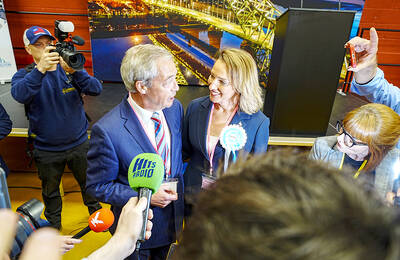
‘FRAGMENTING’: British politics have for a long time been dominated by the Labor Party and the Tories, but polls suggest that Reform now poses a significant challenge Hard-right upstarts Reform UK snatched a parliamentary seat from British Prime Minister Keir Starmer’s Labor Party yesterday in local elections that dealt a blow to the UK’s two establishment parties. Reform, led by anti-immigrant firebrand Nigel Farage, won the by-election in Runcorn and Helsby in northwest England by just six votes, as it picked up gains in other localities, including one mayoralty. The group’s strong showing continues momentum it built up at last year’s general election and appears to confirm a trend that the UK is entering an era of multi-party politics. “For the movement, for the party it’s a very, very big
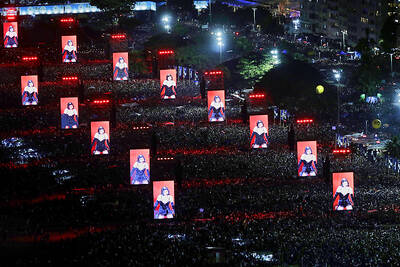
ENTERTAINMENT: Rio officials have a history of organizing massive concerts on Copacabana Beach, with Madonna’s show drawing about 1.6 million fans last year Lady Gaga on Saturday night gave a free concert in front of 2 million fans who poured onto Copacabana Beach in Rio de Janeiro for the biggest show of her career. “Tonight, we’re making history... Thank you for making history with me,” Lady Gaga told a screaming crowd. The Mother Monster, as she is known, started the show at about 10:10pm local time with her 2011 song Bloody Mary. Cries of joy rose from the tightly packed fans who sang and danced shoulder-to-shoulder on the vast stretch of sand. Concert organizers said 2.1 million people attended the show. Lady Gaga
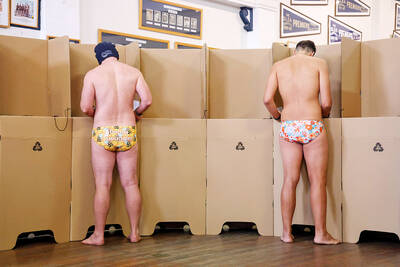
SUPPORT: The Australian prime minister promised to back Kyiv against Russia’s invasion, saying: ‘That’s my government’s position. It was yesterday. It still is’ Left-leaning Australian Prime Minister Anthony Albanese yesterday basked in his landslide election win, promising a “disciplined, orderly” government to confront cost-of-living pain and tariff turmoil. People clapped as the 62-year-old and his fiancee, Jodie Haydon, who visited his old inner Sydney haunt, Cafe Italia, surrounded by a crowd of jostling photographers and journalists. Albanese’s Labor Party is on course to win at least 83 seats in the 150-member parliament, partial results showed. Opposition leader Peter Dutton’s conservative Liberal-National coalition had just 38 seats, and other parties 12. Another 17 seats were still in doubt. “We will be a disciplined, orderly


 RSS
RSS