


Tens of thousands of people protesting a referendum they said would turn Venezuela into a version of communist Cuba marched through central Caracas on Thursday, yelling slogans against President Hugo Chavez.
The mass demonstration -- the last before the referendum on Sunday -- denounced reforms that would allow Chavez to run for reelection indefinitely, gag the press in emergencies and impose what he calls "economic socialism" on the country.
"It's not socialism -- it's communism, like the one they have in Cuba," said one protester, Virginia Zapata, a 29-year-old dentist.
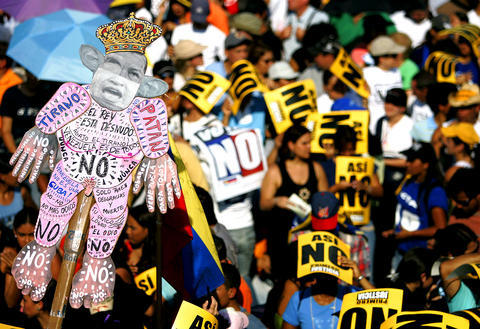
PHOTO: AP
Another protester, 71-year-old retiree Maruja Zamora de Grossman, said: "I'm marching against Chavez to leave a better country for my eight children, 23 grandchildren and my great-grandchild."
Around them, the crowd waved anti-Chavez banners and wore T-shirts with the words "Why don't you just shut up?" That was a reference to a slapdown King Juan Carlos of Spain gave Chavez at a summit earlier this month.
Venezuelan television showed a camera crew from a state channel jostled by protesters, and a gang of pro-Chavez militants assaulting demonstrators at a metro station entrance.
But the rally passed off without major incident, in contrast to protests earlier this month by university students that were broken up by teargas-firing police.
Tensions are flowing strongly as recent polls suggest a dead heat, or even that the "no" vote could triumph.
The result could be so close that many fear it will trigger street violence.
Unlike in past Venezuelan elections, international observers have not been invited to monitor balloting, opening the way for allegations of fraud.
Leopoldo Lopez, the opposition mayor of the upmarket Chacao District in Caracas, told reporters that "violence would only benefit the government."
Chavez, who has raised the pitch of his populist rhetoric as the referendum date nears, has vowed to "neutralize" any unrest. He has also called any who oppose his reforms "traitors."
Chavez claims the US government is fomenting unrest to challenge the referendum, and possibly even have him assassinated.
His foreign minister went on television late on Wednesday waving what he said was a Central Intelligence Agency plan to secure a "no" victory.
A spokesperson for the US State Department on Thursday urged all Venezuelans to exercise their "inalienable right" to vote in Sunday's referendum, but stopped short of suggesting how they should cast their ballots.
US-based Human Rights Watch warned on Thursday in a statement that Chavez's constitutional amendments would enable him to "suspend basic rights indefinitely by maintaining a perpetual state of emergency ... in violation of international law."
Private polling institute Datanalisis said that 44.6 percent of voters reject the constitutional reforms, while 30.8 percent are in favor.
Another survey firm, Hinterlaces, put the split as 46 percent against and 45 percent for.
"There is a sector of Chavez supporters who don't seem very enthused by the reforms. This doesn't mean that Chavez will lose the referendum, but the results will be much more ambivalent than in previous elections," analyst German Campos of the firm Consultores 30.11 told reporters.

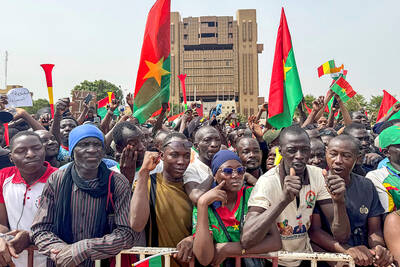
Kehinde Sanni spends his days smoothing out dents and repainting scratched bumpers in a modest autobody shop in Lagos. He has never left Nigeria, yet he speaks glowingly of Burkina Faso military leader Ibrahim Traore. “Nigeria needs someone like Ibrahim Traore of Burkina Faso. He is doing well for his country,” Sanni said. His admiration is shaped by a steady stream of viral videos, memes and social media posts — many misleading or outright false — portraying Traore as a fearless reformer who defied Western powers and reclaimed his country’s dignity. The Burkinabe strongman swept into power following a coup in September 2022
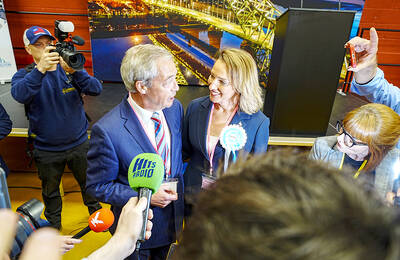
‘FRAGMENTING’: British politics have for a long time been dominated by the Labor Party and the Tories, but polls suggest that Reform now poses a significant challenge Hard-right upstarts Reform UK snatched a parliamentary seat from British Prime Minister Keir Starmer’s Labor Party yesterday in local elections that dealt a blow to the UK’s two establishment parties. Reform, led by anti-immigrant firebrand Nigel Farage, won the by-election in Runcorn and Helsby in northwest England by just six votes, as it picked up gains in other localities, including one mayoralty. The group’s strong showing continues momentum it built up at last year’s general election and appears to confirm a trend that the UK is entering an era of multi-party politics. “For the movement, for the party it’s a very, very big
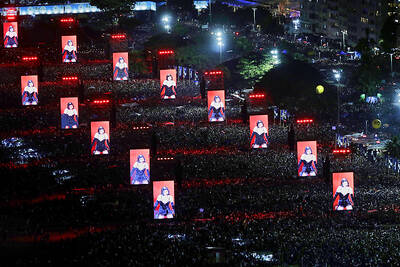
ENTERTAINMENT: Rio officials have a history of organizing massive concerts on Copacabana Beach, with Madonna’s show drawing about 1.6 million fans last year Lady Gaga on Saturday night gave a free concert in front of 2 million fans who poured onto Copacabana Beach in Rio de Janeiro for the biggest show of her career. “Tonight, we’re making history... Thank you for making history with me,” Lady Gaga told a screaming crowd. The Mother Monster, as she is known, started the show at about 10:10pm local time with her 2011 song Bloody Mary. Cries of joy rose from the tightly packed fans who sang and danced shoulder-to-shoulder on the vast stretch of sand. Concert organizers said 2.1 million people attended the show. Lady Gaga
SUPPORT: The Australian prime minister promised to back Kyiv against Russia’s invasion, saying: ‘That’s my government’s position. It was yesterday. It still is’ Left-leaning Australian Prime Minister Anthony Albanese yesterday basked in his landslide election win, promising a “disciplined, orderly” government to confront cost-of-living pain and tariff turmoil. People clapped as the 62-year-old and his fiancee, Jodie Haydon, who visited his old inner Sydney haunt, Cafe Italia, surrounded by a crowd of jostling photographers and journalists. Albanese’s Labor Party is on course to win at least 83 seats in the 150-member parliament, partial results showed. Opposition leader Peter Dutton’s conservative Liberal-National coalition had just 38 seats, and other parties 12. Another 17 seats were still in doubt. “We will be a disciplined, orderly


 RSS
RSS