


Nearly 6,000 Sunni Arab residents joined a security pact with US forces in what US officers described as a critical step in plugging the remaining escape routes for extremists flushed from former strongholds.
The new alliance -- called the largest single volunteer mobilization since the war began -- covers the "last gateway" for groups such as al-Qaeda in Iraq seeking new havens in northern Iraq, US military officials said on Wednesday.
US commanders have tried to build a ring around insurgents who fled military offensives launched earlier this year in the western Anbar Province and later into Baghdad and surrounding areas. In many places, the US-led battles were given key help from tribal militias -- mainly Sunnis -- that had turned against al-Qaeda and other groups.
Extremists have sought new footholds in northern areas once loyal to Saddam Hussein's Baath party as the US-led gains have mounted across central regions. But their ability to strike near the capital remains.
A woman wearing an explosive-rigged belt blew herself up near a US patrol near Baqubah, about 56km northeast of Baghdad, the military announced on Wednesday. The blast on Tuesday -- a rare attack by a female suicide bomber -- wounded seven US troops and five Iraqis, the statement said.
The ceremony to pledge the 6,000 new fighters was presided over by a dozen sheiks -- each draped in black robes trimmed with gold braiding -- who signed the contract on behalf of tribesmen at a small US outpost in north-central Iraq.
For about US$275 a month -- nearly the salary for the typical Iraqi policeman -- the tribesmen will man about 200 security checkpoints beginning Dec. 7, supplementing hundreds of Iraqi forces already in the area.
About 77,000 Iraqis nationwide, mostly Sunnis, have broken with the insurgents and joined US-backed self-defense groups.
Those groups have played a major role in the lull in violence: 648 Iraqi civilians have been killed or found dead in November to date, according to figures compiled by the Associated Press. This compares with 2,155 in May as the so-called "surge" of nearly 30,000 additional troops gained momentum.
US troop deaths in Iraq have also dropped sharply. So far this month, the military has reported 35 deaths -- including a US soldier killed on Wednesday in western Baghdad -- compared with 38 last month. In June, 101 US soldiers died in Iraq.
Village mayors and others who signed Wednesday's agreement say about 200 militants have sought refuge in the area, about 50km southwest of Kirkuk on the edge of the semi-autonomous Kurdish region. Hawija is a predominantly Sunni Arab cluster of villages that has long been a flashpoint.
The recently arrived militants have waged a campaign of killing and intimidation to try to establish a new base, said Sheikh Khalaf Ali Issa, mayor of Zaab village.
"They killed 476 of my citizens and I will not let them continue their killing," Issa said.
With the help of the new Sunni allies, "the Hawija area will be an obstacle to militants, rather than a pathway for them," said Major Sean Wilson, with the Army's 1st Brigade, 10th Mountain Division. "They're another set of eyes that we needed in this critical area."
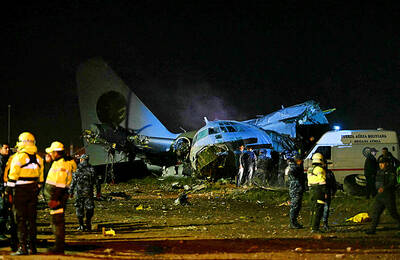
MONEY GRAB: People were rushing to collect bills scattered on the ground after the plane transporting money crashed, which an official said hindered rescue efforts A cargo plane carrying money on Friday crashed near Bolivia’s capital, damaging about a dozen vehicles on highway, scattering bills on the ground and leaving at least 15 people dead and others injured, an official said. Bolivian Minister of Defense Marcelo Salinas said the Hercules C-130 plane was transporting newly printed Bolivian currency when it “landed and veered off the runway” at an airport in El Alto, a city adjacent to La Paz, before ending up in a nearby field. Firefighters managed to put out the flames that engulfed the aircraft. Fire chief Pavel Tovar said at least 15 people died, but
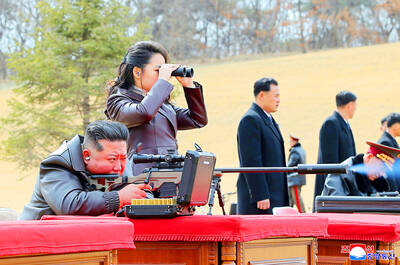
LIKE FATHER, LIKE DAUGHTER: By showing Ju-ae’s ability to handle a weapon, the photos ‘suggest she is indeed receiving training as a successor,’ an academic said North Korea on Saturday released a rare image of leader Kim Jong-un’s teenage daughter firing a rifle at a shooting range, adding to speculation that she is being groomed as his successor. Kim’s daughter, Ju-ae, has long been seen as the next in line to rule the secretive, nuclear-armed state, and took part in a string of recent high-profile outings, including last week’s military parade marking the closing stages of North Korea’s key party congress. Pyongyang’s official Korean Central News Agency (KCNA) released a photo of Ju-ae shooting a rifle at an outdoor shooting range, peering through a rifle scope
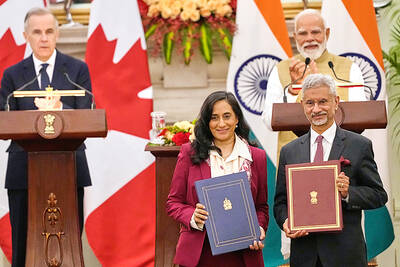
India and Canada yesterday reached a string of agreements, including on critical mineral cooperation and a “landmark” uranium supply deal for nuclear power, the countries’ leaders said in New Delhi. The pacts, which also covered technology and promoting the use of renewable energy, were announced after Indian Prime Minister Narendra Modi and Canadian Prime Minister Mark Carney hailed a fresh start in the relationship between their nations. “Our ties have seen a new energy, mutual trust and positivity,” Modi said. Carney’s visit is a key step forward in ties that effectively collapsed in 2023 after Ottawa accused New Delhi
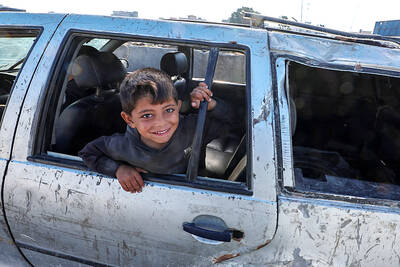
Gaza is rapidly running out of its limited fuel supply and stocks of food staples might become tight, officials said, after Israel blocked the entry of fuel and goods into the war-shattered territory, citing fighting with Iran. The Israeli military closed all Gaza border crossings on Saturday after announcing airstrikes on Iran carried out jointly with the US. Israeli authorities late on Monday night said that they would reopen the Kerem Shalom crossing from Israel to Gaza yesterday, for “gradual entry of humanitarian aid” into the strip, without saying how much. Israeli authorities previously said the crossings could not be operated safely during


 RSS
RSS