


A prominent Indonesian politician said Australia's ambassador apologized yesterday over his alleged ill treatment during a trip to Sydney, defusing a diplomatic row between the two nations.
Jakarta Governor Sutiyoso, a retired general, said he received the apology from Australian Ambassador Bill Farmer during a meeting between the pair over this week's incident.
Sutiyoso has complained that police entered his hotel room using a master key and urged him to give evidence at an inquest into the death of five Australia-based journalists in East Timor in 1975.
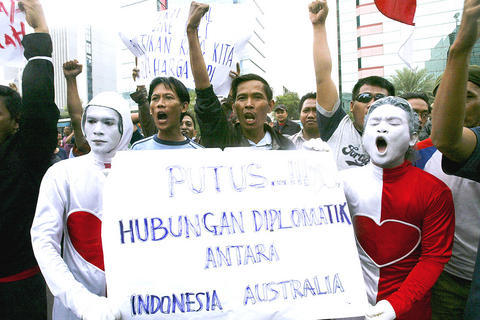
PHOTO: AP
A furious and offended Sutiyoso demanded an apology from Australia while the Indonesian government said his treatment in Sydney on Tuesday was unacceptable.
"We are a nation with a big heart. We have to forgive, even more so because the problem was only a technical problem," Sutiyoso said after the meeting.
"It should not be that because of a technical problem, we continue to demand things that are illogical. The Australian side has apologized and we will get an official apology letter," he told reporters.
An Australian embassy spokesman declined comment over the apology.
Prime Minister John Howard earlier sought to calm the row saying that while coroners conducting inquests acted independently of the government, "proper courtesy should be extended" when they carried out their work.
The incident sparked a flurry of diplomatic activity and the row has received extensive media coverage in Indonesia.
Indonesian Foreign Minister Hassan Wirajuda summoned Farmer late on Wednesday to lodge a formal protest over the incident.
"We have demanded a clarification and accountability from the parties concerned in Australia," a foreign ministry spokesman said yesterday.
"We deem that the actions of the local police personnel are unacceptable and inappropriate, even more so because Sutiyoso was there as a government official at the invitation of the local government," spokesman Kristiarto Legowo said.
Australian Foreign Minister Alexander Downer also spoke on Wednesday night with his Indonesian counterpart, the embassy in Jakarta said.
Security was stepped up outside the Australian embassy as youths gathered for a second day to protest Sutiyoso's treatment, ElShinta radio said.
Sutiyoso has said police entered his room in Sydney while he was taking a nap with a subpoena requesting that he give evidence at the inquest.
Sutiyoso, who had been the guest of the New South Wales Government and the state premier, cut short his visit and flew back to Jakarta.
The inquest in Sydney is probing the death of a cameraman who was among five British, Australian and New Zealand newsmen killed in the border town of Balibo ahead of the Indonesian military's invasion of East Timor in 1975.
The journalists were officially reported to have been killed in crossfire, but their families insist they were murdered and there was a cover-up by Canberra and Jakarta.
Sutiyoso, a retired lieutenant general, served in the military for three decades and was part of Indonesia's occupation of East Timor. He has denied any role in the killings.
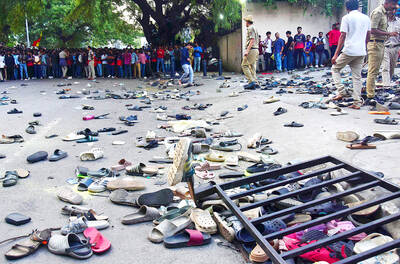
Packed crowds in India celebrating their cricket team’s victory ended in a deadly stampede on Wednesday, with 11 mainly young fans crushed to death, the local state’s chief minister said. Joyous cricket fans had come out to celebrate and welcome home their heroes, Royal Challengers Bengaluru, after they beat Punjab Kings in a roller-coaster Indian Premier League (IPL) cricket final on Tuesday night. However, the euphoria of the vast crowds in the southern tech city of Bengaluru ended in disaster, with Indian Prime Minister Narendra calling it “absolutely heartrending.” Karnataka Chief Minister Siddaramaiah said most of the deceased are young, with 11 dead
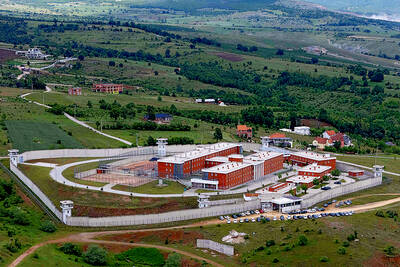
By 2027, Denmark would relocate its foreign convicts to a prison in Kosovo under a 200-million-euro (US$228.6 million) agreement that has raised concerns among non-governmental organizations (NGOs) and residents, but which could serve as a model for the rest of the EU. The agreement, reached in 2022 and ratified by Kosovar lawmakers last year, provides for the reception of up to 300 foreign prisoners sentenced in Denmark. They must not have been convicted of terrorism or war crimes, or have a mental condition or terminal disease. Once their sentence is completed in Kosovan, they would be deported to their home country. In

Brazil, the world’s largest Roman Catholic country, saw its Catholic population decline further in 2022, while evangelical Christians and those with no religion continued to rise, census data released on Friday by the Brazilian Institute of Geography and Statistics (IBGE) showed. The census indicated that Brazil had 100.2 million Roman Catholics in 2022, accounting for 56.7 percent of the population, down from 65.1 percent or 105.4 million recorded in the 2010 census. Meanwhile, the share of evangelical Christians rose to 26.9 percent last year, up from 21.6 percent in 2010, adding 12 million followers to reach 47.4 million — the highest figure

LOST CONTACT: The mission carried payloads from Japan, the US and Taiwan’s National Central University, including a deep space radiation probe, ispace said Japanese company ispace said its uncrewed moon lander likely crashed onto the moon’s surface during its lunar touchdown attempt yesterday, marking another failure two years after its unsuccessful inaugural mission. Tokyo-based ispace had hoped to join US firms Intuitive Machines and Firefly Aerospace as companies that have accomplished commercial landings amid a global race for the moon, which includes state-run missions from China and India. A successful mission would have made ispace the first company outside the US to achieve a moon landing. Resilience, ispace’s second lunar lander, could not decelerate fast enough as it approached the moon, and the company has


 RSS
RSS