


Tamil Tiger rebels ambushed an eastern Sri Lankan military post and killed at least two soldiers, officials said yesterday, days after the military captured several main rebel bases, leaving dozens of guerrillas dead.
Military spokesman Brigadier Prasad Samarasinghe said the rebel attack took place in Batticaloa district's Vavunativu village late on Sunday.
The areas is about 50km south of Vaharai village, the scene of fierce weekend fighting.
Tamil Tiger spokesman Rasiah Ilanthirayan confirmed the incident, indicating that the rebels are still active in eastern Sri Lanka despite the military operation.
"Acquiring some real estate does not mean much," Ilanthirayan said, referring to the military's advance into eastern rebel territories.
Fighting between the Tigers and security forces has escalated in the past few months as the government has stepped up attempts to rout insurgents from parts of the north and east.
The rebels have been fighting since 1983 to establish an independent homeland for Sri Lanka's minority ethnic Tamils following decades of discrimination under the majority Sinhalese-dominated government.
A 2002 truce still exists on paper, but has largely collapsed since the resurgence of large-scale fighting last year.
On Sunday morning, Sri Lankan troops killed at least 18 Tigers as they tried to flee into rebel-held jungle in Batticaloa district, Samara-singhe said.
Troops also found the bodies of 22 rebels who were killed in an army assault on Saturday on several rebel bases in Batticaloa district's Kathiraveli and Vaharai villages, he said.
On Saturday, the army took control for the first time in 11 years of a main road connecting the island nation's two main towns, Batticaloa and Trincomalee.
The village of Vaharai, located on an impoverished rebel-held strip of coastline in Batticaloa district, has been the scene of heavy fighting for months.
More than 500 combatants have been killed in Vaharai since October, according to the military.
The government says the Tigers used Vaharai as a transit point to smuggle drugs and arms into the country and as a base for naval attacks.
The army's capture of Vaharai sent thousands of terrified villagers fleeing toward the neighboring government-held village of Mankerni, from where they were transported to several refugee camps far from the battle zone.
They are staying in flimsy tents and crowded school facilities.
Worried Tamil parents said their children were being detained as security forces screened refugees for suspected rebels.


Kehinde Sanni spends his days smoothing out dents and repainting scratched bumpers in a modest autobody shop in Lagos. He has never left Nigeria, yet he speaks glowingly of Burkina Faso military leader Ibrahim Traore. “Nigeria needs someone like Ibrahim Traore of Burkina Faso. He is doing well for his country,” Sanni said. His admiration is shaped by a steady stream of viral videos, memes and social media posts — many misleading or outright false — portraying Traore as a fearless reformer who defied Western powers and reclaimed his country’s dignity. The Burkinabe strongman swept into power following a coup in September 2022
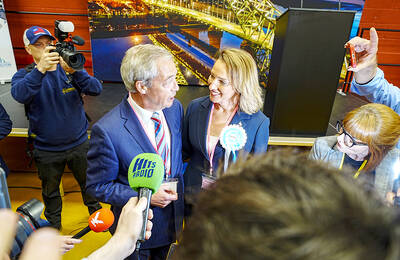
‘FRAGMENTING’: British politics have for a long time been dominated by the Labor Party and the Tories, but polls suggest that Reform now poses a significant challenge Hard-right upstarts Reform UK snatched a parliamentary seat from British Prime Minister Keir Starmer’s Labor Party yesterday in local elections that dealt a blow to the UK’s two establishment parties. Reform, led by anti-immigrant firebrand Nigel Farage, won the by-election in Runcorn and Helsby in northwest England by just six votes, as it picked up gains in other localities, including one mayoralty. The group’s strong showing continues momentum it built up at last year’s general election and appears to confirm a trend that the UK is entering an era of multi-party politics. “For the movement, for the party it’s a very, very big
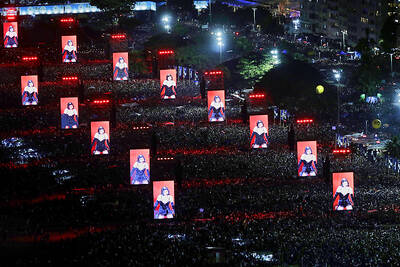
ENTERTAINMENT: Rio officials have a history of organizing massive concerts on Copacabana Beach, with Madonna’s show drawing about 1.6 million fans last year Lady Gaga on Saturday night gave a free concert in front of 2 million fans who poured onto Copacabana Beach in Rio de Janeiro for the biggest show of her career. “Tonight, we’re making history... Thank you for making history with me,” Lady Gaga told a screaming crowd. The Mother Monster, as she is known, started the show at about 10:10pm local time with her 2011 song Bloody Mary. Cries of joy rose from the tightly packed fans who sang and danced shoulder-to-shoulder on the vast stretch of sand. Concert organizers said 2.1 million people attended the show. Lady Gaga
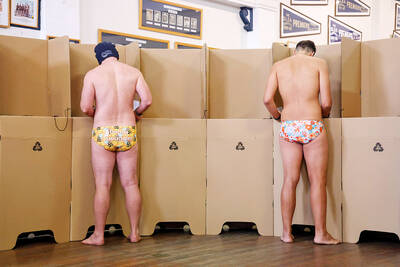
SUPPORT: The Australian prime minister promised to back Kyiv against Russia’s invasion, saying: ‘That’s my government’s position. It was yesterday. It still is’ Left-leaning Australian Prime Minister Anthony Albanese yesterday basked in his landslide election win, promising a “disciplined, orderly” government to confront cost-of-living pain and tariff turmoil. People clapped as the 62-year-old and his fiancee, Jodie Haydon, who visited his old inner Sydney haunt, Cafe Italia, surrounded by a crowd of jostling photographers and journalists. Albanese’s Labor Party is on course to win at least 83 seats in the 150-member parliament, partial results showed. Opposition leader Peter Dutton’s conservative Liberal-National coalition had just 38 seats, and other parties 12. Another 17 seats were still in doubt. “We will be a disciplined, orderly


 RSS
RSS