


US and Iraqi forces arrested a top aide to radical Shiite cleric Moqtada al-Sadr yesterday in Baghdad, his office said.
Sheik Abdul-Hadi al-Darraji, al-Sadr's media director in Baghdad, was captured during a 2am raid on a mosque in the eastern neighborhood of Baladiyat, an official in al-Sadr's office said, speaking on condition of anonymity.
The US military said special Iraqi army forces operating with coalition advisers captured a high-level, illegal armed group leader in Baladiyat, but it did not identify the detainee. It said two other suspects were detained by Iraqi forces for further questioning.
The raid near Baghdad's Sadr City district came as Defense Secretary Robert Gates flew in to the southern city of Basra to meet the US commander in Iraq, General George Casey.
Dealing with Sadr and his Mehdi Army militia is a burning issue for the US and Shiite Prime Minister Nuri al-Maliki as they prepare what many see as a last-ditch effort to rein in sectarian violence that is pushing Iraq into civil war.
Sadr, a young populist cleric with a mass following and some backing from Shiite Iran, is a key ally of Maliki, who has been criticized by Washington and leaders of the once-dominant Sunni Arab minority for failing to disarm the Mehdi Army.
Maliki, however, has said this month he will crack down on Shiite militias and said some 400 Mehdi Army members had been arrested in mainly Shiite southern Iraq over recent days.
The US military said in a statement that Iraqi special forces backed by US advisers seized an unnamed man they described as a death squad leader in Baladiyat wanted for kidnap, torture and murder and linked to fugitive Shiite warlord Abu Deraa.
Aides to Sadr said the man held was Abdul-Hadi al-Darraji, a prominent media spokesman for their movement. An official in Sadr's political office branded his detention a deliberate "provocation" but said they would not respond with violence.
"He was arrested at midnight with two cousins," Abdul-Mehdi al-Matiri said, adding that a guard was shot dead during the arrest and that he believed the two others detained had since been released.
The US statement made no mention of any violence and US officials had no immediate comment. Though the statement did not identify Darraji, details of the operation given by the US military coincided with those given by Sadr's office.
`ANGRY'
Matiri said: "We are angry. This is a kind of revenge. Sheikh Darraji deals with the media. He is not a military man."
The US military said: "In an Iraqi-led operation, special Iraqi army forces captured a high-level, illegal armed group leader during operations with Coalition advisers."
It said he was suspected of leading "punishment" activities -- an apparent reference to informal courts meting out rough justice according to strict interpretations of Islamic law. These included "kidnapping, torture and murder."
Maliki has in the past criticized raids on Shiite groups conducted by Iraqi army special forces under the direct command of US officers, saying he has not been adequately consulted.
However, he has announced that the coming crackdown in Baghdad, backed by most of the 21,500 US reinforcements being sent by President George W. Bush, will tackle Shiite militias as well as Sunni insurgents.
In other violence, after a bloody few days of bombings in Baghdad, an official in Sadr's movement said a Shiite mosque in the violent southern district of Dora was badly damaged in an explosion.
In the northern oil capital of Kirkuk, police said gunmen killed the preacher of a major Sunni mosque.
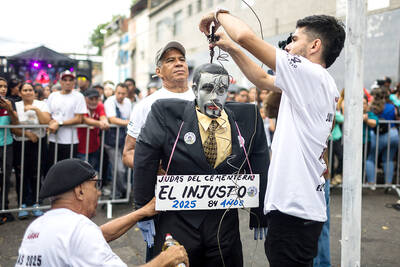
POLITICAL PRISONERS VS DEPORTEES: Venezuela’s prosecutor’s office slammed the call by El Salvador’s leader, accusing him of crimes against humanity Salvadoran President Nayib Bukele on Sunday proposed carrying out a prisoner swap with Venezuela, suggesting he would exchange Venezuelan deportees from the US his government has kept imprisoned for what he called “political prisoners” in Venezuela. In a post on X, directed at Venezuelan President Nicolas Maduro, Bukele listed off a number of family members of high-level opposition figures in Venezuela, journalists and activists detained during the South American government’s electoral crackdown last year. “The only reason they are imprisoned is for having opposed you and your electoral fraud,” he wrote to Maduro. “However, I want to propose a humanitarian agreement that

ECONOMIC WORRIES: The ruling PAP faces voters amid concerns that the city-state faces the possibility of a recession and job losses amid Washington’s tariffs Singapore yesterday finalized contestants for its general election on Saturday next week, with the ruling People’s Action Party (PAP) fielding 32 new candidates in the biggest refresh of the party that has ruled the city-state since independence in 1965. The move follows a pledge by Singaporean Prime Minister Lawrence Wong (黃循財), who took office last year and assumed the PAP leadership, to “bring in new blood, new ideas and new energy” to steer the country of 6 million people. His latest shake-up beats that of predecessors Lee Hsien Loong (李顯龍) and Goh Chok Tong (吳作棟), who replaced 24 and 11 politicians respectively

Young women standing idly around a park in Tokyo’s west suggest that a giant statue of Godzilla is not the only attraction for a record number of foreign tourists. Their faces lit by the cold glow of their phones, the women lining Okubo Park are evidence that sex tourism has developed as a dark flipside to the bustling Kabukicho nightlife district. Increasing numbers of foreign men are flocking to the area after seeing videos on social media. One of the women said that the area near Kabukicho, where Godzilla rumbles and belches smoke atop a cinema, has become a “real
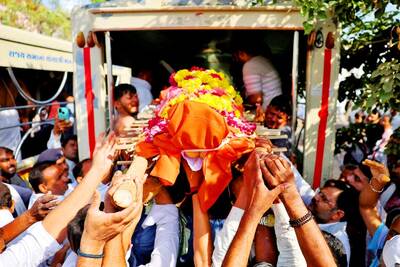
‘WATER WARFARE’: A Pakistani official called India’s suspension of a 65-year-old treaty on the sharing of waters from the Indus River ‘a cowardly, illegal move’ Pakistan yesterday canceled visas for Indian nationals, closed its airspace for all Indian-owned or operated airlines, and suspended all trade with India, including to and from any third country. The retaliatory measures follow India’s decision to suspend visas for Pakistani nationals in the aftermath of a deadly attack by shooters in Kashmir that killed 26 people, mostly tourists. The rare attack on civilians shocked and outraged India and prompted calls for action against their country’s archenemy, Pakistan. New Delhi did not publicly produce evidence connecting the attack to its neighbor, but said it had “cross-border” links to Pakistan. Pakistan denied any connection to


 RSS
RSS