


Outgoing Thai Prime Minister Thaksin Shinawatra said yesterday he was weighing whether to run for re-election but would wait to decide until after the confusion surrounding new court-ordered polls has cleared.
Two days after a high court ordered the nullification of April 2 polls, it remained unclear when the new elections would take place and if Thaksin, the target of a months-long anti-government campaign, would seek to return as prime minister.
"I'm still confused," he told reporters, when asked about his political plans. "I will have to wait until the political direction is clearer. We don't know when the election will be."
A day earlier, two of Thaksin's top aides said they expected him to run in coming parliamentary polls but it was unlikely he would return as prime minister.
Thaksin called the April 2 snap election three years ahead of schedule to defuse anti-government street protests and win a fresh mandate amid growing calls for his resignation.
The Constitutional Court ruled on Monday that the Election Commission had scheduled the polls too soon after Thaksin dissolved parliament, making it unfair for small parties. The court also ruled that ballot booths had been positioned in a way that compromised voters' right to privacy.
Thaksin stepped down shortly after last month's vote, saying he felt compelled to take a "break" from politics to restore unity, but his opponents have accused him of plotting a comeback.
Indeed, his political hiatus was short-lived. He remains the leader of the ruling Thai Rak Thai party and has spend much of his time at closed-door meetings with party members.
When asked if he was ready to make a comeback, Thaksin admitted to feeling restless.
"I have too much energy," he said, smiling, as he entered the party's Bangkok headquarters. "I may have to go to the gym more often or play more golf to burn off the extra energy."
Meanwhile, a bomb exploded yesterday in a popular morning market in Pattani in southern Thailand, killing three people and injuring 16 others, radio reports said.
The victims included two female teachers, one of whom was pregnant, and one army soldier who died from shrapnel wounds at hospital, Pattani police said.
The device, hidden in a parked motorcycle, went off outside a crowded food stall, where dozens of people, including soldiers, were having their breakfast, Pattani's deputy police superintendent Lieutenant Colonel Somporn Misuk said.
The explosion, believed to have been triggered by a mobile phone, was the latest in a long list of acts of violence in Thailand's majority-Muslim "deep South," where more than 1,200 people have died in clashes, ambushes, shootings, explosions and beheadings since January 2004.
The deep South consists of Narathiwat, Pattani and Yala provinces, which border Malaysia.
The area, once an independent Islamic sultanate, was first conquered by Bangkok in 1786 but only came under direct rule of the Thai bureaucracy in 1902.
A separatist struggle has simmered in the area for decades, fuelled by the local population's sense of religious and cultural alienation from the predominantly Buddhist Thai state.

PARLIAMENT CHAOS: Police forcibly removed Brazilian Deputy Glauber Braga after he called the legislation part of a ‘coup offensive’ and occupied the speaker’s chair Brazil’s lower house of Congress early yesterday approved a bill that could slash former Brazilian president Jair Bolsonaro’s prison sentence for plotting a coup, after efforts by a lawmaker to disrupt the proceedings sparked chaos in parliament. Bolsonaro has been serving a 27-year term since last month after his conviction for a scheme to stop Brazilian President Luiz Inacio Lula da Silva from taking office after the 2022 election. Lawmakers had been discussing a bill that would significantly reduce sentences for several crimes, including attempting a coup d’etat — opening up the prospect that Bolsonaro, 70, could have his sentence cut to

A powerful magnitude 7.6 earthquake shook Japan’s northeast region late on Monday, prompting tsunami warnings and orders for residents to evacuate. A tsunami as high as three metres (10 feet) could hit Japan’s northeastern coast after an earthquake with an estimated magnitude of 7.6 occurred offshore at 11:15 p.m. (1415 GMT), the Japan Meteorological Agency (JMA) said. Tsunami warnings were issued for the prefectures of Hokkaido, Aomori and Iwate, and a tsunami of 40cm had been observed at Aomori’s Mutsu Ogawara and Hokkaido’s Urakawa ports before midnight, JMA said. The epicentre of the quake was 80 km (50 miles) off the coast of
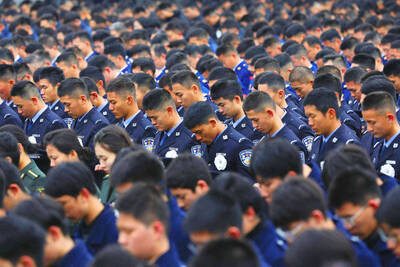
China yesterday held a low-key memorial ceremony for the 1937 Nanjing Massacre, with Chinese President Xi Jinping (習近平) not attending, despite a diplomatic crisis between Beijing and Tokyo over Taiwan. Beijing has raged at Tokyo since Japanese Prime Minister Sanae Takaichi last month said that a hypothetical Chinese attack on Taiwan could trigger a military response from Japan. China and Japan have long sparred over their painful history. China consistently reminds its people of the 1937 Nanjing Massacre, in which it says Japanese troops killed 300,000 people in what was then its capital. A post-World War II Allied tribunal put the death toll

A passerby could hear the cacophony from miles away in the Argentine capital, the unmistakable sound of 2,397 dogs barking — and breaking the unofficial world record for the largest-ever gathering of golden retrievers. Excitement pulsed through Bosques de Palermo, a sprawling park in Buenos Aires, as golden retriever-owners from all over Argentina transformed the park’s grassy expanse into a sea of bright yellow fur. Dog owners of all ages, their clothes covered in dog hair and stained with slobber, plopped down on picnic blankets with their beloved goldens to take in the surreal sight of so many other, exceptionally similar-looking ones.


 RSS
RSS