


For years, they languished in prison camps in North Vietnam, fighting to keep hope alive. Then in 1973, a cargo plane later dubbed the "Hanoi Taxi" swooped down and took home a group of US prisoners of war.
Now, more than 30 years later, the Air Force is retiring the aircraft that in two trips rescued 79 POWs captured during the Vietnam War. Many of those who took the flights of freedom reunited on Friday to ride the Hanoi Taxi once more and relive the unforgettable.
"It brought back a lot of memories," Orson Swindle, 69, of Alexandria, Virginia, said of the 79-minute flight at Wright-Patterson Air Force Base near Dayton. Swindle, a POW for more than six years after being shot down 1966, said the feeling then of seeing the plane coming to take him home in 1973 "was just incredible."
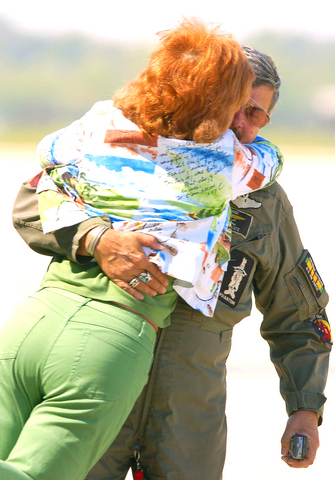
PHOTO: AP
"When we landed over here, I was just overwhelmed with emotion," Swindle said. "So it was good to remember. I truly believe that we lose a lot if we don't keep remembering."
A total 124 POWs who flew the Hanoi Taxi or other rescue planes gathered at the base on Friday for two flights, with 62 aboard each. The C-141 Air Force Reserve transport plane, the last in service, retired yesterday after landing near the National Museum of the US Air Force on the base.
Those on the day's first flight, which took them over the Dayton area, said a loud cheer erupted as they took off and that the flight was filled with animated discussions, punctuated by quiet lulls of reflection.
"We sat there and just kind of looked out the window and did a lot of recollection," said Bill Robinson, 62, Madisonville, Tennessee. He was shot down in 1965 and freed in 1973.
"As I'm getting old, I realize I am part of history," he said. "It definitely was a re-enactment, a wonderful feeling."
The POWs were called by name, one-by-one, to board the plane, as was done when they left Vietnam. The plane had a black POW-MIA flag on its brow.
Reminiscent of the joyful scenes three decades earlier of homecomings from Vietnam, wives and other relatives dashed out onto the taxiway, arms outstretched, to greet the veterans at the end of their flight on Friday
Jerri Mechenbier, wife of retired Air Force Reserve Major General Ed Mechenbier, a POW who later flew the plane himself, said, "It's nostalgic. It's sad in a way. It's the end of an era."
In his last mission nearly two years ago, Mechenbier flew it to Hanoi to bring home remains of fallen comrades
"I haven't seen him upset, but he hides his feelings well, as all POWs do," she said. "My husband never dwells on the painful parts. In fact, it was many years and through interviews that I found out that things were not quite so pleasant for him."
The Hanoi Taxi was the first of 18 C-141s that picked up nearly 600 POWs in "Operation Homecoming." The Hanoi Taxi landed at Gia Lamb Airport on Feb. 12, 1973, then carried 40 POWs to Clark Air Force Base in the Philippines and later back to the US.


Kehinde Sanni spends his days smoothing out dents and repainting scratched bumpers in a modest autobody shop in Lagos. He has never left Nigeria, yet he speaks glowingly of Burkina Faso military leader Ibrahim Traore. “Nigeria needs someone like Ibrahim Traore of Burkina Faso. He is doing well for his country,” Sanni said. His admiration is shaped by a steady stream of viral videos, memes and social media posts — many misleading or outright false — portraying Traore as a fearless reformer who defied Western powers and reclaimed his country’s dignity. The Burkinabe strongman swept into power following a coup in September 2022
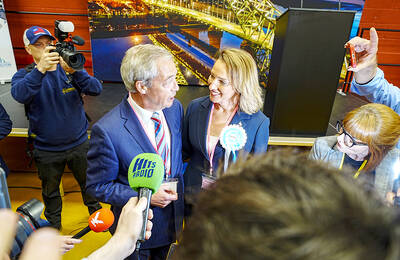
‘FRAGMENTING’: British politics have for a long time been dominated by the Labor Party and the Tories, but polls suggest that Reform now poses a significant challenge Hard-right upstarts Reform UK snatched a parliamentary seat from British Prime Minister Keir Starmer’s Labor Party yesterday in local elections that dealt a blow to the UK’s two establishment parties. Reform, led by anti-immigrant firebrand Nigel Farage, won the by-election in Runcorn and Helsby in northwest England by just six votes, as it picked up gains in other localities, including one mayoralty. The group’s strong showing continues momentum it built up at last year’s general election and appears to confirm a trend that the UK is entering an era of multi-party politics. “For the movement, for the party it’s a very, very big
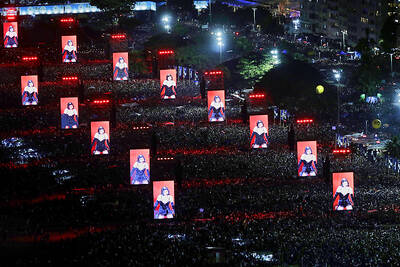
ENTERTAINMENT: Rio officials have a history of organizing massive concerts on Copacabana Beach, with Madonna’s show drawing about 1.6 million fans last year Lady Gaga on Saturday night gave a free concert in front of 2 million fans who poured onto Copacabana Beach in Rio de Janeiro for the biggest show of her career. “Tonight, we’re making history... Thank you for making history with me,” Lady Gaga told a screaming crowd. The Mother Monster, as she is known, started the show at about 10:10pm local time with her 2011 song Bloody Mary. Cries of joy rose from the tightly packed fans who sang and danced shoulder-to-shoulder on the vast stretch of sand. Concert organizers said 2.1 million people attended the show. Lady Gaga
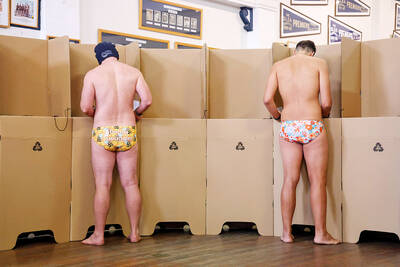
SUPPORT: The Australian prime minister promised to back Kyiv against Russia’s invasion, saying: ‘That’s my government’s position. It was yesterday. It still is’ Left-leaning Australian Prime Minister Anthony Albanese yesterday basked in his landslide election win, promising a “disciplined, orderly” government to confront cost-of-living pain and tariff turmoil. People clapped as the 62-year-old and his fiancee, Jodie Haydon, who visited his old inner Sydney haunt, Cafe Italia, surrounded by a crowd of jostling photographers and journalists. Albanese’s Labor Party is on course to win at least 83 seats in the 150-member parliament, partial results showed. Opposition leader Peter Dutton’s conservative Liberal-National coalition had just 38 seats, and other parties 12. Another 17 seats were still in doubt. “We will be a disciplined, orderly


 RSS
RSS