


Nepal's government waited yesterday for a response from Maoist rebels to its call for peace talks, after the Cabinet matched the insurgents' ceasefire declaration and said it would drop terrorism charges against them.
The government also said it would release jailed Maoist leaders if the rebels join talks to end the bloody 10-year insurgency that has left more than 12,500 people dead.
"We have already called the Maoists to talks and once the dialogue process starts, the rebel leaders detained in various prisons will also be released," Cabinet member Gopal Man Shrestha said.
Thousands have been detained during the insurgency and the interior ministry said up to 700 Maoists, of all ranks, were currently held. The Royal Nepalese Army Web site details 53 people on its "most wanted" list of Maoists, headed by rebel chief Prachanda.
The Cabinet on Wednesday also started the process of negating actions taken since the King Gyandendra took control in February last year, invalidating municipal elections three months ago for mayors and city and town council members.
While Cabinet decisions usually take at least a day to be released, the actions were announced immediately after it met, apparently to show politicians are moving quickly to address public impatience after three weeks of often-bloody protests forced the king to return the Himalayan country to democracy.
At least 17 protesters died when security forces tried to quell the demonstrations, opening fire with live rounds, rubber bullets and tear gas. The Cabinet announced compensation for the families of those killed.
The Maoists are expected to be brought into the political mainstream, but the process to end the insurgency clearly will not be completely smooth sailing.
Despite their three-month truce declaration, the Maoists beattwo alleged robbers to death in a vigilante execution on Wednesday in southern Nepal, said Santaraj Subedi, the chief government administrator in the area.
The two men were accused of robbing residents of Ganjabhawanipur, a village in an area that has a strong rebel presence about 160km south of the capital, Kathmandu.
The rebels apprehended the men and brought them before villagers who endorsed a death sentence for the alleged robbers, and then the insurgents beat the men to death, Subedi said yesterday.
In addition, Prachanda, has accused the seven-party alliance of engaging in a power struggle -- a reference to disputes over Cabinet appointments -- and said the legislature, which convened last Friday for the first time in four years, isn't up to the tasks at hand.
"This is not the solution to the problems and the demand of the Maoists," he wrote in a pro-Maoist weekly newspaper. "The House has no fresh mandate and cannot solve the problems."
Deputy Prime Minister Khadga Prasad Oli on Wednesday urged the rebels to join peace talks and said that all terrorism-related charges against them will be dropped. The government also will ask Interpol to quash international arrest warrants for the Maoists' leaders.
"We are sure the Maoists will come for the peace talks soonest," Home Minister Krishna Sitaula said. "We believe the talks will be successful because, unlike the previous governments, we have the support of the people."
He pointed out that the alliance already has met the rebels' key demand by committing to rewrite the Constitution.
The last mutual ceasefire, in 2003, broke down over the government's refusal to meet the demand. Another joint truce failed in 2001.
"The previous governments did not have the courage to call for elections for a constitutional assembly," Sitaula said.
Still, the list of critical issues facing the new government is long and rife with treacherous waters to navigate while trying to maintain at least a semblance of unity.


Kehinde Sanni spends his days smoothing out dents and repainting scratched bumpers in a modest autobody shop in Lagos. He has never left Nigeria, yet he speaks glowingly of Burkina Faso military leader Ibrahim Traore. “Nigeria needs someone like Ibrahim Traore of Burkina Faso. He is doing well for his country,” Sanni said. His admiration is shaped by a steady stream of viral videos, memes and social media posts — many misleading or outright false — portraying Traore as a fearless reformer who defied Western powers and reclaimed his country’s dignity. The Burkinabe strongman swept into power following a coup in September 2022
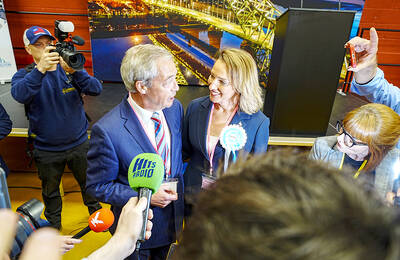
‘FRAGMENTING’: British politics have for a long time been dominated by the Labor Party and the Tories, but polls suggest that Reform now poses a significant challenge Hard-right upstarts Reform UK snatched a parliamentary seat from British Prime Minister Keir Starmer’s Labor Party yesterday in local elections that dealt a blow to the UK’s two establishment parties. Reform, led by anti-immigrant firebrand Nigel Farage, won the by-election in Runcorn and Helsby in northwest England by just six votes, as it picked up gains in other localities, including one mayoralty. The group’s strong showing continues momentum it built up at last year’s general election and appears to confirm a trend that the UK is entering an era of multi-party politics. “For the movement, for the party it’s a very, very big
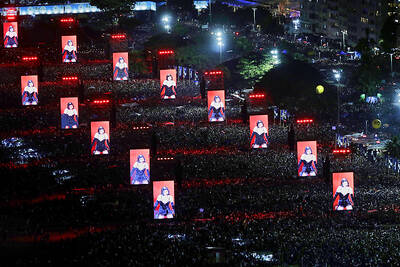
ENTERTAINMENT: Rio officials have a history of organizing massive concerts on Copacabana Beach, with Madonna’s show drawing about 1.6 million fans last year Lady Gaga on Saturday night gave a free concert in front of 2 million fans who poured onto Copacabana Beach in Rio de Janeiro for the biggest show of her career. “Tonight, we’re making history... Thank you for making history with me,” Lady Gaga told a screaming crowd. The Mother Monster, as she is known, started the show at about 10:10pm local time with her 2011 song Bloody Mary. Cries of joy rose from the tightly packed fans who sang and danced shoulder-to-shoulder on the vast stretch of sand. Concert organizers said 2.1 million people attended the show. Lady Gaga

SUPPORT: The Australian prime minister promised to back Kyiv against Russia’s invasion, saying: ‘That’s my government’s position. It was yesterday. It still is’ Left-leaning Australian Prime Minister Anthony Albanese yesterday basked in his landslide election win, promising a “disciplined, orderly” government to confront cost-of-living pain and tariff turmoil. People clapped as the 62-year-old and his fiancee, Jodie Haydon, who visited his old inner Sydney haunt, Cafe Italia, surrounded by a crowd of jostling photographers and journalists. Albanese’s Labor Party is on course to win at least 83 seats in the 150-member parliament, partial results showed. Opposition leader Peter Dutton’s conservative Liberal-National coalition had just 38 seats, and other parties 12. Another 17 seats were still in doubt. “We will be a disciplined, orderly


 RSS
RSS