


Thai Prime Minister Thaksin Shinawatra dismissed calls for his resignation yesterday, heightening tension after thousands of anti-government activists marched to his office and vowed to rally every day until he steps down.
"I will not resign because my resignation will not resolve anything," Thaksin told reporters.
The commander in chief of the army, meanwhile, sought to ease speculation of the army intervening and staging a coup, as it did in 1992 and more than a dozen other times during earlier political crises.

PHOTO: EPA
"The army will not get involved in the political conflict. Political troubles should be resolved by politicians," said General Sondhi Boonyaratkalin, echoing comments of other top military officials. "Military coups are a thing of the past."
At least 100,000 protesters filled the streets around Government House on Sunday and stayed until well past midnight following a boisterous rally. Some 2,000 remained early yesterday and vowed to regroup in larger numbers later in the day.
Thaksin said he had not personally followed the events of the rally but was informed by aides that protesters "were insisting on ousting me." He left Bangkok early on Sunday to campaign in the northeast for snap elections he has called for April 2.
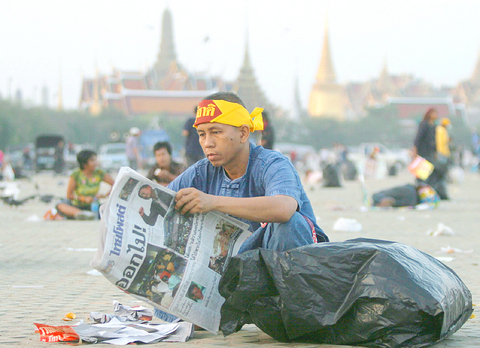
PHOTO: EPA
"As long as the people support me, I will still work because that is how a democracy works," Thaksin told a cheering crowd of supporters in northeastern Khon Kaen Province yesterday.
Tens of thousands of protesters have been demanding his resignation at regular weekend rallies in recent months, putting him on the defensive and leading to the country's biggest political crisis since 1992, when street protests forced the ouster of a military backed government.
The anti-Thaksin campaign swelled last month after the prime minister's family sold its controlling stake in telecom giant Shin Corp to a Singapore state-owned investment company netting 73.3 billion baht (US$1.9 billion). Critics allege the sale involved insider trading and tax dodges.
A group of activists seeking to have the elections declared unconstitutional had filed a petition to Administrative Court. But the court, which handles complaints against state bodies, said yesterday that it was unqualified to accept the petition, said Ampol Singakowin, the court's spokesman.
Meanwhile, in rural areas, where about two-thirds of Thailand's 63 million people live, Thaksin's popularity remains untarnished. In the country's vast and populous rice-farming heartland, it approaches adoration. Farmers and owners of small businesses say their lives have been transformed and that their incomes have doubled during Thaksin's five years in power.
"Even if someone paid me I wouldn't go to an anti-Thaksin demonstration," said Suwat Laocharuen, the village chief of Baan Nonsawan. "We just love him."
Both Thaksin and his opponents expect his party to win the most seats in next month's election. But in a sign of the deepening split between Bangkok and the provinces, the opposition, which draws much of its support from Bangkok and parts of the south, has decided to boycott the poll.
Thaksin's critics have accused him of corruption and abuse of power, charging that he has stripped key institutions of their independence -- the courts, the press, the anti-corruption authorities -- and that he uses his office to further his business interests.
But the argument that Thaksin must therefore resign does not wash with Suwat, the village chief.
"It's not fair that a leader gets two-thirds of the vote and then is brought down by street demonstrations," he said.
In the election in February last year, Thaksin won 61 percent of the vote, a landslide by Thai standards.
He cemented the loyalty of rural Thais with a three-year moratorium on their debts and a government program that offered US$26,000 to every village, from which residents could borrow for small business ventures.
Partly as a result, rural incomes increased 29 percent in 2001, the first year Thaksin was in power, 23 percent the next year and by double digits each year since. Last year, the average rural income reached US$821, according to the Rural Development Information Center of the Interior Ministry.
Baan Suksomboon residents said they would be bitter if Thaksin is removed from power.
"Of course I will be angry," said Muthita Shinpromma, who works at a factory stitching Nike sweatpants for US$3.70 a day. "
Thaksin is helping people at the grassroots," she said.

Brazil, the world’s largest Roman Catholic country, saw its Catholic population decline further in 2022, while evangelical Christians and those with no religion continued to rise, census data released on Friday by the Brazilian Institute of Geography and Statistics (IBGE) showed. The census indicated that Brazil had 100.2 million Roman Catholics in 2022, accounting for 56.7 percent of the population, down from 65.1 percent or 105.4 million recorded in the 2010 census. Meanwhile, the share of evangelical Christians rose to 26.9 percent last year, up from 21.6 percent in 2010, adding 12 million followers to reach 47.4 million — the highest figure

A Chinese scientist was arrested while arriving in the US at Detroit airport, the second case in days involving the alleged smuggling of biological material, authorities said on Monday. The scientist is accused of shipping biological material months ago to staff at a laboratory at the University of Michigan. The FBI, in a court filing, described it as material related to certain worms and requires a government permit. “The guidelines for importing biological materials into the US for research purposes are stringent, but clear, and actions like this undermine the legitimate work of other visiting scholars,” said John Nowak, who leads field

‘THE RED LINE’: Colombian President Gustavo Petro promised a thorough probe into the attack on the senator, who had announced his presidential bid in March Colombian Senator Miguel Uribe Turbay, a possible candidate in the country’s presidential election next year, was shot and wounded at a campaign rally in Bogota on Saturday, authorities said. His conservative Democratic Center party released a statement calling it “an unacceptable act of violence.” The attack took place in a park in the Fontibon neighborhood when armed assailants shot him from behind, said the right-wing Democratic Center, which was the party of former Colombian president Alvaro Uribe. The men are not related. Images circulating on social media showed Uribe Turbay, 39, covered in blood being held by several people. The Santa Fe Foundation

NUCLEAR WARNING: Elites are carelessly fomenting fear and tensions between nuclear powers, perhaps because they have access to shelters, Tulsi Gabbard said After a trip to Hiroshima, US Director of National Intelligence Tulsi Gabbard on Tuesday warned that “warmongers” were pushing the world to the brink of nuclear war. Gabbard did not specify her concerns. Gabbard posted on social media a video of grisly footage from the world’s first nuclear attack and of her staring reflectively at the Hiroshima Peace Memorial. On Aug. 6, 1945, the US obliterated Hiroshima, killing 140,000 people in the explosion and by the end of the year from the uranium bomb’s effects. Three days later, a US plane dropped a plutonium bomb on Nagasaki, leaving abut 74,000 people dead by the


 RSS
RSS