


The flickering television in Candy Lumpkins's trailer blared out The Bold and the Beautiful. It was a fantasy daytime soap vision of US life with little relevance to the reality of this impoverished corner of Kentucky.
The Lumpkins live at the definition of the back of beyond, in a hollow at the top of a valley at the end of a long and muddy dirt road. It is strewn with litter. Packs of stray dogs roam around barking. There is no telephone and since their pump broke two weeks ago Candy has collected water from nearby springs.
It is a vision of deep and abiding poverty. Yet the Lumpkins are not alone in their plight. The US does have vast, wealthy suburbs, huge shopping malls and a busy middle class, but it also has vast numbers of poor, struggling to make it in a low-wage economy with minimal government help.
A shocking 37 million Americans live in poverty. That is 12.7 per cent of the population -- the highest percentage in the developed world. They are found from the hills of Kentucky to Detroit's streets, from the Deep South of Louisiana to the heartland of Oklahoma. Each year since 2001 their number has grown.
Under US President George W Bush an extra 5.4 million have slipped below the poverty line. Yet they are not a story of the unemployed or the destitute. Most have jobs. Many have two. Amos Lumpkins has work and his children go to school. But the economy, stripped of worker benefits like healthcare, is having trouble providing good wages.
Even families with two working parents are often one slice of bad luck -- a medical bill or factory closure -- away from disaster. The minimum wage of US$5.15 an hour has not risen since 1997 and, adjusted for inflation, is at its lowest since 1956.
The gap between the haves and the have-nots looms wider than ever. Faced with rising poverty rates, Bush's trillion-dollar federal budget recently raised massive amounts of defense spending for the war in Iraq and slashed billions from welfare programs.
For a brief moment last year in New Orleans, Hurricane Katrina brought America's poor into the spotlight. Poverty seemed on the government's agenda. That spotlight has now been turned off.
Oklahoma is in the US's heartland. Tulsa looks like picture-book Middle America. Yet there is hunger here. When it comes to the most malnourished poor in America, Oklahoma is ahead of any other state.
It should be impossible to go hungry here. But it is not. Just ask those gathered at a food handout last week. They are a cross section of society: black, white, young couples, pensioners and the middle- aged. A few are out of work or retired, everyone else has jobs.
They are people like Freda Lee, 33, who has two jobs, as a marketer and a cashier. She has come to the nondescript Loaves and Fishes building -- flanked ironically by a Burger King and a McDonald's -- to collect food for herself and three sons.
"America is meant to be free. What's free?" she laughs. "All we can do is pay off the basics."
They are people like Tammy Reinbold, 37. She works part-time and her husband works full-time. They have two children yet rely on the food handouts.
"The church is all we have to fall back on," she says.
She is right. When government help is being cut and wages are insufficient, churches often fill the gap.
But why are some Tulsans going hungry?
Many believe it is the changing face of the US economy. Tulsa has been devastated by job losses. Big-name firms like WorldCom, Williams Energy and CitGo have closed or moved, costing the city about 24,000 jobs. Now Wal-Mart embodies the new US job market: low wages, few benefits.
Well-paid work only goes to the university-educated. Many others who just complete high school face a bleak future.
During the 2004 election the only politician to address poverty directly was Senator John Edwards, whose campaign theme was "Two Americas."
He was derided by Republicans for doing down the country and -- after Senator John Kerry had picked him as his Democratic running mate -- the rhetoric softened in the heat of the campaign.
But, in fact, Edwards was right. While 45.8 million Americans lack any health insurance, the top 20 per cent of earners take over half the national income. At the same time the bottom 20 per cent took home just 3.4 percent.
In the US, to be poor is a stigma. In a country which celebrates individuality and the goal of giving everyone an equal opportunity to make it big, those in poverty are often blamed for their own situation. Experience on the ground does little to bear that out.
When people are working two jobs at a time and still failing to earn enough to feed their families, it seems impossible to call them lazy or selfish.
There seems to be a failure in the system, not the poor themselves.
It is an impression backed up by many of those mired in poverty in Oklahoma and Kentucky. Few asked for handouts. Many asked for decent wages.
"It is unfair. I am working all the time and so what have I done wrong?" Lee says.
But the economy does not seem to be allowing people to make a decent living. It condemns the poor to stay put, fighting against seemingly impossible odds or to pull up sticks and try somewhere else.
In Tulsa, Tammy Reinbold and her family are moving to Texas as soon as they save the money for enough gasoline. It could take several months.
"I've been in Tulsa 12 years and I just gotta try somewhere else," she says.

PRECARIOUS RELATIONS: Commentators in Saudi Arabia accuse the UAE of growing too bold, backing forces at odds with Saudi interests in various conflicts A Saudi Arabian media campaign targeting the United Arab Emirates (UAE) has deepened the Gulf’s worst row in years, stoking fears of a damaging fall-out in the financial heart of the Middle East. Fiery accusations of rights abuses and betrayal have circulated for weeks in state-run and social media after a brief conflict in Yemen, where Saudi airstrikes quelled an offensive by UAE-backed separatists. The United Arab Emirates is “investing in chaos and supporting secessionists” from Libya to Yemen and the Horn of Africa, Saudi Arabia’s al-Ekhbariya TV charged in a report this week. Such invective has been unheard of
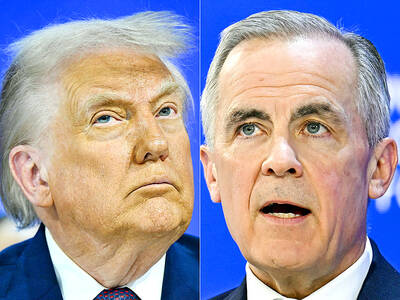
US President Donald Trump on Saturday warned Canada that if it concludes a trade deal with China, he would impose a 100 percent tariff on all goods coming over the border. Relations between the US and its northern neighbor have been rocky since Trump returned to the White House a year ago, with spats over trade and Canadian Prime Minister Mark Carney decrying a “rupture” in the US-led global order. During a visit to Beijing earlier this month, Carney hailed a “new strategic partnership” with China that resulted in a “preliminary, but landmark trade agreement” to reduce tariffs — but

Chinese President Xi Jinping’s (習近平) purge of his most senior general is driven by his effort to both secure “total control” of his military and root out corruption, US Ambassador to China David Perdue said told Bloomberg Television yesterday. The probe into Zhang Youxia (張又俠), Xi’s second-in-command, announced over the weekend, is a “major development,” Perdue said, citing the family connections the vice chair of China’s apex military commission has with Xi. Chinese authorities said Zhang was being investigated for suspected serious discipline and law violations, without disclosing further details. “I take him at his word that there’s a corruption effort under

China executed 11 people linked to Myanmar criminal gangs, including “key members” of telecom scam operations, state media reported yesterday, as Beijing toughens its response to the sprawling, transnational industry. Fraud compounds where scammers lure Internet users into fake romantic relationships and cryptocurrency investments have flourished across Southeast Asia, including in Myanmar. Initially largely targeting Chinese speakers, the criminal groups behind the compounds have expanded operations into multiple languages to steal from victims around the world. Those conducting the scams are sometimes willing con artists, and other times trafficked foreign nationals forced to work. In the past few years, Beijing has stepped up cooperation


 RSS
RSS