


In a stinging defeat for US prosecutors, a former Florida professor accused of helping lead a terrorist group that has carried out suicide bombings against Israel was acquitted on nearly half the charges against him. The jury deadlocked on the rest.
The case against Sami Al-Arian, 47, had been seen as one of the biggest courtroom tests yet of the Patriot Act's expanded search-and-surveillance powers.
After a five-month trial and 13 days of deliberations, the jury acquitted Al-Arian on Tuesday of eight of the 17 counts against him, including a key charge of conspiring to maim and murder people overseas. The jurors deadlocked on the others, including charges he aided terrorists.
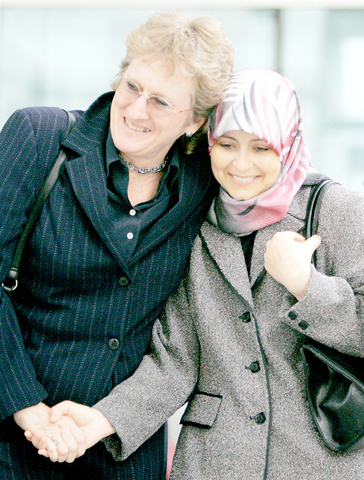
PHOTO: AP
Al-Arian, a former University of South Florida computer engineering professor, wept after the verdicts, and his attorney, Linda Moreno hugged him. He will return to jail until prosecutors decide whether to retry him on the deadlocked charges.
Two co-defendants, Sameeh Hammoudeh and Ghassan Zayed Ballut, were acquitted of all charges. A third, Hatem Naji Fariz, was found not guilty on 25 counts, and jurors deadlocked on the remaining eight.
"While we respect the jury's verdict, we stand by the evidence we presented in court," Department of Justice spokeswoman Tasia Scolinos said.
Al-Arian's wife Nahla celebrated outside the courthouse with family members and supporters.
"I'm ecstatic," she said. "My husband is an outspoken Palestinian activist who loved this country, believed in the system, and the system did not fail him."
Al-Arian was considered one of the most important terrorist figures to be brought to trial in the US since the Sept. 11, 2001, attacks. His indictment in 2003 was hailed by then-attorney general John Ashcroft as one of the first triumphs of the Patriot Act, which was enacted in the weeks after Sept. 11.
The Patriot Act gave the government greatly expanded powers and broke down the wall between foreign intelligence investigations and domestic law enforcement. In the Al-Arian case, officials said, it allowed separate FBI investigations -- one of them a years-long secret foreign intelligence probe of the professor's activities -- to be combined and all the evidence used against him.
A male juror, whose name was being kept secret by the court, said he did not see the case as a First Amendment issue, as defense attorneys had claimed, explaining that the decision came down to lack of proof.


Kehinde Sanni spends his days smoothing out dents and repainting scratched bumpers in a modest autobody shop in Lagos. He has never left Nigeria, yet he speaks glowingly of Burkina Faso military leader Ibrahim Traore. “Nigeria needs someone like Ibrahim Traore of Burkina Faso. He is doing well for his country,” Sanni said. His admiration is shaped by a steady stream of viral videos, memes and social media posts — many misleading or outright false — portraying Traore as a fearless reformer who defied Western powers and reclaimed his country’s dignity. The Burkinabe strongman swept into power following a coup in September 2022
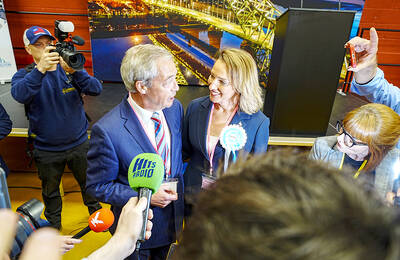
‘FRAGMENTING’: British politics have for a long time been dominated by the Labor Party and the Tories, but polls suggest that Reform now poses a significant challenge Hard-right upstarts Reform UK snatched a parliamentary seat from British Prime Minister Keir Starmer’s Labor Party yesterday in local elections that dealt a blow to the UK’s two establishment parties. Reform, led by anti-immigrant firebrand Nigel Farage, won the by-election in Runcorn and Helsby in northwest England by just six votes, as it picked up gains in other localities, including one mayoralty. The group’s strong showing continues momentum it built up at last year’s general election and appears to confirm a trend that the UK is entering an era of multi-party politics. “For the movement, for the party it’s a very, very big
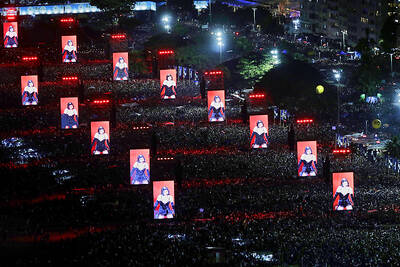
ENTERTAINMENT: Rio officials have a history of organizing massive concerts on Copacabana Beach, with Madonna’s show drawing about 1.6 million fans last year Lady Gaga on Saturday night gave a free concert in front of 2 million fans who poured onto Copacabana Beach in Rio de Janeiro for the biggest show of her career. “Tonight, we’re making history... Thank you for making history with me,” Lady Gaga told a screaming crowd. The Mother Monster, as she is known, started the show at about 10:10pm local time with her 2011 song Bloody Mary. Cries of joy rose from the tightly packed fans who sang and danced shoulder-to-shoulder on the vast stretch of sand. Concert organizers said 2.1 million people attended the show. Lady Gaga

SUPPORT: The Australian prime minister promised to back Kyiv against Russia’s invasion, saying: ‘That’s my government’s position. It was yesterday. It still is’ Left-leaning Australian Prime Minister Anthony Albanese yesterday basked in his landslide election win, promising a “disciplined, orderly” government to confront cost-of-living pain and tariff turmoil. People clapped as the 62-year-old and his fiancee, Jodie Haydon, who visited his old inner Sydney haunt, Cafe Italia, surrounded by a crowd of jostling photographers and journalists. Albanese’s Labor Party is on course to win at least 83 seats in the 150-member parliament, partial results showed. Opposition leader Peter Dutton’s conservative Liberal-National coalition had just 38 seats, and other parties 12. Another 17 seats were still in doubt. “We will be a disciplined, orderly


 RSS
RSS