


A Japanese court yesterday rejected claims that a notorious contest by imperial troops to behead Chinese soldiers was a journalist's fabrication, giving critics of Japan's wartime past a rare legal victory.
In the runup to the infamous Nanjing Massacre, a Japanese newspaper reported in 1937 in the tone of a sports story that two army lieutenants played a game about who would be the first to decapitate 100 Chinese soldiers.
The story was meant to boost morale at the time. But relatives of the two lieutenants, who were later executed, filed a lawsuit in 2003 saying the article was false.
Tokyo District Court Judge Akio Doi rejected the suit, saying, "The lieutenants admitted the fact that they raced to kill 100 people."
"We cannot deny that the article included some false elements and exaggeration, but it is difficult to say the article was fiction not based on facts," Doi said. "Since a final historical assessment on whether the contest of killing 100 people has not yet been made, we cannot say [the article] was obviously false."
Relatives of the lieutenants sought a total of ?36 million (US$330,000) in compensation from the Mainichi Shimbun, whose forerunner published the 1937 story, and the Asahi Shimbun, which said in a 1971 story that the contest had taken place.
The Tokyo Nichinichi Shimbun, which later became the Mainichi Shimbun, ran the article with the headline, "Super record 100 cut down: Mukai at 106 vs Noda at 105. The two lieutenants go into a playoff."
It was referring to lieutenants Toshiaki Mukai and Tsuyoshi Noda, who were later executed by an Allied tribunal over the Nanjing Massacre.
The plaintiffs included Chieko Mukai, the daughter of Toshiaki Mukai, who said the report was "groundless" and had tainted the two families' reputation.
The killing spree came as the lieutenants headed to Nanjing.
Japanese courts have consistently thrown out suits seeking damages for atrocities such as the Nanjing Massacre, saying compensation is made between states rather than individuals.
"It was a wholly reasonable ruling. There is no room for doubt about it," said Katsuichi Honda, a journalist who wrote the 1971 Asahi article.
"Bringing such historical topics into a courtroom appears to be an attempt to deny the Nanjing Massacre or the aggression in China," Honda said.

Through the noise of rushing papers and whirring belts at a print factory in Kyoto, two creators watch their photo essay come to life in broadsheet form — part of an effort to win new audiences in the age of artificial intelligence (AI). Despite the decline of the publishing industry, self-publication and handmade “zine” magazines are growing in popularity in Japan, reflecting the nation’s enduring love of paper in the digital era. While speaking to Agence France-Presse at the plant, his hands black with ink, one of the creators, Kazuma Obara, said: “I think [paper] is a medium that engages all five

‘CROSSING THE LINE’: China’s embassy in Seoul criticized US Forces Korea Commander General Xavier Brunson, asking if his ‘hostile’ remarks were authorized by Washington South Korea and the US are in talks over recent public remarks by the commander of US Forces Korea, Seoul’s presidential office said yesterday, after the comments drew sharp criticism from China. In a recent podcast interview, US Forces Korea Commander General Xavier Brunson described South Korea as “the dagger in the heart of Asia” from China’s east coast, prompting the Chinese embassy in Seoul to say that he had “truly crossed the line.” The interview came amid growing speculation that Washington might seek to expand the role of US Forces Korea in countering the growing regional influence of China, a key
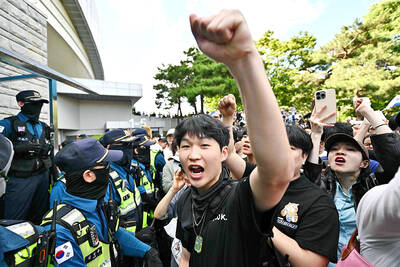
‘ABSURD MISTAKE’: The election commission said that there had been a failure to anticipate turnout after 14 polling stations ran short of ballot papers South Korean riot police yesterday cleared protesters from a Seoul polling station after a 35-hour blockade sparked by a shortage of ballot papers during local elections earlier this week. Wednesday’s election was the first nationwide vote since South Korean President Lee Jae-myung took office following the ouster of Yoon Suk-yeol over his short-lived martial law declaration. Lee’s ruling Democratic Party swept most races, but failed to flip the crucial Seoul mayoral seat. The South Korean National Election Commission apologized, blaming a failure to anticipate turnout after 14 polling stations in Seoul ran short of ballot papers. Some polling stations stayed open until 10pm to

Australian researchers have trained lab-grown brain cells on a silicon computer chip to play the 1990s shooter game Doom and said they are just scratching the surface of what the neurons could be capable of doing. It is the science-fiction work of biotech boffins at Cortical Labs, who researched and developed the technology that harnesses the workings of the brain’s networking system. Each so-called “biological computer” contains about 200,000 living human brain cells, grown from stem cells that were harvested from blood donations. Having mastered the simple computer game Pong, where a paddle is moved up and down to send a ball


 RSS
RSS