


One of the ecumenical movement's most emblematic figures has been stabbed to death during evening prayers at the popular interfaith community he founded in France.
Brother Roger, a 90-year-old Protestant pastor who founded the Taize religious community in 1940, was stabbed by a woman at about 8.40pm on Tuesday in front of a congregation of some 2,500 young people.
The Pope was among religious and political leaders from across Europe who expressed shock.
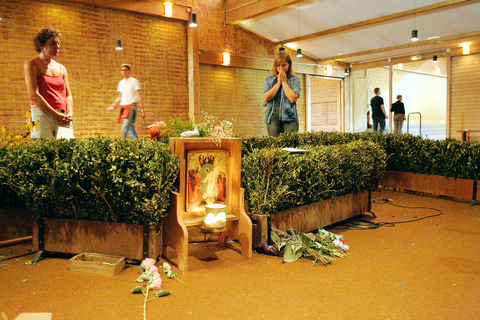
PHOTO: EPA
A gendarmerie spokesman in the nearby town of Macon in Burgundy said a 36-year-old Romanian woman had been wrestled to the ground by two members of the congregation immediately after the killing and was now in custody.
The local public prosecutor, Jean-Louis Coste, said the woman, who had arrived at Taize alone two days earlier, was "not unbalanced enough to justify psychiatric care" and that a judicial investigation would be opened soon.
The woman, named only as Luminita, spoke fairly coherently and was capable of undergoing interrogation, he said. "She said that she didn't intend to kill him but that she wanted to attract his attention. She admits the facts."
He said Luminita had bought the knife on Monday in the nearby town of Cluny. That suggested premeditation, he said.
"The woman who stabbed him had managed to work her way into the middle of the choir," Brother Emile, the Taize religious community's spokesman, told French radio. "She moved towards him, but we didn't notice anything untoward because we had our backs to her. We heard the scream, we turned round, but it was already over."
Brother Emile said Brother Roger had stayed sitting upright but had been seriously wounded in the back and throat. A doctor in the congregation and another from Cluny "did what they could but it was too late. He died soon after 9pm."
President Jacques Chirac said that he was "profoundly moved" by the "tragic death," while the French prime minister, Dominique de Villepin, said the pastor would "remain a leading figure in our religious history."
Germany's Chancellor Gerhard Schroder said that he regarded Brother Roger as one of the "great contemporary personalities of religious life."
Roger Schutz-Marsauche, the son of a Swiss father and a French mother, studied theology at Strasbourg and Lausanne. In 1940, at the age of 25, he left his native Switzerland by bicycle and rented a small farmhouse in Taize, where he welcomed mainly Jewish refugees fleeing the second world war. The village was close to the demarcation line separating free and occupied France.
Today, the community, founded with an enduring call for Christians of all persuasions to come together in peace, love and reconciliation, is made up of more than 100 brothers, including Catholics and Protestants, from nearly 30 countries.
Sunday services draw congregations of up to 5,000 worshippers.

Through the noise of rushing papers and whirring belts at a print factory in Kyoto, two creators watch their photo essay come to life in broadsheet form — part of an effort to win new audiences in the age of artificial intelligence (AI). Despite the decline of the publishing industry, self-publication and handmade “zine” magazines are growing in popularity in Japan, reflecting the nation’s enduring love of paper in the digital era. While speaking to Agence France-Presse at the plant, his hands black with ink, one of the creators, Kazuma Obara, said: “I think [paper] is a medium that engages all five

‘CROSSING THE LINE’: China’s embassy in Seoul criticized US Forces Korea Commander General Xavier Brunson, asking if his ‘hostile’ remarks were authorized by Washington South Korea and the US are in talks over recent public remarks by the commander of US Forces Korea, Seoul’s presidential office said yesterday, after the comments drew sharp criticism from China. In a recent podcast interview, US Forces Korea Commander General Xavier Brunson described South Korea as “the dagger in the heart of Asia” from China’s east coast, prompting the Chinese embassy in Seoul to say that he had “truly crossed the line.” The interview came amid growing speculation that Washington might seek to expand the role of US Forces Korea in countering the growing regional influence of China, a key

Australian researchers have trained lab-grown brain cells on a silicon computer chip to play the 1990s shooter game Doom and said they are just scratching the surface of what the neurons could be capable of doing. It is the science-fiction work of biotech boffins at Cortical Labs, who researched and developed the technology that harnesses the workings of the brain’s networking system. Each so-called “biological computer” contains about 200,000 living human brain cells, grown from stem cells that were harvested from blood donations. Having mastered the simple computer game Pong, where a paddle is moved up and down to send a ball

France experienced its hottest spring on record, the French weather service said on Tuesday, after an exceptional early heat wave that also broke highs for the season in England and Wales. Meteo-France said the average nationwide temperature over March to May was 13.8°C — about 1.7°C above the norm, and surpassing records set in 2011 and 2020. “The warmest spring since records began in 1900,” it said in a bulletin. All three months were warmer than average, but the onset of an “unprecedented heatwave” late last month pushed the mercury to highs typically seen at the height of the summer. “Our country had never


 RSS
RSS