


Lawmakers yesterday ended a damaging battle for legitimacy between rival parliaments, boosting prospects for political stability in Kyrgyzstan after last week's ouster of longtime leader Askar Akayev.
Legislators from an old parliament had struggled for supremacy against newly elected rivals since Thursday, when the Central Asian nation's politics were thrown into turmoil by opposition-led protesters who overran government buildings and toppled Akayev's government.
The old parliament's upper house ended its defiance and disbanded yesterday, one day after a similar move by its lower house, deferring to a new legislature packed with lawmakers supported by the self-exiled president. The move apparently signaled an accommodation between the old elite and the emerging leadership of former opposition figures.
The chamber's speaker, Muratbek Mukashev, read a statement signed by 32 lawmakers saying that the 45-seat house would end its work to avoid further conflict.
"We believe that we have fulfilled our task, especially during the difficult time for our country," Mukashev said.
"You have taken the right and historic decision," said Kyrgyzstan's interim leader Kurmanbek Bakiyev, who had shifted his allegiance from the old parliament to the new one on Monday. "I hope your decision will bring calm."
Opposition-led protesters had risen up against Akayev's government in anger over allegations of vote-rigging in this year's parliamentary elections in February and March, and many opposition supporters felt the newly elected legislature should be overthrown along with Akayev.
The Supreme Court hastily reinstated the old parliament the night of Akayev's ouster. But the new parliament, which already had convened two days earlier, secured the backing of country's election commission over the weekend, and the country's new opposition-dominated leadership increasingly swung toward the new parliament in recent days.
At the height of the conflict, the two parliaments held competing sessions on separate floors of the same building.
Bakiyev, a former opposition leader, was chosen as acting president and prime minister by the old parliament, and he initially opposed the new parliament, but backed the new legislature after it named him prime minister on Monday.
Lawmakers who disbanded yesterday cited continuing complaints over the legitimacy of this year's parliamentary elections, saying "the demands of most of the people for electing a new parliament have not been met."
About 150 protesters gathered outside the parliament building while lawmakers met inside, some demanding that the new parliament dissolve and others asking that results for disputed districts be annulled. But the protesters soon dispersed.
Bakiyev, who maintains 20 of the 75 seats in the new parliament are in dispute, reiterated pledges that those races would be reviewed by the courts and Central Election Commission.
"We cannot dissolve the whole parliament," he said.
The parliamentary dispute threatened to plunge the impoverished nation of 5 million people deeper into crisis after the ouster of Akayev, whose popular support dwindled during a 15-year rule marked by increasing authoritarianism and corruption allegations.
Akayev fled to Russia last week after protesters seized control of administrative buildings in widespread demonstrations.

PARLIAMENT CHAOS: Police forcibly removed Brazilian Deputy Glauber Braga after he called the legislation part of a ‘coup offensive’ and occupied the speaker’s chair Brazil’s lower house of Congress early yesterday approved a bill that could slash former Brazilian president Jair Bolsonaro’s prison sentence for plotting a coup, after efforts by a lawmaker to disrupt the proceedings sparked chaos in parliament. Bolsonaro has been serving a 27-year term since last month after his conviction for a scheme to stop Brazilian President Luiz Inacio Lula da Silva from taking office after the 2022 election. Lawmakers had been discussing a bill that would significantly reduce sentences for several crimes, including attempting a coup d’etat — opening up the prospect that Bolsonaro, 70, could have his sentence cut to

A powerful magnitude 7.6 earthquake shook Japan’s northeast region late on Monday, prompting tsunami warnings and orders for residents to evacuate. A tsunami as high as three metres (10 feet) could hit Japan’s northeastern coast after an earthquake with an estimated magnitude of 7.6 occurred offshore at 11:15 p.m. (1415 GMT), the Japan Meteorological Agency (JMA) said. Tsunami warnings were issued for the prefectures of Hokkaido, Aomori and Iwate, and a tsunami of 40cm had been observed at Aomori’s Mutsu Ogawara and Hokkaido’s Urakawa ports before midnight, JMA said. The epicentre of the quake was 80 km (50 miles) off the coast of
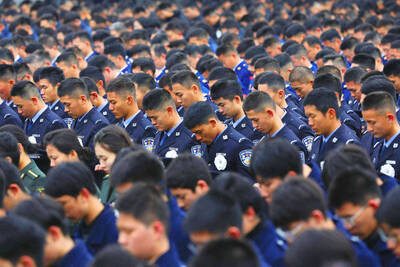
China yesterday held a low-key memorial ceremony for the 1937 Nanjing Massacre, with Chinese President Xi Jinping (習近平) not attending, despite a diplomatic crisis between Beijing and Tokyo over Taiwan. Beijing has raged at Tokyo since Japanese Prime Minister Sanae Takaichi last month said that a hypothetical Chinese attack on Taiwan could trigger a military response from Japan. China and Japan have long sparred over their painful history. China consistently reminds its people of the 1937 Nanjing Massacre, in which it says Japanese troops killed 300,000 people in what was then its capital. A post-World War II Allied tribunal put the death toll

A passerby could hear the cacophony from miles away in the Argentine capital, the unmistakable sound of 2,397 dogs barking — and breaking the unofficial world record for the largest-ever gathering of golden retrievers. Excitement pulsed through Bosques de Palermo, a sprawling park in Buenos Aires, as golden retriever-owners from all over Argentina transformed the park’s grassy expanse into a sea of bright yellow fur. Dog owners of all ages, their clothes covered in dog hair and stained with slobber, plopped down on picnic blankets with their beloved goldens to take in the surreal sight of so many other, exceptionally similar-looking ones.


 RSS
RSS