


A suicide bomber detonated an explosives-laden vehicle near the restive central city of Ramadi, killing 11 Iraqi police commandos and injuring 14 other people including two US Army soldiers, the US military said yesterday.
The Thursday evening blast at a checkpoint on the eastern outskirts of Ramadi also wounded nine Iraqi security-force members and three civilians, bringing the list of victims to 25, US Marine Captain Jeffrey Pool told reporters.
The attacker also died in the explosion near the flashpoint Sunni Triangle city of Ramadi, 115km west of Baghdad.
PHOTO: AFP
In an eastern Baghdad neighborhood, unidentified attackers killed five female translators working for the US military late Thursday, said police Captain Ahmed Aboud.
The translators "were heading home when gunmen driving two cars sprayed them with machine-gun fire," said Aboud yesterday. Further details weren't immediately available.
Insurgents routinely target US forces and their perceived collaborators as well as members of Iraq's government, army and police -- security forces the US military says must gain better control of the strife-torn country before any major US troop withdrawal.
On Thursday, hundreds of power workers shouting "No, no, to terror!" marched through Baghdad to protest attacks that have killed dozens of their colleagues, while demonstrators in the south demanded that the new petroleum minister be appointed from their oil-rich region.
The demonstrations came as negotiators for the two biggest factions in the new National Assembly worked out details of an Iraqi government that US officials hope will pave the way for the eventual withdrawal of coalition forces.
Jawad al-Maliki, a negotiator from the Shiite-led United Iraqi Alliance, said talks had progressed enough for Shiite Arab and ethnic Kurd officials to agree to hold parliament's second session early next week, although no date had been set.
The 275-seat National Assembly met March 16 to swear in its members.
"The negotiations were positive and very good," al-Maliki said. "In the coming days, the meetings will be continuous and decisive."
Lined up behind a black banner with the names of slain power workers, protesters demanded an end to attacks on electricity stations and oil pipelines -- targets in an insurgent effort to weaken the economy and undermine the US-led coalition and interim government.
At the same time, in southern Basra, more than 200 workers gathered outside a local government building to insist that the new government's oil and transportation ministers be someone from that region.
"Everyone must know that the oppressed and persecuted people of the south refuse to have their interests be ignored," protesters said in a statement given to the provincial governor, Mohammed al-Waeli.
Al-Waeli agreed, saying: "We are eager that the people of Basra and the south have clout in the new government."
Some oil workers threatened to disrupt production in the south.
"We will stop pumping the oil and go on strike for those working in the oil field and the ports if our demands aren't met," said Mohammed Abdul Hafez, a union official who was one of the demonstration's organizers.
Kurdish and Shiite negotiators debated Cabinet posts Thursday, and Abdul-Karim al-Anzi, a Shiite official, said lawmakers should be able to elect the president, two vice presidents and parliament's speaker in their session next week.

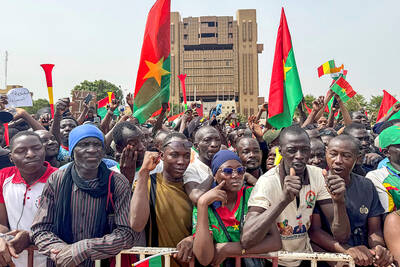
Kehinde Sanni spends his days smoothing out dents and repainting scratched bumpers in a modest autobody shop in Lagos. He has never left Nigeria, yet he speaks glowingly of Burkina Faso military leader Ibrahim Traore. “Nigeria needs someone like Ibrahim Traore of Burkina Faso. He is doing well for his country,” Sanni said. His admiration is shaped by a steady stream of viral videos, memes and social media posts — many misleading or outright false — portraying Traore as a fearless reformer who defied Western powers and reclaimed his country’s dignity. The Burkinabe strongman swept into power following a coup in September 2022
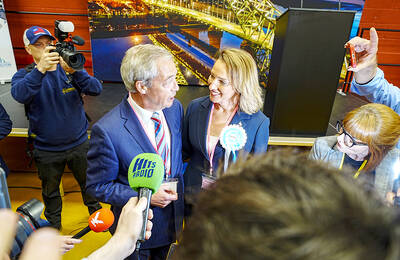
‘FRAGMENTING’: British politics have for a long time been dominated by the Labor Party and the Tories, but polls suggest that Reform now poses a significant challenge Hard-right upstarts Reform UK snatched a parliamentary seat from British Prime Minister Keir Starmer’s Labor Party yesterday in local elections that dealt a blow to the UK’s two establishment parties. Reform, led by anti-immigrant firebrand Nigel Farage, won the by-election in Runcorn and Helsby in northwest England by just six votes, as it picked up gains in other localities, including one mayoralty. The group’s strong showing continues momentum it built up at last year’s general election and appears to confirm a trend that the UK is entering an era of multi-party politics. “For the movement, for the party it’s a very, very big
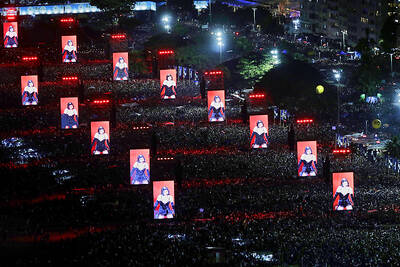
ENTERTAINMENT: Rio officials have a history of organizing massive concerts on Copacabana Beach, with Madonna’s show drawing about 1.6 million fans last year Lady Gaga on Saturday night gave a free concert in front of 2 million fans who poured onto Copacabana Beach in Rio de Janeiro for the biggest show of her career. “Tonight, we’re making history... Thank you for making history with me,” Lady Gaga told a screaming crowd. The Mother Monster, as she is known, started the show at about 10:10pm local time with her 2011 song Bloody Mary. Cries of joy rose from the tightly packed fans who sang and danced shoulder-to-shoulder on the vast stretch of sand. Concert organizers said 2.1 million people attended the show. Lady Gaga
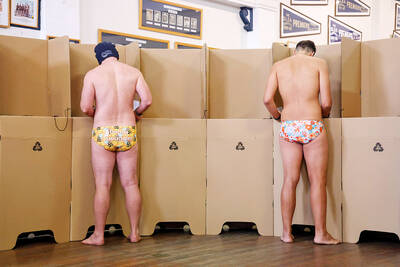
SUPPORT: The Australian prime minister promised to back Kyiv against Russia’s invasion, saying: ‘That’s my government’s position. It was yesterday. It still is’ Left-leaning Australian Prime Minister Anthony Albanese yesterday basked in his landslide election win, promising a “disciplined, orderly” government to confront cost-of-living pain and tariff turmoil. People clapped as the 62-year-old and his fiancee, Jodie Haydon, who visited his old inner Sydney haunt, Cafe Italia, surrounded by a crowd of jostling photographers and journalists. Albanese’s Labor Party is on course to win at least 83 seats in the 150-member parliament, partial results showed. Opposition leader Peter Dutton’s conservative Liberal-National coalition had just 38 seats, and other parties 12. Another 17 seats were still in doubt. “We will be a disciplined, orderly


 RSS
RSS