


Nepalese travelers hit the roads yesterday while food and other essential supplies began flowing freely into cities after communist rebels lifted a crippling two-week countrywide highway blockade to protest the king's power grab.
The rebels said Saturday that their decision was aimed at easing the discomfort of the common people. However, they threatened to step up their military campaign against the army.
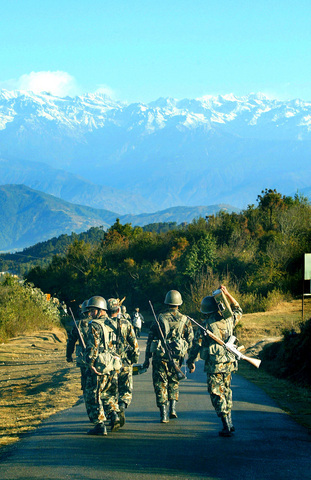
PHOTO: AP
Fighting since 1996 to topple the monarchy and install communist rule, the insurgents blocked the country' highways using crude bombs, mines and boulders, disrupting basic supplies across the Himalayan kingdom and choking off major cities.
Yesterday, buses and cars that had been parked in garages for days ventured out onto the roads snaking through the mountainous country.
"We have had several telephone calls this morning from people who wanted to make reservations. Finally, it's business as usual," said Ram Shrestha, a ticket clerk at the local bus station in the capital, Kathmandu.
During the rebel blockade, vehicles piled up on the highways, waiting for security forces to clear explosives and escort civilian convoys to their destinations without being targeted by the insurgents. Prices of food and other essential items shot up across Nepal.
"We are lifting the indefinite blockade of transportation to show our deep responsibility toward the people," rebel chief Pushpa Kamal Dahal, also known as Prachanda, said in a statement late Saturday.
"We are going to start a new phase of movement increasing military resistance and mass movement of people," Dahal said without elaborating.
A Nepalese army spokesman declined comment.
The terror on the highways spiraled after indiscriminate firing by suspected rebels killed an Indian truck driver and wounded seven Nepalese last week.
Since then, airlines have been overwhelmed with bookings, even though only a tiny percentage of people in this impoverished country can afford air travel.
The insurgents said they were protesting King Gyanendra's decision on Feb. 1 to sack the government, impose emergency rule, and suspend civil liberties.
The monarch, who says he was forced to act because of the insurgency, has ignored repeated calls from the international community that he restore democracy.
Nepal's key allies, India and Britain, have suspended military aid and the US says it also is considering similar action. Several countries have withdrawn their ambassadors from Nepal and stopped aid.

Malaysia yesterday installed a motorcycle-riding billionaire sultan as its new king in lavish ceremonies for a post seen as a ballast in times of political crises. The coronation ceremony for Malaysia’s King Sultan Ibrahim, 65, at the National Palace in Kuala Lumpur followed his oath-taking in January as the country’s 17th monarch. Malaysia is a constitutional monarchy, with a unique arrangement that sees the throne change hands every five years between the rulers of nine Malaysian states headed by centuries-old Islamic royalty. While chiefly ceremonial, the position of king has in the past few years played an increasingly important role. Royal intervention was

X-37B COMPARISON: China’s spaceplane is most likely testing technology, much like US’ vehicle, said Victoria Samson, an official at the Secure World Foundation China’s shadowy, uncrewed reusable spacecraft, which launches atop a rocket booster and lands at a secretive military airfield, is most likely testing technology, but could also be used for manipulating or retrieving satellites, experts said. The spacecraft, on its third mission, was last month observed releasing an object, moving several kilometers away and then maneuvering back to within a few hundred meters of it. “It’s obvious that it has a military application, including, for example, closely inspecting objects of the enemy or disabling them, but it also has non-military applications,” said Marco Langbroek, a lecturer in optical space situational awareness at Delft

The Philippine Air Force must ramp up pilot training if it is to buy 20 or more multirole fighter jets as it modernizes and expands joint operations with its navy, a commander said yesterday. A day earlier US National Security Adviser Jake Sullivan said that the US “will do what is necessary” to see that the Philippines is able to resupply a ship on the Second Thomas Shoal (Renai Shoal, 仁愛暗沙) that Manila uses to reinforce its claims to the atoll. Sullivan said the US would prefer that the Philippines conducts the resupplies of the small crew on the warship Sierra Madre,

AIRLINES RECOVERING: Two-thirds of the flights canceled on Saturday due to the faulty CrowdStrike update that hit 8.5 million devices worldwide occurred in the US As the world continues to recover from massive business and travel disruptions caused by a faulty software update from cybersecurity firm CrowdStrike, malicious actors are trying to exploit the situation for their own gain. Government cybersecurity agencies across the globe and CrowdStrike CEO George Kurtz are warning businesses and individuals around the world about new phishing schemes that involve malicious actors posing as CrowdStrike employees or other tech specialists offering to assist those recovering from the outage. “We know that adversaries and bad actors will try to exploit events like this,” Kurtz said in a statement. “I encourage everyone to remain vigilant


 RSS
RSS