


Their plight has touched hearts around the world: children left parentless and homeless, their futures uncertain and bleak.
In the weeks since the tsunami claimed 31,000 Sri Lankan lives and tore apart a million more, adoption agencies here have been flooded with applications and inundated with telephone calls.
Couples who never thought before of adoption, celibate Buddhist priests and the even the country's president herself have been eager to take in a tsunami-orphaned child.
The government's two main child protection institutions report 2,065 adoption applications -- more than twice the number of children orphaned by the Dec. 26 disaster, according to estimates by the UN children's agency.
"There are not enough orphans to satisfy the number of tsunami adoption applicants," said Sarath Abeygunewardene, commissioner of the Child Care and Probation Department.
And the numbers keep growing.
"We have no kids of our own, and it seemed the best way to help," said Sushila Wijekoon, a doctor who has been working, along with her physician husband, in refugee camps in the southern region of Balapitiya.
Childless after seven years of marriage, they had never applied before, she said.
But authorities caution that a hasty adoption can harm the child and lead to unhappy families.
"The worst thing is to rush into adoptions," said Professor Harendra de Silva, chief of the government National Child Protection Authority. "Some have applied for adoptions in the heat of an emotional response to the tsunami."
De Silva said the first priority should be to trace surviving relatives, keeping the child within the extended family.
"We won't even think of adoption for at least the next six months," he said.
"The issue of adoption should be put on the back-burner for the moment," said Ted Chaiban, head of UNICEF in Sri Lanka, agreeing that the extended family gives children "some familiar surroundings."
Meanwhile, other problems -- and horror stories -- have emerged.
In a Buddhist temple in the south, police arrested a man who tried to sell his two granddaughters to foreigners after their mother was killed in the tsunami.
Villagers and religious clergy speak of grief-stricken mothers taking children off the street, trying to replace those they lost to the deadly waves.
In the eastern district of Ampara, nine desperate women are battling to claim a 3-month-old boy dubbed "Baby 81." The infant was found caked in mud on a beach by an old man and brought to a hospital -- the 81st admission that day.
DNA tests are planned to determine whom, if any, among the nine women is the real mother -- a process that is likely to take months.
Child trafficking in the guise of adoption is another concern, said Arun Tampo, a veteran child activist. "They may take this opportunity to snatch children for work in factories or homes or use them for the sex trade," he said.
In the southern town of Galle, Thalawe Dhamma Joti, a saffron-robed Buddhist monk, sat outside the Child Probation office, hoping the district commissioner would give him some orphans he can train as monks.
"What's the harm? This could be their calling," he said.
Nihal and Padma Kaluarachchi were happy with their family of two children until the tsunami struck.
"We visited several refugee camps, and the plight of the children brought tears to my eyes," said Nihal said, their young son and daughter huddled next to their mother, Padma.
In the camps, Nihal saw some children playing, seemingly oblivious to the disaster that had changed their lives. Others sat in corner, refusing to speak. Four days later after the tsunami, he filed an adoption application.
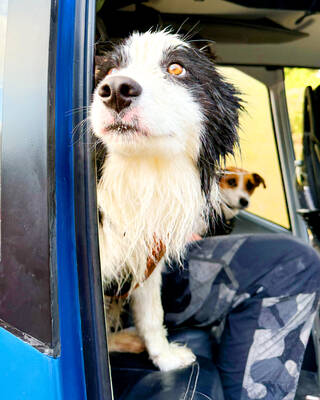
When a hiker fell from a 55m waterfall in wild New Zealand bush, rescuers were forced to evacuate the badly hurt woman without her dog, which could not be found. After strangers raised thousands of dollars for a search, border collie Molly was flown to safety by a helicopter pilot who was determined to reunite the pet and the owner. A week earlier, an emergency rescue helicopter found the woman with bruises and lacerations after a fall at a rocky spot at the waterfall on the South Island’s West Coast. She was airlifted on March 24, but they were forced to

CONFIDENCE BOOSTER: ’After parkour ... you dare to do a lot of things that you think only young people can do,’ a 67-year-old parkour enthusiast said In a corner of suburban Singapore, Betty Boon vaults a guardrail, crawls underneath a slide, executes forward shoulder rolls and scales a steep slope, finishing the course to applause. “Good job,” the 69-year-old’s coach cheers. This is “geriatric parkour,” where about 20 retirees learned to tackle a series of relatively demanding exercises, building their agility and enjoying a sense of camaraderie. Boon, an upbeat grandmother, said learning parkour has aided her confidence and independence as she ages. “When you’re weak, you will be dependent on someone,” she said after sweating it out with her parkour classmates in suburban Toa Payoh,

Chinese dissident artist Gao Zhen (高兟), famous for making provocative satirical sculptures of former Chinese leader Mao Zedong (毛澤東), was tried on Monday over accusations of “defaming national heroes and martyrs,” his wife and a rights group said. Gao, 69, who was detained in 2024 during a visit from the US, faces a maximum three-year prison sentence, said his wife, Zhao Yaliang (趙雅良), and Shane Yi, a researcher at the Chinese Human Rights Defenders group which operates outside the nation. The closed-door, one-day trial took place at Sanhe City People’s Court in Hebei Province neighboring the capital, Beijing, and ended without a

‘TOXIC CLIMATE’: ‘I don’t really recognize Labour anymore... The idea that you can implement far-right ideas in order to stop the far right is nonsense,’ a protester said Tens of thousands of people on Saturday marched through central London to protest against the far right, weeks ahead of local elections and six months after Britain saw one of its largest far-right demonstrations. Organized by hundreds of civic groups, including trade unions, anti-racism campaigners and Muslim representative bodies, Saturday’s Together Alliance event was billed as the biggest in UK history to counter right-wing extremism. A separate pro-Palestinian march had also converged with the main rally. While organizers claimed 500,000 had turned out in total, the police gave a figure of about 50,000. Protesters carrying placards with slogans such as


 RSS
RSS