


The retrial of the only Sept. 11 terror suspect ever convicted opened yesterday with the US under pressure to allow testimony by alleged key al-Qaeda operatives in its custody.
Mounir el Motassadeq, a 30-year-old Moroccan charged with aiding the three Hamburg-based suicide hijackers, won a new trial in March after a German appeals court ruled his first one unfair because the US-held witnesses did not testify.
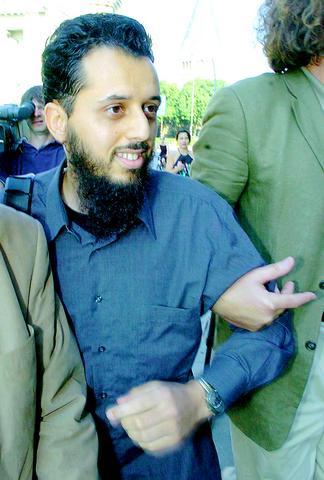
PHOTO: EPA
That decision was a setback to the German government. As he opened the retrial, presiding Judge Ernst-Rainer Schudt stressed that the Hamburg state court wouldn't be swayed by any pressure.
"For me, this is not about fulfilling the expectations of governments or the public," he said.
El Motassadeq, who denies the charges, was released from prison in April when the Hamburg court decided there was no longer sufficient suspicion that he was guilty of more than 3,000 counts of accessory to murder to hold him pending retrial.
His convictions on those charges and for membership in a terrorist group were overturned by the appeals court, making the quest for testimony from the witnesses -- Ramzi Binalshibh and Khalid Shaikh Mohammed -- critical to Germany's second attempt to convict him.
Binalshibh, a Yemeni, is believed to have been the Hamburg cell's key contact with Osama bin Laden's al-Qaeda organization. Mohammed is thought to be the mastermind of the Sept. 11 attacks.
El Motassadeq smiled but said nothing as he entered the court yesterday.
His lawyer said before the retrial opened that he would maintain his client's innocence when the retrial opens, then ask the court to drop the proceedings on the grounds that past experience shows el Motassadeq will not get a fair trial.
Lawyer Josef Graessle-Muenscher, said he would argue that torture "underlies the interrogation system of the United States," making any evidence from Binalshibh or Mohammed inadmissible even if it is provided.
He cited reports from prisoners released from US military detention at Guantanamo Bay, Cuba, and the policy of holding Taliban and al-Qaeda suspects without giving them the usual rights of prisoners of war set out in the Geneva Conventions.
The US Department of Justice refused to allow even transcripts of the two men's interrogations to be admitted as evidence in el Motassadeq's trial.
Lack of their testimony also played a large role in the February acquittal in the same court of el Motassadeq's friend and fellow Moroccan Abdelghani Mzoudi, who faced identical charges.
But now, German prosecutors say they are confident they will be receive more information from the US for the retrial.
"We have made it clear to the United States that we depend on being able to hear Ramzi Binalshibh and Khalid Shaikh Mohammed as witnesses," chief federal prosecutor Kay Nehm was quoted as saying in this week's Focus magazine.
El Motassadeq is accused of helping pay tuition and other bills for members of the Hamburg al-Qaeda cell, which included suicide hijackers Mohamed Atta, Marwan al-Shehhi, and Ziad Jarrah, to allow them to live as students as they plotted the attacks.
He admitted to training in bin Laden's camps in Afghanistan, and witnesses at his trial testified that he was as radical as the rest of the group, often talking of jihad -- holy war -- and his hatred of Israel and the US.
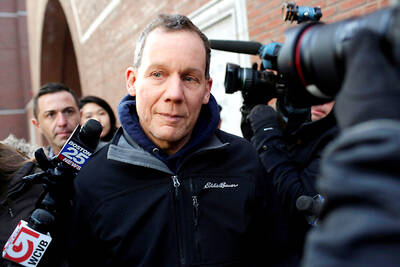
An American scientist convicted of lying to US authorities about payments from China while he was at Harvard University has rebuilt his research lab in Shenzhen, China, to pursue technology the Chinese government has identified as a national priority: embedding electronics into the human brain. Charles Lieber, 67, is among the world’s leading researchers in brain-computer interfaces. The technology has shown promise in treating conditions such as amyotrophic lateral sclerosis and restoring movement in paralyzed people. It also has potential military applications: Scientists at the Chinese People’s Liberation Army have investigated brain interfaces as a way to engineer super soldiers by boosting
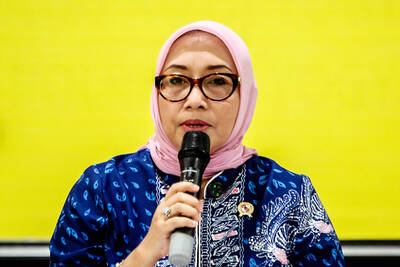
Indonesian police have arrested 13 people after shocking images of alleged abuse against small children at a daycare center went viral, sparking outrage across the nation, officials said on Monday. Police on Friday last week raided Little Aresha, a daycare center in Yogyakarta on Java island, following a report from a former employee. CCTV footage circulating on social media showed children, most younger than two, lying on the floor wearing only diapers, their hands and feet bound with rags. The police have confirmed that the footage is authentic. Police said they also found 20 children crammed into a room just 3m by 3m. “So
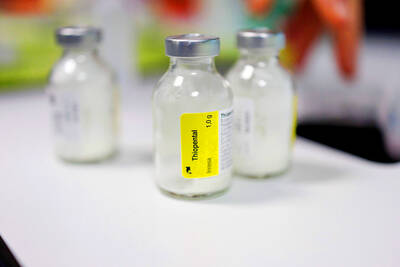
A grieving mother has ended her life at a clinic in Switzerland four years after the death of her only child. Wendy Duffy, 56, a physically healthy woman, died at the Pegasos clinic in Basel after struggling to cope with the death of her 23-year-old son, Marcus. The former care worker, from the West Midlands, England, had previously attempted to take her own life. The case comes as assisted dying would not become law in England and Wales after proposed legislation, branded “hopelessly flawed” by opponents, ran out of time. Ruedi Habegger, the founder of Pegasos, described Duffy’s death as

From post offices and parks to stations and even the summit of Mount Fuji, Japan’s vending machines are ubiquitous, but with the rapid pace of inflation cooling demand for their drinks, operators are being forced to rethink the business. Last month beverage giant DyDo Group Holdings announced it would remove about 20,000 vending machines — about 7 percent of their stock nationwide — by January next year, to “reconstruct a profitable network.” Pokka Sapporo Food & Beverage, based in Nagoya, also said last month it would sell its 40,000-machine operation to Osaka-based Lifedrink Co. “The strength of the vending machine


 RSS
RSS