


A recently declassified US intelligence report from 1991 says that Colombian President Alvaro Uribe, now a staunch ally in Washington's war against drug trafficking, was at that time a close associate of Colombia's most powerful drug lord and an ardent ally of the cocaine traffickers then engulfing this country.
A spokesman for Uribe denounced the findings in the Defense Intelligence Agency's 13-year-old report on Colombia's biggest drug traffickers as "the same information" presented in a smear campaign by political opponents in the 2002 presidential election. And senior US intelligence officials and diplomats cautioned that such reports might not be accurate. However, the statement issued by the presidential spokesman did not directly address the report's most damaging assertion: That Uribe was linked to the top drug kingpin of the era, Pablo Escobar.
The report, dated Sept. 23, 1991, and obtained through the Freedom of Information Act by the National Security Archives, a private, nonpartisan research group based in Washington, says that Uribe, then a senator from the northern state of Antioquia, was "dedicated to collaboration with the Medellin cartel at high government levels."
The report, which the archives made public yesterday, called Uribe a "close personal friend" of the cartel's leader, Escobar, and says Uribe took part in the drug lord's successful efforts to secure a seat as an auxiliary congressman. It said Uribe was linked to an unidentified business involved in narcotics activities in the US, that as a senator he opposed extraditing traffickers to the US and that his father, Alberto Uribe, was killed because of his drug ties.
In response to inquiries by The New York Times, Ricardo Galan, a spokesman for Alvaro Uribe, issued an eight-point response on Friday that said the Defense Intelligence Agency report had been of a preliminary nature. The statement said that in 1991 Uribe was studying at Harvard and that he had never had business dealings in the US.
The statement also said Uribe's father had been killed while trying to resist Marxist rebels who aimed to kidnap him. It affirmed Uribe's commitment to extradition, though only loosely explained Uribe's opposition as a senator to a proposed referendum on extradition. It did not address the report's allegation that Uribe participated in the campaign that took Escobar to Congress.
Robert Zimmerman, a State Department spokesman, was more emphatic in denying the report's findings. "We completely disavow these allegations about President Uribe," he said, adding, "We have no credible information that substantiates or corroborates the allegations in an unevaluated 1991 report."
Still, the report is sure to raise new questions about allegations made in 2001 and 2002, when Uribe was campaigning for the presidency, about possible ties to drug dealers, including the powerful Ochoa clan in Medellin, Colombia's drug-trafficking center. Solid evidence was never presented, though, and Uribe won in a landslide based on his pledge that he would fight Marxist rebels and drug traffickers.
The US has strongly supported Uribe since then, and he is considered among the Bush administration's closest allies in its effort to curb drug trafficking.
During his two years in office, much of Colombia's vast drug fields have been eradicated in Washington-financed fumigation efforts. About 150 Colombians accused of drug trafficking have been extradited to the US, more than double the number extradited by Uribe's predecessor during his four-year term.

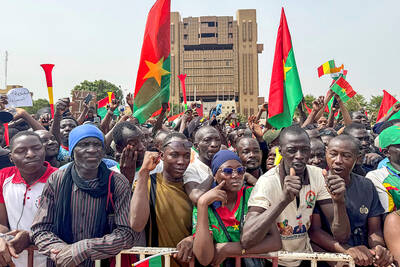
Kehinde Sanni spends his days smoothing out dents and repainting scratched bumpers in a modest autobody shop in Lagos. He has never left Nigeria, yet he speaks glowingly of Burkina Faso military leader Ibrahim Traore. “Nigeria needs someone like Ibrahim Traore of Burkina Faso. He is doing well for his country,” Sanni said. His admiration is shaped by a steady stream of viral videos, memes and social media posts — many misleading or outright false — portraying Traore as a fearless reformer who defied Western powers and reclaimed his country’s dignity. The Burkinabe strongman swept into power following a coup in September 2022
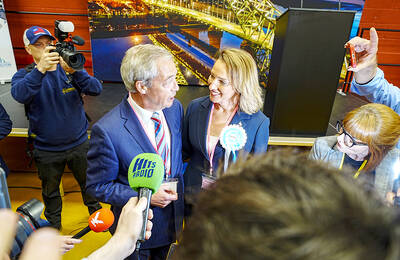
‘FRAGMENTING’: British politics have for a long time been dominated by the Labor Party and the Tories, but polls suggest that Reform now poses a significant challenge Hard-right upstarts Reform UK snatched a parliamentary seat from British Prime Minister Keir Starmer’s Labor Party yesterday in local elections that dealt a blow to the UK’s two establishment parties. Reform, led by anti-immigrant firebrand Nigel Farage, won the by-election in Runcorn and Helsby in northwest England by just six votes, as it picked up gains in other localities, including one mayoralty. The group’s strong showing continues momentum it built up at last year’s general election and appears to confirm a trend that the UK is entering an era of multi-party politics. “For the movement, for the party it’s a very, very big

ENTERTAINMENT: Rio officials have a history of organizing massive concerts on Copacabana Beach, with Madonna’s show drawing about 1.6 million fans last year Lady Gaga on Saturday night gave a free concert in front of 2 million fans who poured onto Copacabana Beach in Rio de Janeiro for the biggest show of her career. “Tonight, we’re making history... Thank you for making history with me,” Lady Gaga told a screaming crowd. The Mother Monster, as she is known, started the show at about 10:10pm local time with her 2011 song Bloody Mary. Cries of joy rose from the tightly packed fans who sang and danced shoulder-to-shoulder on the vast stretch of sand. Concert organizers said 2.1 million people attended the show. Lady Gaga
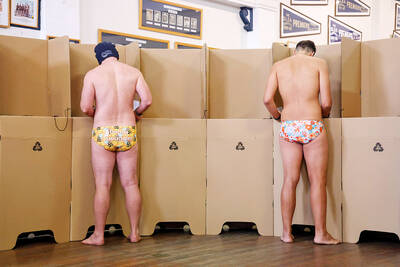
SUPPORT: The Australian prime minister promised to back Kyiv against Russia’s invasion, saying: ‘That’s my government’s position. It was yesterday. It still is’ Left-leaning Australian Prime Minister Anthony Albanese yesterday basked in his landslide election win, promising a “disciplined, orderly” government to confront cost-of-living pain and tariff turmoil. People clapped as the 62-year-old and his fiancee, Jodie Haydon, who visited his old inner Sydney haunt, Cafe Italia, surrounded by a crowd of jostling photographers and journalists. Albanese’s Labor Party is on course to win at least 83 seats in the 150-member parliament, partial results showed. Opposition leader Peter Dutton’s conservative Liberal-National coalition had just 38 seats, and other parties 12. Another 17 seats were still in doubt. “We will be a disciplined, orderly


 RSS
RSS