


Hundreds of people blocked traffic in northern India on yesterday in protest against the government's failure to win the release of three men held hostage in Iraq, as a deadline set by the kidnappers drew near.
Villagers squatted on a state highway leading to the home of Antaryami, one of seven foreign truck drivers being held by militants, who threatened to kill one of them by 7pm yesterday.
His captors released a videotape showing a masked man pointing an automatic rifle at Antaryami, who looked frightened and was sweating.
"If something happens to him, we will burn government offices and the government will be responsible," said his sister Harjinder Kaur in Una in the northern state of Himachal Pradesh.
Groups of protestors sat on railway tracks, disrupting train services.
The kidnappers have demanded that the Kuwaiti transport company the seven men worked for should stop doing business in Iraq or they will behead the men one by one.
Three Kenyans and an Egyptian, employed along with the Indians, are among the hostages of an Iraqi group that calls itself the "Black Flags." It has not said who they would kill first.
Antaryami's father urged the kidnappers to free his son, saying they were poor people.
"I fold my hands and ask you to release my son, your demands have to do with the government and not with poor people like us," Ram Murthi said.
India has no troops in Iraq, but hundreds of poor Indians have gone there to work -- many as support staff, including chefs, kitchen assistants, accountants and bus drivers for the US military.
The Indian government voiced its deep anxiety about the three and stressed none would return if freed, the foreign ministry said after guerrillas threatened to kill on yesterday one of seven men they were holding.
"We are are deeply disturbed by this development and share the sentiment of concern and anxiety of the family members," Junior Foreign Minister Edappakath Ahamed said in a statement.
Ahamed urged the guerrillas to set the Indians free, saying they were poor men who had gone to Kuwait to find jobs and were not working for forces in Iraq.
The government's latest expression of anxiety came a day Pakistan confirmed that two of its nationals, employed by an Arab firm doing contract work for a US company in Iraq, were executed by their kidnappers.

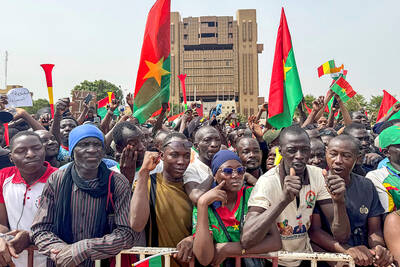
Kehinde Sanni spends his days smoothing out dents and repainting scratched bumpers in a modest autobody shop in Lagos. He has never left Nigeria, yet he speaks glowingly of Burkina Faso military leader Ibrahim Traore. “Nigeria needs someone like Ibrahim Traore of Burkina Faso. He is doing well for his country,” Sanni said. His admiration is shaped by a steady stream of viral videos, memes and social media posts — many misleading or outright false — portraying Traore as a fearless reformer who defied Western powers and reclaimed his country’s dignity. The Burkinabe strongman swept into power following a coup in September 2022
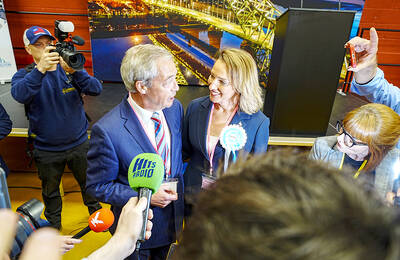
‘FRAGMENTING’: British politics have for a long time been dominated by the Labor Party and the Tories, but polls suggest that Reform now poses a significant challenge Hard-right upstarts Reform UK snatched a parliamentary seat from British Prime Minister Keir Starmer’s Labor Party yesterday in local elections that dealt a blow to the UK’s two establishment parties. Reform, led by anti-immigrant firebrand Nigel Farage, won the by-election in Runcorn and Helsby in northwest England by just six votes, as it picked up gains in other localities, including one mayoralty. The group’s strong showing continues momentum it built up at last year’s general election and appears to confirm a trend that the UK is entering an era of multi-party politics. “For the movement, for the party it’s a very, very big
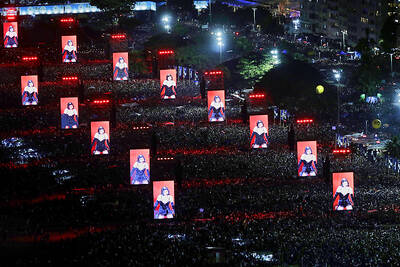
ENTERTAINMENT: Rio officials have a history of organizing massive concerts on Copacabana Beach, with Madonna’s show drawing about 1.6 million fans last year Lady Gaga on Saturday night gave a free concert in front of 2 million fans who poured onto Copacabana Beach in Rio de Janeiro for the biggest show of her career. “Tonight, we’re making history... Thank you for making history with me,” Lady Gaga told a screaming crowd. The Mother Monster, as she is known, started the show at about 10:10pm local time with her 2011 song Bloody Mary. Cries of joy rose from the tightly packed fans who sang and danced shoulder-to-shoulder on the vast stretch of sand. Concert organizers said 2.1 million people attended the show. Lady Gaga
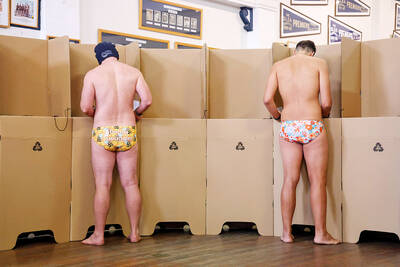
SUPPORT: The Australian prime minister promised to back Kyiv against Russia’s invasion, saying: ‘That’s my government’s position. It was yesterday. It still is’ Left-leaning Australian Prime Minister Anthony Albanese yesterday basked in his landslide election win, promising a “disciplined, orderly” government to confront cost-of-living pain and tariff turmoil. People clapped as the 62-year-old and his fiancee, Jodie Haydon, who visited his old inner Sydney haunt, Cafe Italia, surrounded by a crowd of jostling photographers and journalists. Albanese’s Labor Party is on course to win at least 83 seats in the 150-member parliament, partial results showed. Opposition leader Peter Dutton’s conservative Liberal-National coalition had just 38 seats, and other parties 12. Another 17 seats were still in doubt. “We will be a disciplined, orderly


 RSS
RSS