


Peruvian President Alejandro Toledo on Sunday brought in seven independent figures in a Cabinet reshuffle aimed at restoring his credibility and avoiding early elections.
But opposition politicians and analysts said the changes alone would not save Toledo, who has a public approval rating of 7 percent after two and one-half years in power.
"I don't believe this will calm the political crisis," novelist and former presidential candidate Mario Vargas Llosa told America Television. "Toledo is weak and lacks leadership."
Toledo brought back Pedro Pablo Kuczynski as his economy and finance minister after intense talks with political parties and business groups to form a "consensus Cabinet."
The new team was to be sworn in yesterday.
Its task will be to end the turmoil that has rocked the government after corruption scandals cost four ministers and the vice president their jobs since November.
"What we hope is that it gives a sufficient margin of support to stabilize the government to see it last until 2006," political analyst Eduardo Toche said.
Many ordinary Peruvians say Toledo has failed to turn strong economic growth into jobs and prosperity. They want early elections before the president's term ends in 2006.
Some political parties and commentators have called for Toledo to stay in his post but hand real power to Prime Minister Carlos Ferrero.
"Nothing will change with this make-over," said lawmaker Cesar Zumaeta, a member of the largest opposition party, the American Popular Revolutionary Alliance.
"The situation is going to get more complicated because in the next few weeks there will be very strong social demonstrations. There's an agricultural strike, a transport strike, a coca growers' [meeting], and Toledo will be to blame for failing to change his attitude," he said.
Toledo's Peru Posible party said opposition parties had jumped to criticize the Cabinet even before it had been sworn in.
Toledo's credibility took a blow last month when an audiotape revealed a friend and former adviser discussing bribing judges with a key member of the corruption network spawned by the government of disgraced former president Alberto Fujimori.
Announcing the ministerial changes, Ferrero said Kuczynski, a fund manager widely respected on Wall Street, had been tapped to return to the post he held in Toledo's first Cabinet between July 2001 and July 2002.
Kuczynski took over from another independent figure, Jaime Quijandria.
The president moved him back to his previous job as energy and mines minister. Mining is the motor behind the Andean nation's US$60 billion economy.
Toledo also brought in new ministers of justice, education, health, employment, production and transport.
Seven ministers remain in their posts, including the foreign, interior and defense ministers.
Ferrero told a news conference that only the ministers of housing and agriculture belonged to a political party.
"The number of independents is higher than ever ... We have been very careful that none has any links with political groups," Ferrero told reporters.
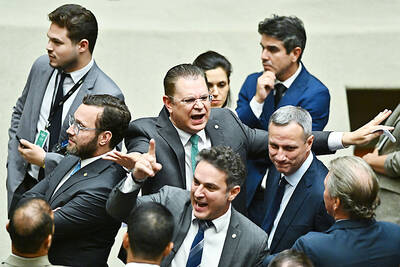
PARLIAMENT CHAOS: Police forcibly removed Brazilian Deputy Glauber Braga after he called the legislation part of a ‘coup offensive’ and occupied the speaker’s chair Brazil’s lower house of Congress early yesterday approved a bill that could slash former Brazilian president Jair Bolsonaro’s prison sentence for plotting a coup, after efforts by a lawmaker to disrupt the proceedings sparked chaos in parliament. Bolsonaro has been serving a 27-year term since last month after his conviction for a scheme to stop Brazilian President Luiz Inacio Lula da Silva from taking office after the 2022 election. Lawmakers had been discussing a bill that would significantly reduce sentences for several crimes, including attempting a coup d’etat — opening up the prospect that Bolsonaro, 70, could have his sentence cut to
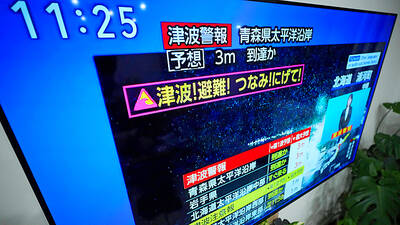
A powerful magnitude 7.6 earthquake shook Japan’s northeast region late on Monday, prompting tsunami warnings and orders for residents to evacuate. A tsunami as high as three metres (10 feet) could hit Japan’s northeastern coast after an earthquake with an estimated magnitude of 7.6 occurred offshore at 11:15 p.m. (1415 GMT), the Japan Meteorological Agency (JMA) said. Tsunami warnings were issued for the prefectures of Hokkaido, Aomori and Iwate, and a tsunami of 40cm had been observed at Aomori’s Mutsu Ogawara and Hokkaido’s Urakawa ports before midnight, JMA said. The epicentre of the quake was 80 km (50 miles) off the coast of
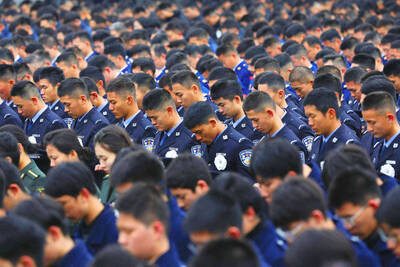
China yesterday held a low-key memorial ceremony for the 1937 Nanjing Massacre, with Chinese President Xi Jinping (習近平) not attending, despite a diplomatic crisis between Beijing and Tokyo over Taiwan. Beijing has raged at Tokyo since Japanese Prime Minister Sanae Takaichi last month said that a hypothetical Chinese attack on Taiwan could trigger a military response from Japan. China and Japan have long sparred over their painful history. China consistently reminds its people of the 1937 Nanjing Massacre, in which it says Japanese troops killed 300,000 people in what was then its capital. A post-World War II Allied tribunal put the death toll
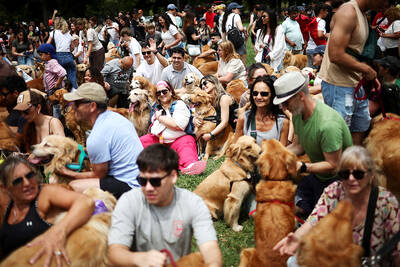
A passerby could hear the cacophony from miles away in the Argentine capital, the unmistakable sound of 2,397 dogs barking — and breaking the unofficial world record for the largest-ever gathering of golden retrievers. Excitement pulsed through Bosques de Palermo, a sprawling park in Buenos Aires, as golden retriever-owners from all over Argentina transformed the park’s grassy expanse into a sea of bright yellow fur. Dog owners of all ages, their clothes covered in dog hair and stained with slobber, plopped down on picnic blankets with their beloved goldens to take in the surreal sight of so many other, exceptionally similar-looking ones.


 RSS
RSS