


Jun Yong-il, a South Korean soldier who returned home this week after being held in North Korea for 50 years, still had a big brother's swagger when finally reunited with his sister yesterday.
"My little sister, come here! I will hug you and carry you on my back as I used to. I am not as weak as I look," 72-year-old Jun said as his sister, Boon-yi, buried her tearful face in his chest.
The sister -- a toddler when Jun last saw her before joining the South Korean military during the 1950-53 Korean War -- is now a graying 57-year-old woman.
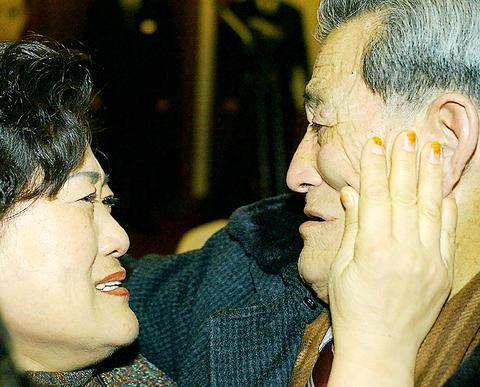
PHOTO: AP
"I am sorry that I was away so long and did not do my duty as brother," Jun said, holding her face with his weathered hands.
Jun reportedly fled North Korea in June by swimming across the river-border with China. He and an unidentified female companion were arrested in the eastern Chinese city of Hangzhou in November while trying to board a flight to South Korea with forged passports. Until his arrest in China, the South Korean government had counted him off as killed in action for half a century.
After lengthy diplomatic negotiations, China allowed the couple to fly to South Korea on Christmas Eve. South Korean President Roh Moo-hyun hailed it "a precious Christmas present."
Jun is the latest of more than 30 South Korean prisoners of war who have managed to escape the North since 1994, as the communist country relaxed control over the movements of its hunger-stricken populace.
The aging POW's return galvanizes South Korea's resolve to pursue the fate of at least 300 others still believed to be held in the North.
Details of Jun's life in North Korea were not yet known. He is going through a two-month debriefing by South Korean authorities. Upon landing in South Korea on Wednesday, the gray-haired man proudly said he had never forgotten he was a South Korean soldier.
Yesterday, wearing a black felt hat and striped silk tie, Jun strode into a Defense Ministry room where officials arranged a brief reunion with his two sisters, brother and a nephew.
"Until she died, mother so often talked about you," said his 78-year-old sister Yong-mok.
Not immediately recognizing the sister after 50 years, Jun asked, "Who are you?"
He later said, "Sister, I am sorry. But you should know that God helped me remain healthy enough to live this long so that I could see you again."
The 65-year-old brother, Soo-il, kneeled down on the floor and made a deep bow to his brother.
Jun joined the South Korean army in 1951 and was captured by Chinese troops who fought alongside North Korean forces in the Korean War.
Fighting stopped in 1953 but the North and South are still technically at war after the conflict ended in an armistice, not a peace treaty.
Efforts to bring the forgotten soldiers home have made little progress, as Pyongyang denies holding any POWs.
Jun, who was a private first class when captured, is expected to be promoted to staff sergeant before being formally discharged from the military. He could get up to US$334,000 in unpaid salary and other compensation.
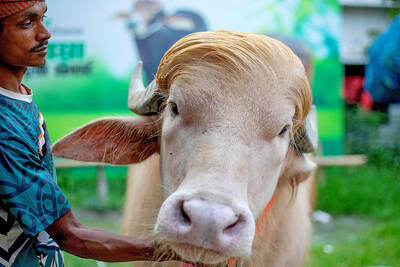
Crowds in Bangladesh are flocking to snap photographs with an unlikely social media star — an albino buffalo with flowing blond hair nicknamed “Donald Trump” that is due to be sacrificed within days. Owner Zia Uddin Mridha, 38, said his brother named the 700kg bull over its flowing helmet of hair resembling the signature look of the US president. “My younger brother picked this name because of the buffalo’s extraordinary hair,” he said at his farm in Narayanganj, just outside the capital, Dhaka. Mridha said that a constant stream of curious visitors — social media fans, onlookers and children — have come throughout

It began as a satirical online project. Now millions of young people in India are flocking to it as an outlet for their frustration. A parody political party called the Cockroach Janta Party, with the insect as its symbol, has exploded across India’s social media by turning absurdist humor into protest. Memes and short videos mocking corruption, joblessness and political dysfunction have flooded social media sites, where millions of users are embracing the cockroach — known for its ability to survive harsh conditions — as a tongue-in-cheek symbol of endurance. The online movement’s rise has been unusually rapid. The Cockroach Janta Party (CJP)

HOTTER: While Indians are accustomed to summer heat, climate change has caused northwestern India to warm faster than other parts of the country, an academic said Roads and markets have emptied during afternoons and some farmers have switched to nighttime work to avoid scorching temperatures as a heat wave grips large parts of India. The India Meteorological Department forecast maximum temperatures for yesterday of about 45°C in the capital, New Delhi, where authorities have opened temporary “cooling zones” to help people cope. The weather department warned that conditions would likely persist across several northern regions in the coming days, with temperatures staying well above seasonal averages. Authorities urged people to stay indoors during the hottest hours and take precautions against heat-related illnesses. India declares a heat wave whenever maximum temperatures

A Hong Kong astronaut is to join a Chinese space mission for the first time as part of a three-person crew launching today, as Beijing edges closer to its goal of landing people on the moon. The Tiangong space station — crewed by teams of three astronauts that are typically rotated every six months — is the crown jewel of China’s space program, boosted by billions in state investment in a bid to catch up with the US and Russia. The Shenzhou-23 mission is to blast off at 11:08pm from the Jiuquan Satellite Launch Center in northwestern China, carrying three astronauts to


 RSS
RSS