


Persuaded by the US, Pacific Rim leaders are ready to step up their fight against terrorism, but they acknowledge the sobering reality that al-Qaeda-linked extremist groups seem to be recovering quickly from a spate of recent crackdowns and are plotting a new series of attacks.
Underscoring these fears, terror is challenging free trade as the main topic at the annual meeting of the 21-member Asia-Pacific Economic Cooperation grouping in Bangkok.
The choice of venue is dramatically apt as Southeast Asia is at particular risk. Jemaah Islamiyah, a terror group seeking a pan-Islamic state across the region, killed 202 people when it bombed a Bali nightclub district in Indonesia a year ago and is blamed for a string of deadly attacks elsewhere.
Security for the summit, which formally starts today, is tight. Thai fighter jets escorted arriving VIPs planes bringing in leaders from 21 member economies and countries. Helicopters shadowed motorcades through the city's unusually empty streets.
We are confident "that we can provide enough security for them," said Air Chief Marshall Kongsak Wantana, who commands Thailand's airforce.
At the meeting, leaders are expected to make a promise to "dismantle" terror groups, according to draft communique obtained by reporters.
US President George W. Bush, who is pushing hard for support for his war on terror, also wants APEC leaders to discuss how to head off what could be more catastrophic danger in the years ahead: North Korea's ambitions to amass nuclear weapons.
Yesterday, Bush accorded the status of non-NATO ally to Thailand, upgrading US military ties with a country that has given crucial help in counter-terrorism. During a visit to the Philippines just before arriving in Bangkok, Bush promised help to modernize the army there to fight terrorists.
And on Saturday, the US announced a US$5.4 million project to station US officials in the Philippines to work with the Asian Development Bank on improving security at airports, ports and container handling facilities.
That came after APEC members agreed to a US request to strictly control the production and sale of portable missiles that can shoot down civilian jetliners.
In presummit meetings, senior officials of APEC countries acknowledged that terrorism severely damages economic growth. But some APEC members have been reluctant to focus so much on security at a trade forum. That includes China, but a US official said "we overcame" that reluctance.
Authorities have cracked the ring responsible for the Bali bombing and in August arrested Hambali, Jamaah Islamiyah's operations chief and Osama bin Laden's alleged point man in Asia.
But the organization was able to regroup within three weeks of Hambali's arrest, a senior Indonesian intelligence adviser told reporters this week.
The adviser said the group is in the middle of a recruitment drive and has appointed 48 people to carry out new attacks between December and April on international hotels and other Western targets in Asia. The adviser and other Asian officials said the three new top Jamaah Islamiyah leaders are believed to have played key roles in the Aug. 5 bombing of Jakarta's J.W. Marriott hotel that killed 12 people.
The three -- two Indonesian and one Malaysian -- include a new operations chief to replace Hambali and top bombmakers, they said.

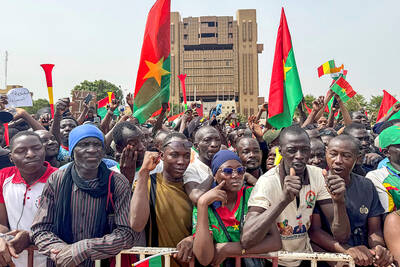
Kehinde Sanni spends his days smoothing out dents and repainting scratched bumpers in a modest autobody shop in Lagos. He has never left Nigeria, yet he speaks glowingly of Burkina Faso military leader Ibrahim Traore. “Nigeria needs someone like Ibrahim Traore of Burkina Faso. He is doing well for his country,” Sanni said. His admiration is shaped by a steady stream of viral videos, memes and social media posts — many misleading or outright false — portraying Traore as a fearless reformer who defied Western powers and reclaimed his country’s dignity. The Burkinabe strongman swept into power following a coup in September 2022
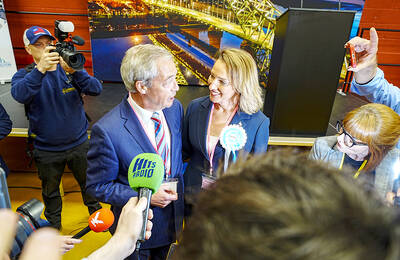
‘FRAGMENTING’: British politics have for a long time been dominated by the Labor Party and the Tories, but polls suggest that Reform now poses a significant challenge Hard-right upstarts Reform UK snatched a parliamentary seat from British Prime Minister Keir Starmer’s Labor Party yesterday in local elections that dealt a blow to the UK’s two establishment parties. Reform, led by anti-immigrant firebrand Nigel Farage, won the by-election in Runcorn and Helsby in northwest England by just six votes, as it picked up gains in other localities, including one mayoralty. The group’s strong showing continues momentum it built up at last year’s general election and appears to confirm a trend that the UK is entering an era of multi-party politics. “For the movement, for the party it’s a very, very big
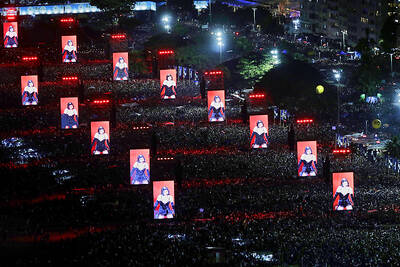
ENTERTAINMENT: Rio officials have a history of organizing massive concerts on Copacabana Beach, with Madonna’s show drawing about 1.6 million fans last year Lady Gaga on Saturday night gave a free concert in front of 2 million fans who poured onto Copacabana Beach in Rio de Janeiro for the biggest show of her career. “Tonight, we’re making history... Thank you for making history with me,” Lady Gaga told a screaming crowd. The Mother Monster, as she is known, started the show at about 10:10pm local time with her 2011 song Bloody Mary. Cries of joy rose from the tightly packed fans who sang and danced shoulder-to-shoulder on the vast stretch of sand. Concert organizers said 2.1 million people attended the show. Lady Gaga
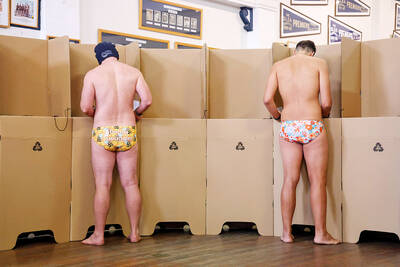
SUPPORT: The Australian prime minister promised to back Kyiv against Russia’s invasion, saying: ‘That’s my government’s position. It was yesterday. It still is’ Left-leaning Australian Prime Minister Anthony Albanese yesterday basked in his landslide election win, promising a “disciplined, orderly” government to confront cost-of-living pain and tariff turmoil. People clapped as the 62-year-old and his fiancee, Jodie Haydon, who visited his old inner Sydney haunt, Cafe Italia, surrounded by a crowd of jostling photographers and journalists. Albanese’s Labor Party is on course to win at least 83 seats in the 150-member parliament, partial results showed. Opposition leader Peter Dutton’s conservative Liberal-National coalition had just 38 seats, and other parties 12. Another 17 seats were still in doubt. “We will be a disciplined, orderly


 RSS
RSS