


The Sanyang Industry Co (
Huang, also chairman of the ChinFon Group (
"There has long existed a stereotype about Korean vehicles among Taiwanese consumers -- that Korean cars are cheap and made poorly," said Sanyang Spokesman Yeh Fong-ming (葉峰明), citing unpleasant experiences with many Taiwanese consumers over the past decade.
"In the past some local sales agents for Korean brandnames did not offer appropriate after-sale services, with some even shutting down their businesses unexpectedly," Yeh said.
Sanyang is expected to sell as many as 16,000 cars this year, down about 5.9 percent from last year, according to Yeh.
"We still have an inventory of about 8,000 Honda vehicles that we must sell this year. And we also target sales of some 8,000 Hyundai cars this year," Yeh said.
Under the new pact with Hyundai, Sanyang will start to market and manufacture the Korean cars in Taiwan in the second half of the year, according to president Huang Kuang-wu (黃光武).
"We will initially introduce Hyundai's recreational Matrix and sporty Coupe [models] into the country," Huang said. "Then we will begin to manufacture Hyundai Elantra models -- both 1,600cc and 1,800cc sedans -- in September."
The Sanyang president declined to spell out the company's strategy for revamping the image of Korean vehicles, saying only that the company will "do its best" and "spend a lot money" to achieve that goal.
But he said the partnership with Hyundai is the company's best strategy for the Taiwan market.
"Together with Hyundai, which is the world's seventh largest automaker with an annual output of 2.6 million vehicles last year, I believe Sanyang will become one of the top-5 automobile companies in Taiwan next year and one of the top three in the domestic sedan market within the next three years," Huang said.
In fact, the ChinFon Group has been collaborating with Hyundai since November 1999 when Chin Chun Motor Co (
Over the last three years, Chin Chun has sold Hyundai's Atos-Prime, Santa Fe and Trajet models here, but will focus exclusively on Hyundai's XG line of luxury cars in the future, Huang said. "Sanyang will lead Chin Fon's auto business unit in the future," he added.
As for overhauling the local reputation of Korean-made cars, rival carmaker Formosa Automobile Corp (
Also troubled by its ties to Korea, Formosa rolled out its first automobile -- the Magnus -- at the end of 2000 through a technology pact with Korea's Daewoo Motor Co. Thus far Formosa has sold about 5,000 Magnus 2,000cc sedans in Taiwan.
"We had initially encountered consumer resistance while trying to market our cars," Tseng recalled.
But the company gradually made a turn-around last year by emphasizing its vehicles were a combination of local and European quality standard parts, Tseng said.
Formosa has fared well in selling its 1,300cc Matiz models since unveiling the new lineup in January this year.
"For the first four months we have sold 2,100 Matiz cars, with Nissan's March our biggest competitor in the market," Tseng said.
The company targets sales of 8,000 Matiz this year, he added.

RESILIENCE: Taiwan plays a key role in semiconductors, energy, information infrastructure and advanced manufacturing, AIT Director Raymond Greene said Taiwan’s continued investment in deterrence and resilience remains vital, especially in uncrewed systems and other emerging technologies, American Institute in Taiwan (AIT) Director Raymond Greene said yesterday. Greene made the remarks at the annual National Strategic Summit on Supply Chain Resilience held by the Research Institute for Democracy, Society and Emerging Technology (DSET), a government-backed think tank. As Taiwan last year became the US’ fourth-largest trading partner and supply chain security is becoming more important, cooperation in emerging technologies continues to deepen between the two countries, he said. The US is committed to accelerating innovation, building key infrastructure, strengthening cooperation

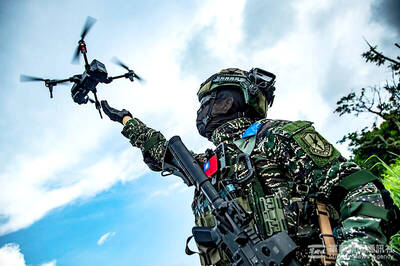
The National Chungshan Institute of Science and Technology yesterday showcased its locally developed variants of the Vision 60 robotic patrol dog, which it plans to deploy on the nation’s outlying territories in the South China Sea. The variants were produced under the Joint Lab project — created by the institute and domestic companies — and assembled with domestically produced motors, lenses and artificial intelligence (AI) systems alongside licensed tech from the US, Missile and Rocket Systems Research Division deputy director Jen Kuo-kang (任國光) told the media event at a military base in Taipei’s Dazhi (大直) area. Taiwan has built up its strengths

RIGHT DIRECTION: Taiwan’s efforts to prevent forced labor include a proposal to ‘fully prohibit’ employers from withholding workers’ documents, an official said Taiwan is to establish a mechanism to restrict imports of goods linked to forced labor, the Executive Yuan said yesterday, after the US proposed imposing additional tariffs on Taiwanese goods over labor concerns. “The Ministry of Labor and the Ministry of Economic Affairs are to establish an interministerial review procedure,” Executive Yuan spokesperson Michelle Lee (李慧芝) said at a news briefing in Taipei. “The government is to use the Foreign Trade Act [貿易法] as the legal basis to restrict imports of goods produced with forced labor” and bring its supply chain governance more in line with international standards on human rights, resilience

NOT IMMEDIATE: Taiwan has a chance to appeal the proposed 10 percent tariff before it starts, while other countries face a 12.5 percent tariff from the trade office Taiwan is among 60 economies determined by the US to have failed to impose or enforce a ban on the importation of goods produced with forced labor, according to a notice released on Tuesday by the Office of the US Trade Representative (USTR), which proposed imposing an additional 10 percent or more tariff on them. The USTR in a statement said that following an investigation, it had determined under Section 301 of the Trade Act of 1974 that the failure of the 60 economies to impose and effectively enforce a prohibition on the importation of goods produced with forced labor is


 RSS
RSS