

Taiwan is working toward independently launching domestically manufactured satellites, President William Lai (賴清德) said yesterday, highlighting increased government investment in space technology.
Speaking at the opening of the Taiwan International Assembly of Space Science, Technology and Industry in Tainan, Lai said the government was supporting domestic satellite and rocket development while building the “necessary testing and launch facilities.”
The government has approved a facility for rocket research, development, assembly and testing in Tainan’s Shalun (沙崙), and selected Pingtung County’s Jioupeng (九鵬) as the site of a national rocket launch facility, Lai said.
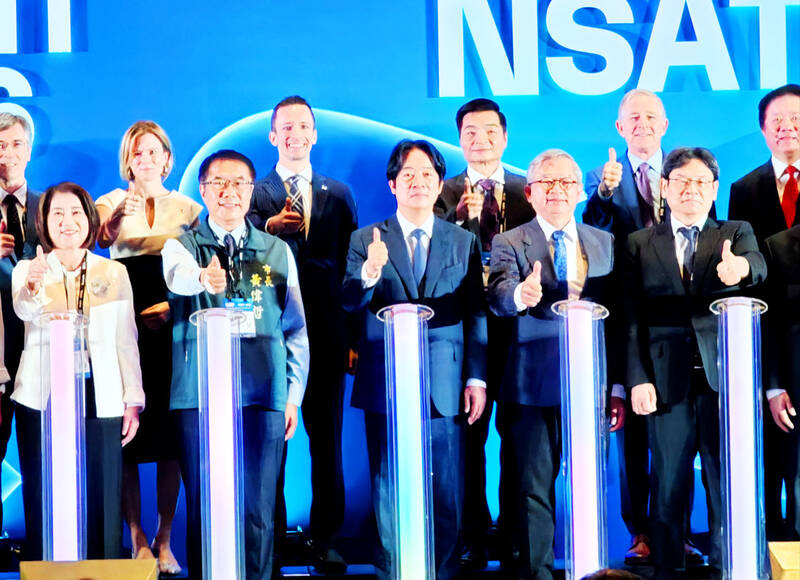
Photo: Wu Chun-feng, Taipei Times
According to a timetable previously announced by the Taiwan Space Agency (TASA), the Shalun base is expected to begin operations in 2030, while the Jioupeng launch facility is expected to become operational in 2032.
“As these facilities are completed, we will make progress toward launching satellites independently,” Lai said.
Taiwan currently relies on foreign launch service providers, such as SpaceX, to send its satellites into orbit. A launch site in Pingtung County’s Syuhai (旭海) is used to launch sounding rockets for scientific research and technology testing rather than orbital satellite launches.
The government has also increased funding for the third phase of its National Space Technology Long- term Development Program to NT$71 billion (US$2.16 billion) and extended its implementation through 2031, Lai said.
The revision, approved by the Executive Yuan in October last year, increased the original 10-year program’s budget from NT$25.1 billion and extended its end date from 2028 to 2031.
“Investing in space is investing in our shared future,” Lai said.
Satellite data can help monitor environmental changes and support disaster relief efforts, while satellite communications can maintain essential connectivity when ground-based networks were damaged, he said.
National Science and Technology Council Minister Wu Cheng-wen (吳誠文) said Taiwan would participate in NASA’s efforts to return astronauts to the moon, although he did not specify the nature of its involvement.
The US-led Artemis program, officially named in 2019, aims to return astronauts to the moon by 2028, establish a long-term lunar base by 2030 and lay the groundwork for future crewed missions to Mars.
In May, TASA said Taiwan had been invited for the first time to submit proposals addressing 32 technological gaps identified by NASA under the Artemis program.
Wu said the government would consult industry representatives and hold information sessions on Taiwan’s potential role in the Artemis program, while helping local companies move beyond component manufacturing into technology development and system design.
The four-day event, cohosted by TASA and the Tainan City Government, received more than 3,500 registrations, bringing together representatives of space agencies, research institutions and industry from 32 countries to discuss space technology and resilience.
This year’s event, the third since the event was first held in 2023, also features more than 80 exhibitors, TASA said.
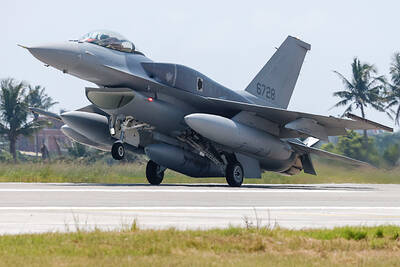
The second flight of F-16V jets from the US is expected to arrive at Chihhang Air Base in Taitung today. Minister of National Defense Wellington Koo (顧立雄) on Friday said that the new fighters would arrive in Taiwan soon. The Air Force Command yesterday issued a media notice for a filming session scheduled for today, effectively confirming the arrival. It is the second part of an order for 66 F-16Vs to arrive in Taiwan following the delivery of the first two aircraft last month. Three jets are expected this time, sources said. The three aircraft in the latest batch are single-seat models, bearing military serial
LONG WAIT: Deliveries of the 66 jets were expected to begin in 2023 and be completed by this year, but technical issues had pushed back the timetable The second batch of F-16V Block 70 jets purchased by Taiwan from the US, aircraft 6729, 6731 and 6732, arrived at Chihhang Air Base in Taitung County at about 11am yesterday, the air force said. The cockpit of the first aircraft to land, tail number 6732, displayed the Republic of China flag. The pilot of the last aircraft, tail number 6731, made a hand gesture representing the number “21” to the crowd. Airmen on the ground recognized it as the signature of the 21st Fighter Squadron. Sources said the pilot who made the gesture was Chiang Hui-yu (蔣惠宇), a graduate of the
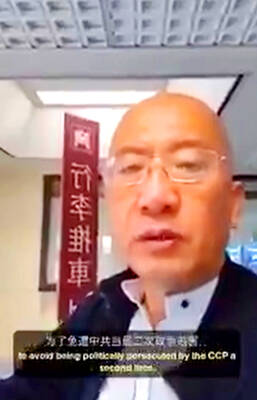
Former China Central Television (CCTV) talk show host Cheng Wanjun (程萬軍) yesterday sought political asylum in Taiwan, a day after arriving at Taiwan Taoyuan International Airport on a connecting flight from Thailand. In a video posted on X, Cheng said he was appealing to Taiwan to grant him temporary asylum on humanitarian grounds while he sought permanent resettlement in a third country. Cheng said he previously served as editor-in-chief of the journal Law and Life and hosted legal affairs programs on state-run CCTV. He said he ran afoul of Chinese authorities in 2019 after a video surfaced showing him discussing rulers whose actions
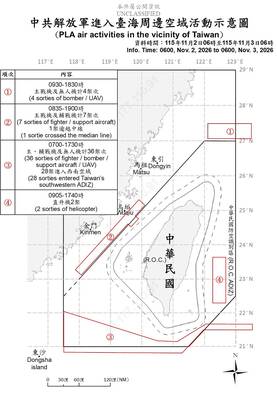
FORTY-NINE AIRCRAFT: The frequency and number of aircraft and ship sorties will likely continue to increase, but the important thing is vigilance, an analyst said Taiwan detected 49 sorties of military aircraft around Taiwan in the 24 hours leading up to 6am yesterday, in what analysts described as heightened “gray zone” activity. Aside from the 49 Chinese military aircraft, six warships and six government vessels were also detected around the nation during the period, the Ministry of National Defense said. Su Tzu-yun (蘇紫雲), director of the Institute for National Defense and Security Research’s Defense Strategy and Resources Division, said that the sudden surge in Chinese military aircraft and vessels around Taiwan was part of what he described as a “quiet exercise,” with Beijing maintaining high-intensity “gray zone”


 RSS