

Harsher penalties without early threat detection and efforts to identify those behind the action would not deter transnational repression, Taipei District Court national security judge and Institute for National Defense and Security Research adjunct fellow Hsu Kai-chieh (許凱傑) said on Friday.
Taiwan should draw on the experiences of Canada and Australia, which have measures to share threat information and penalize preparatory acts involving foreign interference before attacks occur, he said.
Amendments must clearly define what constitutes a legal violation and how “foreign forces” are identified, ensuring that people are not accused of breaking the law simply because of their political views or correspondence with people in China, he added.

Photo: Huang Yun-hsuan, Taipei Times
“Defensive democracy does not lower the standards of the rule of law. Rather, it means ensuring that democracies have the means, through rigorous legal procedures, to prevent authoritarian states from exploiting the openness of democratic societies to oppress their people,” he said.
The prevention of transnational repression requires early warnings, investigations to identify those behind the acts and protection for victims, he said.
The government should ensure that people who might be targeted receive timely information about threats, Hsu said.
For example, Canada allows intelligence agencies to share threat information with people and organizations outside the government, he said, adding that it helps potential targets take precautions.
Meanwhile, Australia criminalizes preparatory acts involving foreign interference, as well as providing funding or substantial support to foreign intelligence services, Hsu said.
Such provisions give law enforcement agencies opportunities to disrupt operations before targets are attacked, he added.
The Anti-Infiltration Act (反滲透法) covers some forms of such conduct, but there is room for improvement in provisions addressing threats, coercion, unlawful detention and the illegal collection or use of personal data when such acts involve foreign infiltration, he said.
He also called for greater interagency cooperation, saying that an operation could involve surveillance, cyberattacks and direction from overseas, but as some information is held separately by the police, cybersecurity agencies and intelligence services, investigators could struggle to link seemingly unrelated incidents.
US legislative proposals and Germany’s experience could provide useful references for Taiwan as it develops coordination channels and reporting mechanisms, Hsu said.
Information sharing must comply with evidence-gathering rules and protect intelligence sources, ensuring that investigative leads can be turned into evidence that stand up in court, he added.
Hsu also warned that the public might hesitate to report threats, because they fear retaliation.
The government should provide reliable channels for seeking help, security advice and legal assistance, as well as clear procedures for receiving reports, assessing risks and providing protection, he said.
Making victims feel safe enough to seek help would also allow authorities to preserve evidence earlier and prevent further harm, he added.
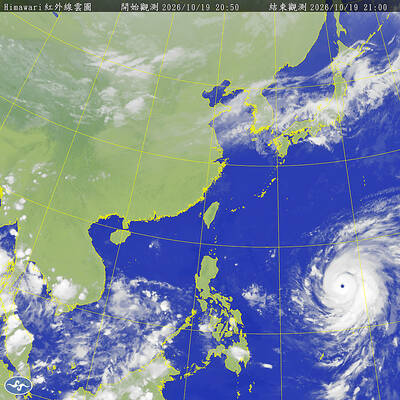
Typhoon Champi is forecast to turn northward earlier than previously expected, sparing Taiwan a direct hit but still bringing heavy rain to the north of the country on Friday and Saturday, the Central Weather Administration (CWA) said yesterday. Typhoon Champi had strengthened and increased in size over the past 12 hours, and as of yesterday afternoon, was packing sustained winds of 198kph near its center, CWA forecaster Cheng Chieh-jen (鄭傑仁) said. However, due to the weakening of a Pacific high-pressure system the storm is now expected to turn northward earlier than initially forecast, likely around Japan’s Ishigaki Island, Cheng said. As Champi brushes
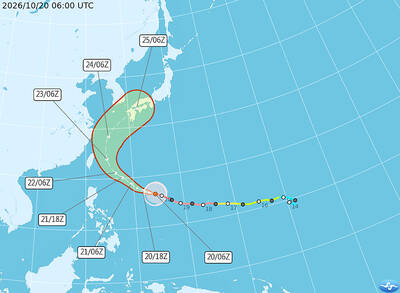
A sea warning for Typhoon Champi might be issued tonight, while the storm’s trajectory would determine whether a land warning is to be issued tomorrow night, the Central Weather Administration (CWA) said yesterday. As of 2pm yesterday, Champi was about 1,536km east-southeast of Taiwan proper’s southernmost point, Oluanpi (鵝鑾鼻), packing maximum sustained winds of 198kph, CWA forecaster Tseng Chao-cheng (曾昭誠) said. The storm was moving west-northwest at 23kph and was expected to strengthen over the next 24 hours before weakening slightly as it approaches cooler waters east of Taiwan, Tseng said. Champi is expected to turn north tomorrow, with the angle of the
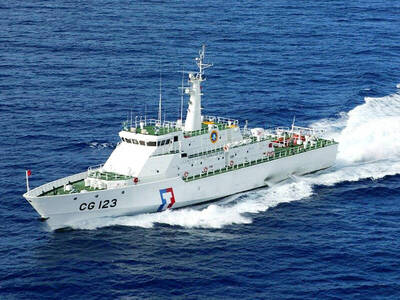
A patrol vessel donated by the Coast Guard Administration (CGA) to the Philippines would not be used in waters near Taiwan or areas where Taiwanese fishing vessels operate, Premier Cho Jung-tai (卓榮泰) said yesterday. The vessel, formerly the CGA's 500-tonne-class Kinmen (金門), was commissioned into the Philippine Coast Guard on Oct. 2. Speaking at the Legislative Yuan, Cho said the Philippines had pledged during the donation process that the vessel would be used only for designated missions and would not operate in waters related to Taiwan. The vessel could even provide assistance to Taiwan if needed, he added. Responding to questions from Chinese
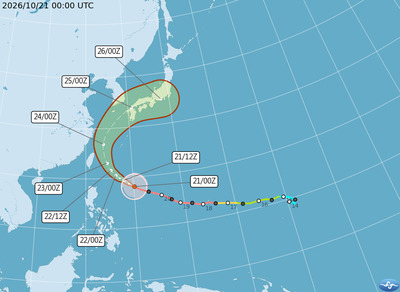
Stable weather in northern Taiwan is expected to give way to rain this evening, while other parts of the country are to remain cloudy to sunny, the Central Weather Administration (CWA) said today. Northern and northeastern Taiwan could see intermittent rain this afternoon as seasonal northeasterly winds strengthen, with heavy rain possible in the greater Taipei area and Yilan County into the evening, CWA forecaster Chu Mei-lin (朱美霖) said. Despite the approaching rain, daytime highs across Taiwan are to remain above 30°C, reaching 34°C in central and southern Taiwan, the CWA said. Starting tomorrow, seasonal northeasterly winds and the outer currents of Typhoon


 RSS