

National Taiwan University (NTU) has established open semiconductor research facilities that give researchers access to equipment for chip fabrication, development, analysis and testing.
The facilities were established under the National Science and Technology Council’s (NSTC) Taiwan Chip-based Industrial Innovation Program (CBI), allowing researchers from other universities to use the equipment to create an open semiconductor research and development environment.
The NSTC has identified gaps in the resources available for university-led semiconductor research and invested NT$300 million (US$9.2 million) over three years to establish 60 key facilities and pieces of equipment at seven semiconductor research institutes nationwide, CBI convener and National Chi Nan University president Wu Tung-hsing (武東星) said.

Photo: Cheng I-hwa, AFP
NTU contributed NT$100 million toward 11 of the facilities and has made them available to academics, students and researchers through its Web site, Wu said.
The CBI program has helped integrate semiconductor-related resources at universities, while NTU’s participation has helped bring its research capabilities in line with those of leading universities overseas, NTU College of Advanced Technology dean Wu Chih-i (吳志毅) said.
NTU has a cleanroom that has been used by more than 12,000 people over the past three years. Usage increased from 7.5 percent in 2024 to 23.8 percent this year, NTU professor Chen Chien-fu (陳建甫) said.
The university has electron-beam lithography equipment with a resolution of up to 8 nanometers, atomic layer deposition and etching systems, and equipment for measuring nanomaterials and semiconductor devices, Chen said.
The program has also contributed to research published by NTU professors, including a paper published in Nature on July 1 titled “Directly probing the carrier transfer length in 2D-material transistors.”
A team led by Lee Min-hung (李敏鴻) has also developed a hafnium zirconium oxide nanocapacitor that combines energy storage, waste-heat power generation and active chip cooling, providing a potential new approach to energy and thermal management for future chips.
NTU said it has approached Taiwan Semiconductor Manufacturing Co, Powerchip Semiconductor Manufacturing Corp, Etron Technology, Ennostar Corp, Radiant Opto-Electronics Corp, Innolux Corp and Materials Analysis Technology about collaborations based on its research.
The collaborations could be worth a combined NT$84 million, it said.
The university is also working with international partners, including Pennsylvania State University, on cross-border research and training for semiconductor talent, it added.
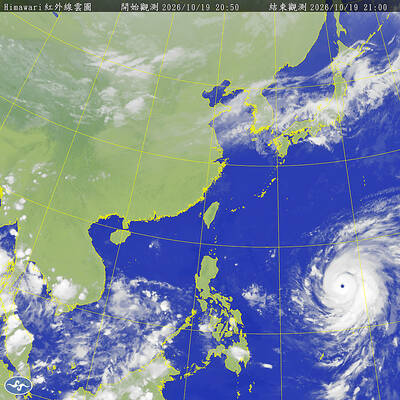
Typhoon Champi is forecast to turn northward earlier than previously expected, sparing Taiwan a direct hit but still bringing heavy rain to the north of the country on Friday and Saturday, the Central Weather Administration (CWA) said yesterday. Typhoon Champi had strengthened and increased in size over the past 12 hours, and as of yesterday afternoon, was packing sustained winds of 198kph near its center, CWA forecaster Cheng Chieh-jen (鄭傑仁) said. However, due to the weakening of a Pacific high-pressure system the storm is now expected to turn northward earlier than initially forecast, likely around Japan’s Ishigaki Island, Cheng said. As Champi brushes
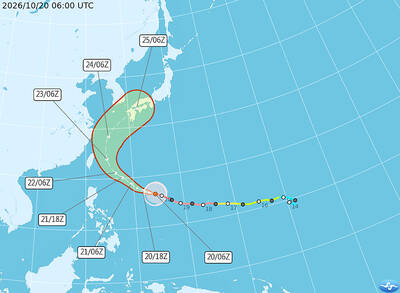
A sea warning for Typhoon Champi might be issued tonight, while the storm’s trajectory would determine whether a land warning is to be issued tomorrow night, the Central Weather Administration (CWA) said yesterday. As of 2pm yesterday, Champi was about 1,536km east-southeast of Taiwan proper’s southernmost point, Oluanpi (鵝鑾鼻), packing maximum sustained winds of 198kph, CWA forecaster Tseng Chao-cheng (曾昭誠) said. The storm was moving west-northwest at 23kph and was expected to strengthen over the next 24 hours before weakening slightly as it approaches cooler waters east of Taiwan, Tseng said. Champi is expected to turn north tomorrow, with the angle of the
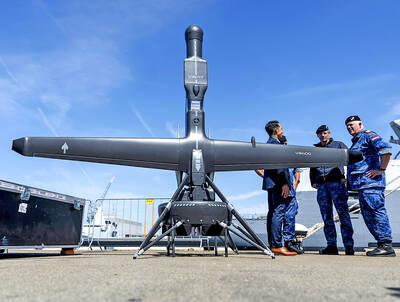
DEFENSE PROCUREMENT: Taiwan could become the largest operator of V-BAT drones outside the US if the contract is finalized, the Ministry of National Defense said The navy and the coast guard reportedly plan to acquire 292 units of MQ-35A V-BAT vertical takeoff and landing (VTOL) surveillance drones. The Navy said it would procure the drones through an open bidding process. If the contract is awarded and finalized, it would make Taiwan one of the largest buyers of the uncrewed aerial vehicle (UAV) developed by the US-based defense technology company Shield AI. The Coast Guard Administration budgeted NT$1.2 billion (US$37.1 million) to buy 12 drones, which have been delivered, Shield AI said in a report on Oct 13. The navy is planning to spend NT$36 billion under
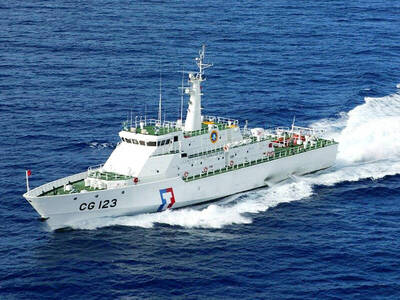
A patrol vessel donated by the Coast Guard Administration (CGA) to the Philippines would not be used in waters near Taiwan or areas where Taiwanese fishing vessels operate, Premier Cho Jung-tai (卓榮泰) said yesterday. The vessel, formerly the CGA's 500-tonne-class Kinmen (金門), was commissioned into the Philippine Coast Guard on Oct. 2. Speaking at the Legislative Yuan, Cho said the Philippines had pledged during the donation process that the vessel would be used only for designated missions and would not operate in waters related to Taiwan. The vessel could even provide assistance to Taiwan if needed, he added. Responding to questions from Chinese


 RSS