

The Kaohsiung Mass Rapid Transit Bureau yesterday said that it has used 211 inclinometers to monitor tree stability in green tunnels of the city’s light-rail system during Typhoon Champi.
Kaohsiung’s light rail is known for two green tunnels: Totoro Tunnel, which is between Kaohsiung Museum of Fine Arts Station and Neiwei Arts Center Station and lined with Madagascar almond trees, and Hulk Tunnel, which runs from Heart of Love River Station to the Shu-Te Home-Economics and Commercial High School Station, featuring tall rain trees.
Kaohsiung Deputy Mayor Charles Lin (林欽榮) yesterday inspected the fixation work for the light-rail green channels.
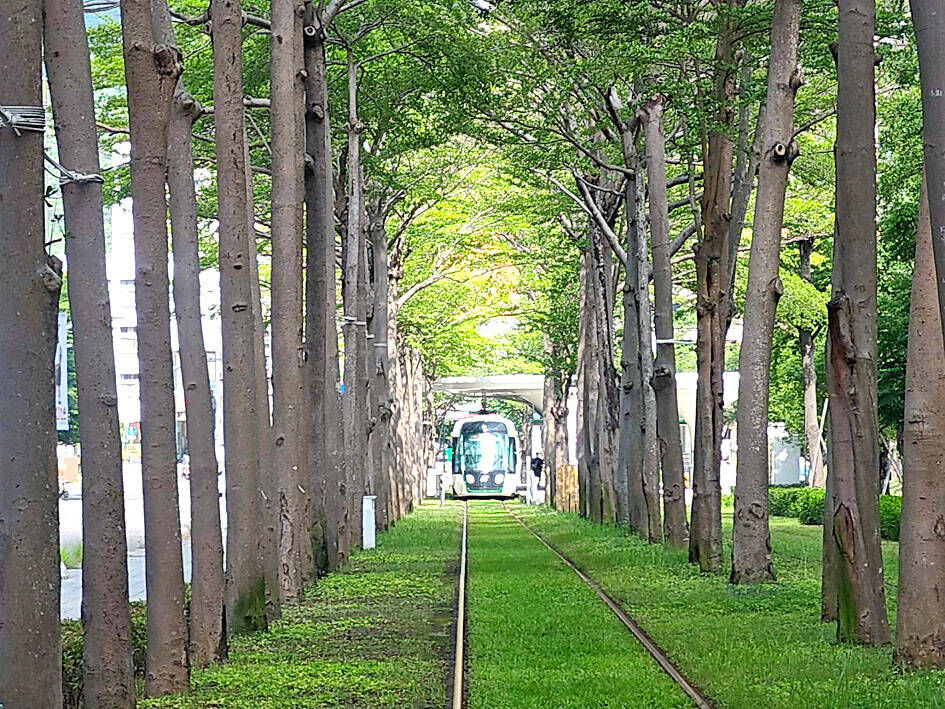
Photo: Wang Jung-hsiang, Taipei Times
He said that the city government has collaborated with the National Center for Research on Earthquake Engineering on introducing technology to monitor the light rail section along Dashun Road.
Tree inclinometers were set up along the green channels to monitor tree stability around the clock, Lin said, helping enhance the city’s disaster response capabilities during the typhoon as any abnormality can be reported in real-time.
The bureau said it has set up typhoon-resistant fixation work for all 453 Madagascar almond trees and rain trees along the light rail.
Different supports such as steel tubes, steel cables, bamboo poles or ropes were applied, depending on the tree species and operating conditions, it said, adding that it had trimmed 42 trees along the light rail following the previous typhoon.
An additional 11 tree inclinometers were set up in the green tunnels prior to Typhoon Champi, the bureau said.
Kaohsiung Rapid Transit Corp general manager Joseph Wang (王亞洲) said that Kaohsiung’s light rail system had a daily ridership of about 40,000 passengers from January to this month.
While the annual ridership reached 13.33 million passengers last year, it is projected to surpass 15 million passengers this year, up by 66 percent compared with the originally estimated 9 million passengers, he said.
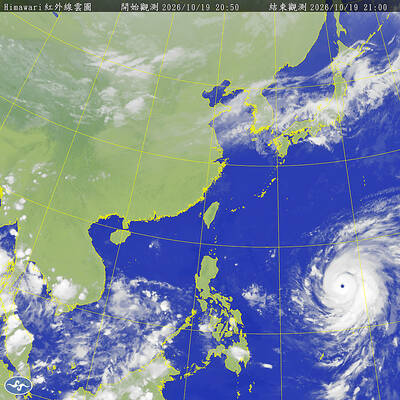
Typhoon Champi is forecast to turn northward earlier than previously expected, sparing Taiwan a direct hit but still bringing heavy rain to the north of the country on Friday and Saturday, the Central Weather Administration (CWA) said yesterday. Typhoon Champi had strengthened and increased in size over the past 12 hours, and as of yesterday afternoon, was packing sustained winds of 198kph near its center, CWA forecaster Cheng Chieh-jen (鄭傑仁) said. However, due to the weakening of a Pacific high-pressure system the storm is now expected to turn northward earlier than initially forecast, likely around Japan’s Ishigaki Island, Cheng said. As Champi brushes
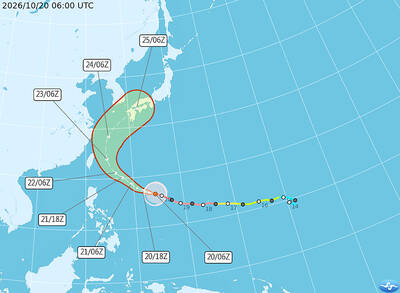
A sea warning for Typhoon Champi might be issued tonight, while the storm’s trajectory would determine whether a land warning is to be issued tomorrow night, the Central Weather Administration (CWA) said yesterday. As of 2pm yesterday, Champi was about 1,536km east-southeast of Taiwan proper’s southernmost point, Oluanpi (鵝鑾鼻), packing maximum sustained winds of 198kph, CWA forecaster Tseng Chao-cheng (曾昭誠) said. The storm was moving west-northwest at 23kph and was expected to strengthen over the next 24 hours before weakening slightly as it approaches cooler waters east of Taiwan, Tseng said. Champi is expected to turn north tomorrow, with the angle of the
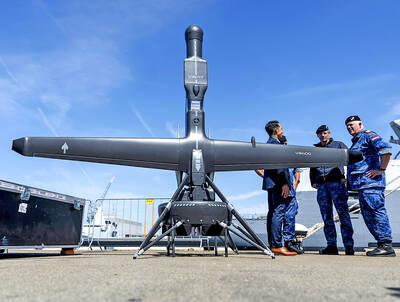
DEFENSE PROCUREMENT: Taiwan could become the largest operator of V-BAT drones outside the US if the contract is finalized, the Ministry of National Defense said The navy and the coast guard reportedly plan to acquire 292 units of MQ-35A V-BAT vertical takeoff and landing (VTOL) surveillance drones. The Navy said it would procure the drones through an open bidding process. If the contract is awarded and finalized, it would make Taiwan one of the largest buyers of the uncrewed aerial vehicle (UAV) developed by the US-based defense technology company Shield AI. The Coast Guard Administration budgeted NT$1.2 billion (US$37.1 million) to buy 12 drones, which have been delivered, Shield AI said in a report on Oct 13. The navy is planning to spend NT$36 billion under
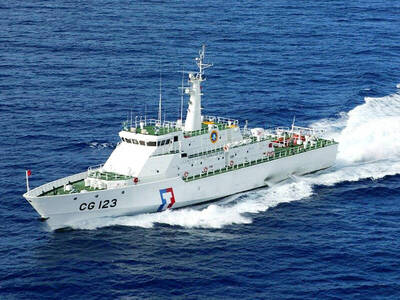
A patrol vessel donated by the Coast Guard Administration (CGA) to the Philippines would not be used in waters near Taiwan or areas where Taiwanese fishing vessels operate, Premier Cho Jung-tai (卓榮泰) said yesterday. The vessel, formerly the CGA's 500-tonne-class Kinmen (金門), was commissioned into the Philippine Coast Guard on Oct. 2. Speaking at the Legislative Yuan, Cho said the Philippines had pledged during the donation process that the vessel would be used only for designated missions and would not operate in waters related to Taiwan. The vessel could even provide assistance to Taiwan if needed, he added. Responding to questions from Chinese


 RSS