

Taiwanese democracy advocate Lee Ming-che (李明哲) on Tuesday met with the European Parliament, calling for greater protection for human rights advocates, follow-up action on resolutions concerning Hong Kong and deeper cooperation between Taiwan and Europe in the face of China’s transnational repression.
A delegation led by Lee met with European Parliament members Bernard Guetta and Engin Eroglu, joined by Representative to the EU and Belgium Hsieh Chih-wei (謝志偉), the New School for Democracy said in a statement last week.
Lee thanked the European Parliament for its solidarity when he was detained in China for five years.
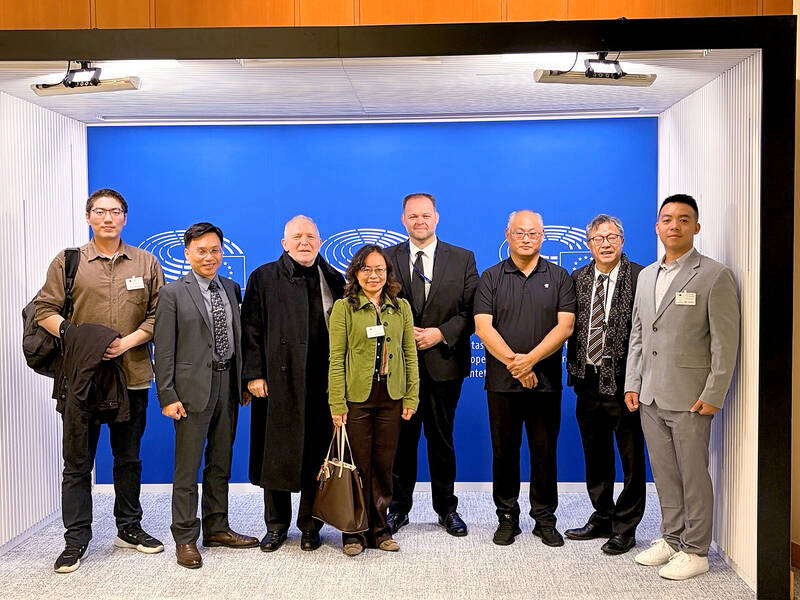
Photo courtesy of the New School for Democracy via CNA
Transnational repression not only targets advocates, but also often involves threats against their family members, deterring persecuted people from speaking out, he said.
Lee said that while he was detained, China threatened his wife with concerns about his safety, and demanded that she stop speaking out and cut off contact with the Taiwanese government and civil society groups.
Family members of other people detained in China have reached out to him for help since he returned to Taiwan, he said.
They fear that speaking out or seeking help from the Taiwanese government could impact their loved ones’ safety, Lee said, adding that threats to loved ones’ safety silence people, cover up the truth and leave advocates isolated.
He called on democratic countries to provide state protection and work with non-governmental organizations to ensure that people facing threats can safely seek help and continue participating in public affairs.
Guetta and Eroglu drew parallels between the cross-strait situation and Russia and Ukraine, asking about Taiwan’s assistance to Ukraine and how the nation is resisting Chinese repression and infiltration.
Taiwan’s resistance is visible and invisible, Taiwanese human rights advocate Hsiao I-ming (蕭逸民) said.
For example, China exploits criminal cases and manipulates information to deepen distrust of the government and divide Taiwanese society, Hsiao said.
Supporting and protecting victims, and fostering a society built on mutual assistance and trust are part of the everyday work of defending democracy, he said.
Lee uses the Internet to introduce Chinese to Taiwan’s democratic experience and built a network to support the families of Chinese political prisoners, Hsiao said, citing it as an example of resistance that goes unseen.
This cross-border exchange of democratic ideas and mutual support helps people facing political persecution, he said.
China’s threats against Taiwan do not only involve the military, but also directly impact people’s freedom and democratic rights, he said, adding that judicial reform, protecting victims and advocating for human rights are all part of resisting authoritarianism.

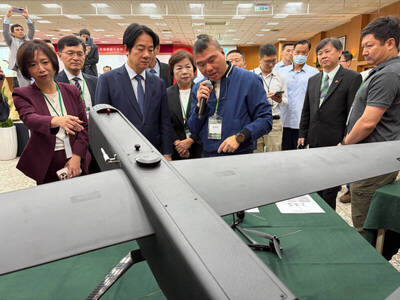
Two executives of drone supplier Jiin Ming Industry Co (錦明實業) have been detained and held incommunicado over the company's alleged use of prohibited China-made chips and camera lenses in drones supplied under recent military contracts, the Taoyuan District Prosecutors' Office said today. In a statement, prosecutors said they raided the offices of Jiin Ming — headquartered in Taoyuan — as well as those of its subsidiaries and its suppliers on Thursday last week. The raids followed a report that the company had breached its procurement contracts by putting the prohibited components into drones delivered to the military. During the raids, prosecutors summoned

South Korean boy band BigBang drew 120,000 fans to three concerts at Taipei Dome from Friday through yesterday, as the band thanked them for their support over their 20-year career. The Taipei Dome concerts were part of BigBang's "2026-2027 World Tour XX: Cosmos." Friday's concert was BigBang's first performance in Taiwan in 11 years. During the encore, group leader G-Dragon (GD) shouted "I love you" in Chinese and said he was especially happy to perform in Taiwan with bandmates Taeyang and Daesung. "Taipei, I'm very grateful to you all," GD said in Chinese, asking fans to wait for the band's return. Daesung thanked
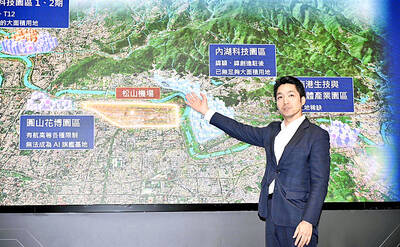
DETAILED PLAN NEEDED: Relocating the airport would affect not just travelers, but also undermine national defense and emergency medical services, a legislator said Taipei Mayor Chiang Wan-an (蔣萬安) yesterday proposed relocating Taipei International Airport (Songshan airport) and turning the site into an artificial intelligence (AI) park, drawing opposition from politicians across party lines. Chiang’s plan would turn the 300 hectares into an AI park featuring tech clusters, residential communities and green space. The industrial cluster would host 200 domestic enterprises, generate NT$12 trillion (US$376.47 billion) in output, and accommodate 65,000 jobs and 35,000 residents, he said. Cabinet spokeswoman Michelle Lee (李慧芝) said the Executive Yuan was surprised by the announcement, as the Taipei City Government did not discuss the proposal with the central government before making
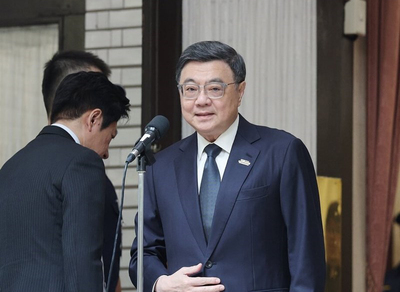
The government would continue monitoring online rumors that a pneumonic plague outbreak has spread from Russia into China and could enhance existing quarantine measures, Premier Cho Jung-tai (卓榮泰) said today. During a legislative meeting, Democratic Progressive Party Legislator Wang Ting-yu (王定宇) said rumors were circulating that the disease had spread across several Chinese provinces. He asked Cho whether the government was prepared to prevent the disease from spreading to Taiwan, given the frequent exchanges between Taiwan and China, and how concerned the government was about the alleged outbreak. The Ministry of Health and Welfare implemented border quarantine measures after briefing the Executive Yuan


 RSS
RSS