

The Ministry of Digital Affairs (MODA) yesterday said it had notified the nation’s largest supermarket chains to inspect their Internet of Things (IoT) devices and install firmware updates to address security vulnerabilities, after a cyberattack earlier this week caused about 150 supermarkets in France to incur substantial food losses.
The incident involving Internet-connected refrigeration systems — which resulted in fridges and freezers heating up to 50°C, spoiling food and triggering fires — was one of the main subjects discussed at the legislature’s Transportation Committee meeting yesterday.
Democratic Progressive Party (DPP) Legislator Hsu Chih-chieh (許智傑) said Taiwan has an extremely high density of convenience stores and supermarkets, so people’s lives would be hugely disrupted if similar attacks happen in Taiwan.
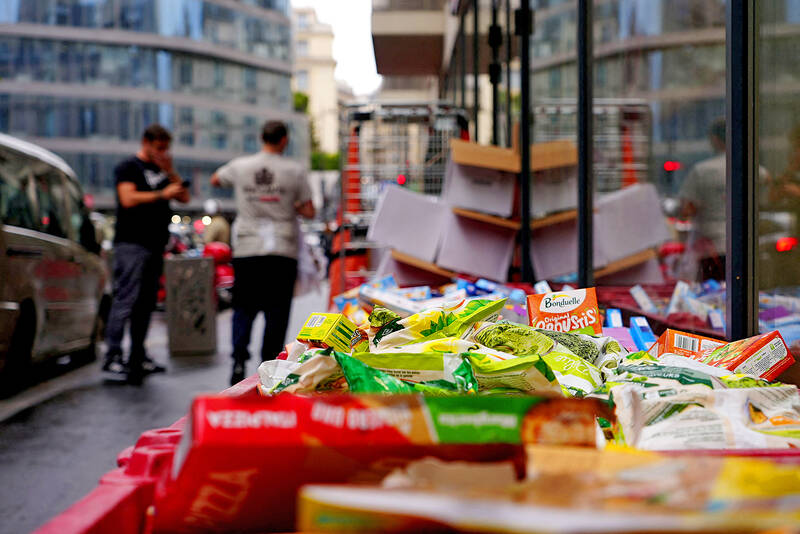
Photo: Reuters
The ministry should address the issue and prevent hackers from launching cyberattacks on Taiwan’s critical infrastructure using IoT, he added.
Minister of Digital Affairs Lin Yi-ching (林宜敬) said many companies began linking their internal systems to public Internet networks when IoT became a trend about a decade ago, but they overlooked the importance of cybersecurity protection.
“The global trend in the corporate world is disconnecting the internal networks from the Internet unless it is absolutely necessary. They only need to connect to the Intranet and monitor access to internal systems by establishing a whitelist,” Lin said.
Administration for Cybersecurity Director-General Tsai Fu-lung (蔡福隆) said the firmware of the French supermarkets’ refrigeration system was outdated and its vulnerabilities has not been addressed for a long time, so hackers had the opportunity to tamper with the temperature setting.
“After the incident, we quickly notified the supermarket chains around the nation through the Taiwan Computer Emergency Response Team/Coordination Center to examine IoT devices and update firmware,” Tsai said.
Meanwhile, DPP Legislator Lin Chun-hsien (林俊憲) highlighted the national security risks posed by the use of eSIMs, which many Taiwanese travelers purchase when they travel overseas.
A Taiwan’s Consumers’ Foundation survey found that 72 percent of 172 eSIMs purchased from the market have Internet traffic routed through China or Hong Kong, rather than the countries users are traveling in, he said.
This means that the content transmitted through these eSIMs are subject to regulation and surveillance under Hong Kong’s National Security Law or China’s Cybersecurity Law, he added.
The minister said the market is inundated with cheap, but unsafe eSIM cards routed through Chinese telecoms — such as China Mobile — as their massive consumer base gives them greater bargaining power when negotiating profit-sharing arrangements for international roaming services.
The government can regulate eSIMs sold through domestic e-commerce platforms such as momo and PChome, but lacks jurisdiction over those purchased from overseas Web sites, he said.
To reduce the risks associated with cheap foreign SIM cards, the Ministry of Digital Affairs and the National Communications Commission, in collaboration with Taiwan’s three major telecom operators, require customers to purchase domestic eSIMs online using real-name authentication, he added.


Two executives of drone supplier Jiin Ming Industry Co (錦明實業) have been detained and held incommunicado over the company's alleged use of prohibited China-made chips and camera lenses in drones supplied under recent military contracts, the Taoyuan District Prosecutors' Office said today. In a statement, prosecutors said they raided the offices of Jiin Ming — headquartered in Taoyuan — as well as those of its subsidiaries and its suppliers on Thursday last week. The raids followed a report that the company had breached its procurement contracts by putting the prohibited components into drones delivered to the military. During the raids, prosecutors summoned

South Korean boy band BigBang drew 120,000 fans to three concerts at Taipei Dome from Friday through yesterday, as the band thanked them for their support over their 20-year career. The Taipei Dome concerts were part of BigBang's "2026-2027 World Tour XX: Cosmos." Friday's concert was BigBang's first performance in Taiwan in 11 years. During the encore, group leader G-Dragon (GD) shouted "I love you" in Chinese and said he was especially happy to perform in Taiwan with bandmates Taeyang and Daesung. "Taipei, I'm very grateful to you all," GD said in Chinese, asking fans to wait for the band's return. Daesung thanked
The government would continue monitoring online rumors that a pneumonic plague outbreak has spread from Russia into China and could enhance existing quarantine measures, Premier Cho Jung-tai (卓榮泰) said today. During a legislative meeting, Democratic Progressive Party Legislator Wang Ting-yu (王定宇) said rumors were circulating that the disease had spread across several Chinese provinces. He asked Cho whether the government was prepared to prevent the disease from spreading to Taiwan, given the frequent exchanges between Taiwan and China, and how concerned the government was about the alleged outbreak. The Ministry of Health and Welfare implemented border quarantine measures after briefing the Executive Yuan

DETAILED PLAN NEEDED: Relocating the airport would affect not just travelers, but also undermine national defense and emergency medical services, a legislator said Taipei Mayor Chiang Wan-an (蔣萬安) yesterday proposed relocating Taipei International Airport (Songshan airport) and turning the site into an artificial intelligence (AI) park, drawing opposition from politicians across party lines. Chiang’s plan would turn the 300 hectares into an AI park featuring tech clusters, residential communities and green space. The industrial cluster would host 200 domestic enterprises, generate NT$12 trillion (US$376.47 billion) in output, and accommodate 65,000 jobs and 35,000 residents, he said. Cabinet spokeswoman Michelle Lee (李慧芝) said the Executive Yuan was surprised by the announcement, as the Taipei City Government did not discuss the proposal with the central government before making


 RSS
RSS