

Companies’ ability to cut emissions would affect their future orders and Taiwan’s industrial competitiveness, President William Lai (賴清德) said yesterday, pledging financial and policy support for their transition.
Increasingly stringent emissions requirements in international supply chains mean businesses need to build net zero goals into their operating decisions, Lai said at the Energy Taiwan and Net-Zero Taiwan exhibitions in Taipei.
“The ability to cut carbon affects future orders and directly influences the international competitiveness of Taiwan’s industries,” he said.
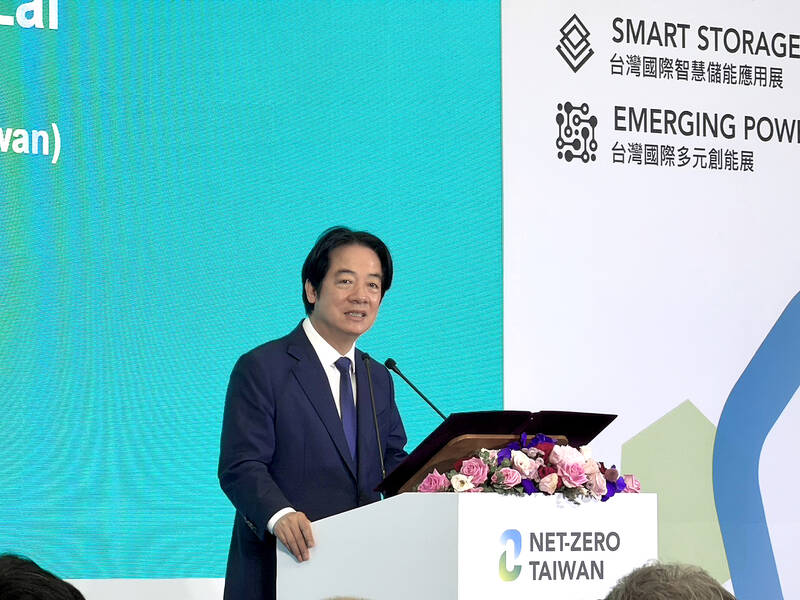
Photo: Lin Ching-hua, Taipei Times
To support that transition, the government will use carbon fee revenue to help industries go green and fund technological innovation, Lai said, adding that Taiwan has completed its first round of carbon fee declarations and payments, putting a price on emissions.
Other measures included the Taiwan Green Growth Fund, which seeks to attract private investment for net zero industries, and plans to invest an additional NT$100 billion (US$3.12 billion) over eight years to help micro, small and medium-sized enterprises (MSMEs) pursue digital and net zero transitions, Lai said.
He reiterated Taiwan’s targets of cutting greenhouse gas emissions by 28 percent and 38 percent by 2030 and 2035 respectively compared with 2005 levels.
Reliable power supplies are also essential as artificial intelligence (AI) drives up electricity demand, he said.
Taiwan’s renewable energy capacity has risen from 4.7 gigawatts (GW) in 2016 to 25GW, and its cumulative offshore wind capacity ranks fifth in the world, Lai said, adding that the government would continue developing a mix of renewable sources, energy storage, energy conservation and grid resilience.
Taiwan External Trade Development Council Chairman Huang Chih-fang (黃志芳) linked energy supply to the pace of technological change.
“As AI changes our world, energy will determine how far the transformation can go,” Huang said, emphasizing that no single technology could meet the challenge alone.
Lucas Lin (林雍堯), chairperson of SEMI’s Green Energy and Sustainability Alliance, said companies needed to translate customers’ renewable energy commitments into everyday production and supply chain decisions, making the net zero transition a source of industrial upgrading and competitiveness.
The exhibitions, organized by the council and the alliance, feature more than 400 companies and run through tomorrow in Hall 1 of the Taipei Nangang Exhibition Center.
Displays cover renewable energy, energy storage, energy efficiency, carbon management and green finance, offering businesses technologies and services for reducing emissions.

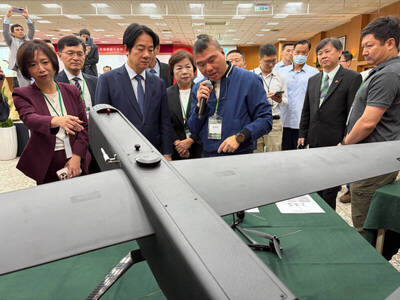
Two executives of drone supplier Jiin Ming Industry Co (錦明實業) have been detained and held incommunicado over the company's alleged use of prohibited China-made chips and camera lenses in drones supplied under recent military contracts, the Taoyuan District Prosecutors' Office said today. In a statement, prosecutors said they raided the offices of Jiin Ming — headquartered in Taoyuan — as well as those of its subsidiaries and its suppliers on Thursday last week. The raids followed a report that the company had breached its procurement contracts by putting the prohibited components into drones delivered to the military. During the raids, prosecutors summoned

South Korean boy band BigBang drew 120,000 fans to three concerts at Taipei Dome from Friday through yesterday, as the band thanked them for their support over their 20-year career. The Taipei Dome concerts were part of BigBang's "2026-2027 World Tour XX: Cosmos." Friday's concert was BigBang's first performance in Taiwan in 11 years. During the encore, group leader G-Dragon (GD) shouted "I love you" in Chinese and said he was especially happy to perform in Taiwan with bandmates Taeyang and Daesung. "Taipei, I'm very grateful to you all," GD said in Chinese, asking fans to wait for the band's return. Daesung thanked
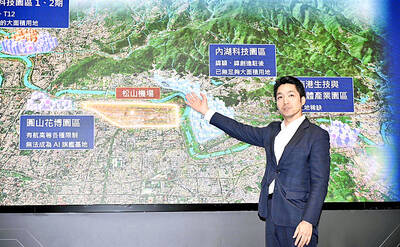
DETAILED PLAN NEEDED: Relocating the airport would affect not just travelers, but also undermine national defense and emergency medical services, a legislator said Taipei Mayor Chiang Wan-an (蔣萬安) yesterday proposed relocating Taipei International Airport (Songshan airport) and turning the site into an artificial intelligence (AI) park, drawing opposition from politicians across party lines. Chiang’s plan would turn the 300 hectares into an AI park featuring tech clusters, residential communities and green space. The industrial cluster would host 200 domestic enterprises, generate NT$12 trillion (US$376.47 billion) in output, and accommodate 65,000 jobs and 35,000 residents, he said. Cabinet spokeswoman Michelle Lee (李慧芝) said the Executive Yuan was surprised by the announcement, as the Taipei City Government did not discuss the proposal with the central government before making
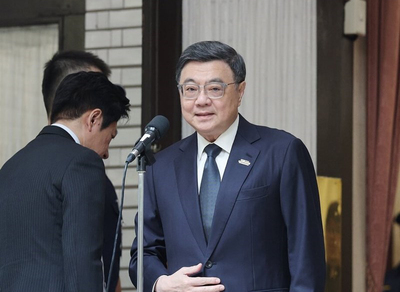
The government would continue monitoring online rumors that a pneumonic plague outbreak has spread from Russia into China and could enhance existing quarantine measures, Premier Cho Jung-tai (卓榮泰) said today. During a legislative meeting, Democratic Progressive Party Legislator Wang Ting-yu (王定宇) said rumors were circulating that the disease had spread across several Chinese provinces. He asked Cho whether the government was prepared to prevent the disease from spreading to Taiwan, given the frequent exchanges between Taiwan and China, and how concerned the government was about the alleged outbreak. The Ministry of Health and Welfare implemented border quarantine measures after briefing the Executive Yuan


 RSS
RSS