

The Taiwan Bridges Program has built bridges of knowledge, generations and peace, President William Lai (賴清德) said at the program’s closing ceremony at National Taiwan University in Taipei yesterday.
The program was launched by Academia Sinica and the university in November last year in collaboration with 12 academic or research institutions and the International Peace Foundation.
A total of 31 Nobel Prize laureates were invited to Taiwan for exchanges within seven months of the program’s launch.
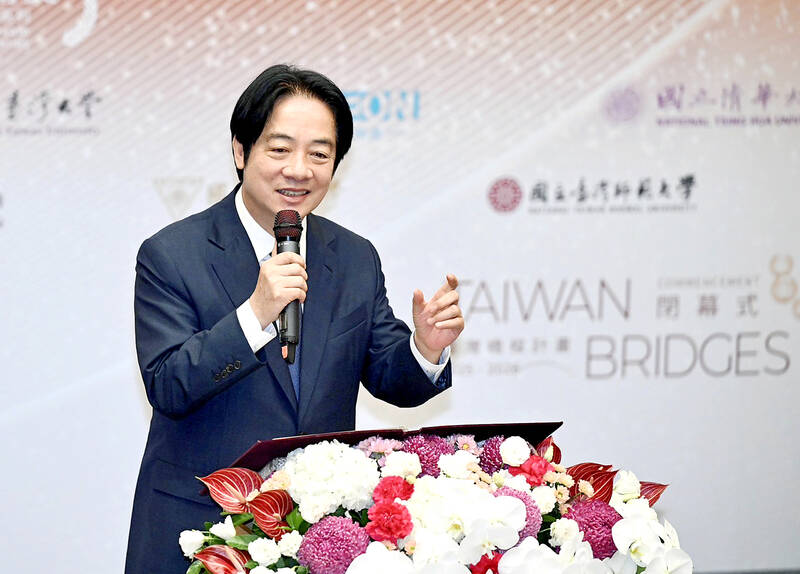
Photo: Lo Pei-de, Taipei Times
Lai, serving as the program’s honorary chairman, said in his address he expects Taiwan to become an anchor around which international scientific exchanges and conversations revolve.
“The program has built three bridges,” he said.
Firstly, “the bridge of knowledge” invited the world’s cutting-edge knowledge into Taiwan while bringing Taiwan’s academic researchers to the world, Lai said.
Faced with climate change, artificial intelligence, pandemic threats and shifting geopolitics, no country can find all of the answers on its own, he said, adding Taiwan must work with the world to ask the right questions and seek solutions together.
Secondly, “the bridge between generations” brought 31 world-changing academics to school campuses in Taiwan to deliver lectures, Lai said.
The students attending the lectures could become influential scientists in two decades and contribute to the world, he said.
Third, “the bridge of peace” encourages researchers of different fields to think how they can leverage their expertise to add to global peace and prosperity, he said.
Referring to the vision he outlined in November last year of Taiwan producing three more Nobel laureates within 30 years, Lai said the government would enhance basic research and higher education, support researchers in exploring the unknown, and expand international research collaborations and talent exchanges.
It would seek to turn initial encounters into long-term partnerships and bring together the government, foundations and broader society to build a stable, long-term support system, he said.
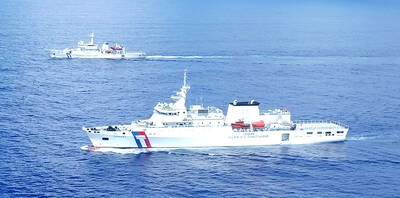
‘FRIENDSHIP FLEET’: A CGA official is scheduled to meet with the president of the Pacific nation, while one of the ships is to host a banquet and National Day event Two Coast Guard Administration (CGA) patrol vessels have docked at Malakal Harbor in Palau as part of an expedition exercise and diplomatic visit, during which a senior official is expected to meet with Palauan President Surangel Whipps Jr, the agency said yesterday. The two vessels, the 4,000-tonne-class Chiayi and the 1,000-tonne-class Penghu, set sail for Palau from Taiwan last week and arrived on Tuesday at Malakal Harbor, the CGA’s Fleet Branch said in a statement. The journey marks the second time the CGA has dispatched a “friendship fleet” to another country, after it sent its first-ever goodwill fleet, comprising the Hualien and
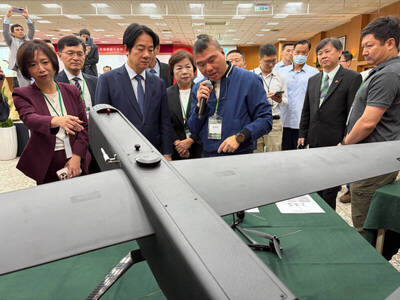
Two executives of drone supplier Jiin Ming Industry Co (錦明實業) have been detained and held incommunicado over the company's alleged use of prohibited China-made chips and camera lenses in drones supplied under recent military contracts, the Taoyuan District Prosecutors' Office said today. In a statement, prosecutors said they raided the offices of Jiin Ming — headquartered in Taoyuan — as well as those of its subsidiaries and its suppliers on Thursday last week. The raids followed a report that the company had breached its procurement contracts by putting the prohibited components into drones delivered to the military. During the raids, prosecutors summoned
The Coast Guard Administration (CGA) today said that two of its patrol vessels have docked at Palau's Malakal Harbor as part of an expedition exercise and diplomatic visit, during which a senior official is expected to meet with the Palauan president. The two vessels, the 4,000-tonne-class Chiayi (嘉義) and the 1,000-tonne-class Penghu (澎湖), set sail for Palau from Taiwan last week and arrived at Malakal Harbor yesterday, the CGA's Fleet Branch said in a statement. The journey marked the second time the CGA has dispatched a "Friendship Fleet" to another country, after it sent its first-ever goodwill fleet, comprising the Hualien (花蓮)
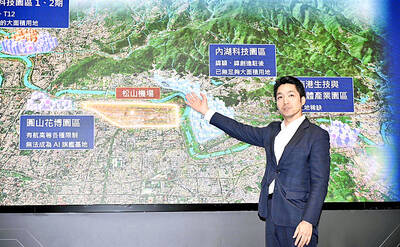
DETAILED PLAN NEEDED: Relocating the airport would affect not just travelers, but also undermine national defense and emergency medical services, a legislator said Taipei Mayor Chiang Wan-an (蔣萬安) yesterday proposed relocating Taipei International Airport (Songshan airport) and turning the site into an artificial intelligence (AI) park, drawing opposition from politicians across party lines. Chiang’s plan would turn the 300 hectares into an AI park featuring tech clusters, residential communities and green space. The industrial cluster would host 200 domestic enterprises, generate NT$12 trillion (US$376.47 billion) in output, and accommodate 65,000 jobs and 35,000 residents, he said. Cabinet spokeswoman Michelle Lee (李慧芝) said the Executive Yuan was surprised by the announcement, as the Taipei City Government did not discuss the proposal with the central government before making


 RSS
RSS