

Minister of Health and Welfare Shih Chung-liang (石崇良) yesterday reiterated that the ministry has no plans to ask social workers to distribute illegal drugs in community centers as the government’s drug policy comes under scrutiny.
Heated debates on the government’s drug prevention policies were triggered by Taipei Mayor Chiang Wan-an’s (蔣萬安) re-election campaign team, who earlier this month questioned Democratic Progressive Party (DPP) Legislator and Taipei mayoral candidate Puma Shen’s (沈伯洋) drug stance, citing an op-ed article he wrote in 2014, when he was a doctoral student.
Chiang and his team accused Shen of supporting decriminalization of drugs and “giving out [illegal] drugs and clean needles in local communities.”
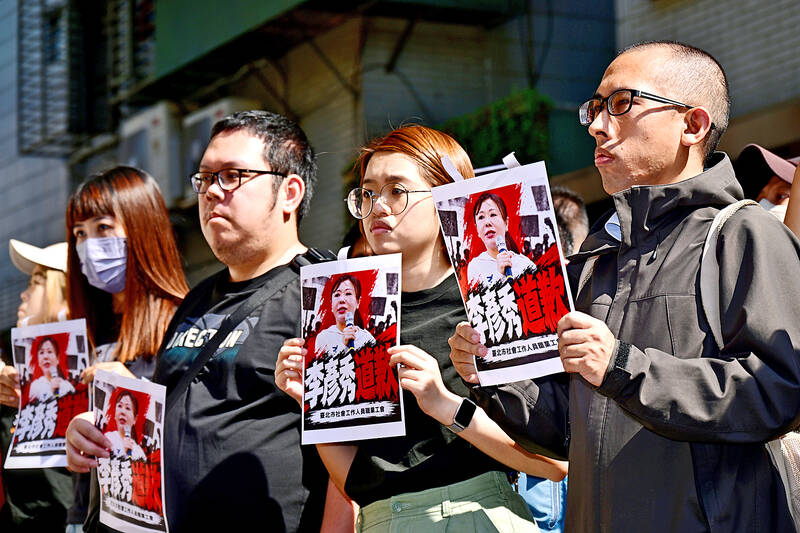
Photo: Chen Yi-kuan, Taipei Times
Shen said that the article was about drug prevention policies around the world, including needle and syringe programs and medication-assisted treatment, which are harm reduction policies.
At a meeting of the legislature’s Social Welfare and Environmental Hygiene Committee, Taiwan People’s Party Legislator Chiu Hui-ju (邱慧洳) said that Shen had mentioned that Taiwan can learn from other countries in “providing drug users drugs and clean needles at community centers,” and questioned whether the “drugs” he mentioned referred to “oral methadone” as his supporters claimed.
Shih said although the existing methadone maintenance therapy service offers oral methadone, it is implemented simultaneously with the needle and syringe program, which gives out sterile injecting equipment to prevent the transmission of blood-borne diseases, so they can be given together.
Methadone is classified as a Category 2 narcotic and a Category 2 controlled drug, he said, adding that Shen has repeatedly explained his stance and the ministry respects the author of the article.
Regarding Chiu’s repeated request that the ministry conduct an assessment report on the feasibility of “providing drugs in local communities,” Shih said that the harm reduction programs have already yielded significant results in reducing HIV and other blood-borne diseases, and there is no need to change them.
The ministry’s stance is clear — it will not provide drugs at community centers and does not need to conduct a feasibility study on distributing them in local communities, he said.
Meanwhile, a claim by Chinese Nationalist Party (KMT) Legislator Lee Yen-hsiu (李彥秀) — a spokesperson for Chiang’s election campaign — last week that social workers would be distributing drugs in local communities prompted social workers to stage a protest in front of her office yesterday, demanding that she apologize.
Democratic Progressive Party Legislator Lin Yueh-chin (林月琴) said many frontline social workers and health professionals have expressed concerns that messages like this could undermine the government’s harm reduction program, smearing social workers as drug enablers and making drug users afraid to ask for help.
Shih said there is no such thing as social workers giving out drugs and that they are not “drug providers,” adding that harm reduction policies do not encourage drug use.
Aside from preventing stigmatization and protecting privacy to ensure the harm reduction services operate without interference, the easy accessibility of the services is another critical factor in the program’s success, he said.
The program is an interdisciplinary collaboration that includes physicians, nurses, pharmacists and social workers, Shih said.
Social workers play a vital role in providing case management, family support and community resource linkage, while helping drug users reintegrate into society, but they are not involved in “giving out drugs,” he stressed.
A Ministry of Health and Welfare’s report states that, to prevent HIV transmission among drug users, the accessible sterile needle and syringe service covers 770 health counseling stations, 388 automated vending machines and 575 needle disposal boxes.
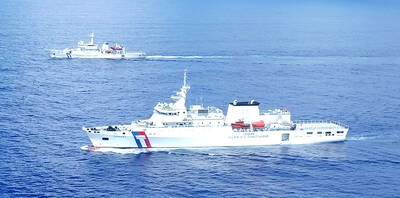
‘FRIENDSHIP FLEET’: A CGA official is scheduled to meet with the president of the Pacific nation, while one of the ships is to host a banquet and National Day event Two Coast Guard Administration (CGA) patrol vessels have docked at Malakal Harbor in Palau as part of an expedition exercise and diplomatic visit, during which a senior official is expected to meet with Palauan President Surangel Whipps Jr, the agency said yesterday. The two vessels, the 4,000-tonne-class Chiayi and the 1,000-tonne-class Penghu, set sail for Palau from Taiwan last week and arrived on Tuesday at Malakal Harbor, the CGA’s Fleet Branch said in a statement. The journey marks the second time the CGA has dispatched a “friendship fleet” to another country, after it sent its first-ever goodwill fleet, comprising the Hualien and
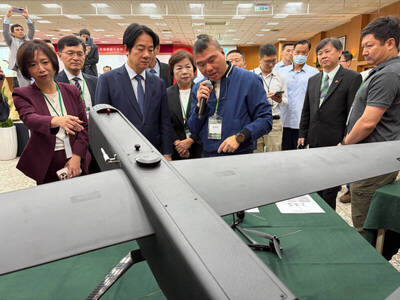
Two executives of drone supplier Jiin Ming Industry Co (錦明實業) have been detained and held incommunicado over the company's alleged use of prohibited China-made chips and camera lenses in drones supplied under recent military contracts, the Taoyuan District Prosecutors' Office said today. In a statement, prosecutors said they raided the offices of Jiin Ming — headquartered in Taoyuan — as well as those of its subsidiaries and its suppliers on Thursday last week. The raids followed a report that the company had breached its procurement contracts by putting the prohibited components into drones delivered to the military. During the raids, prosecutors summoned
The Coast Guard Administration (CGA) today said that two of its patrol vessels have docked at Palau's Malakal Harbor as part of an expedition exercise and diplomatic visit, during which a senior official is expected to meet with the Palauan president. The two vessels, the 4,000-tonne-class Chiayi (嘉義) and the 1,000-tonne-class Penghu (澎湖), set sail for Palau from Taiwan last week and arrived at Malakal Harbor yesterday, the CGA's Fleet Branch said in a statement. The journey marked the second time the CGA has dispatched a "Friendship Fleet" to another country, after it sent its first-ever goodwill fleet, comprising the Hualien (花蓮)
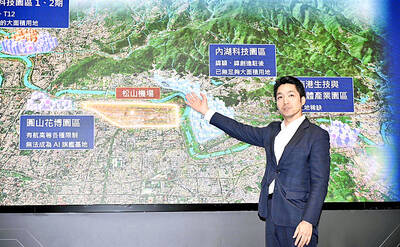
DETAILED PLAN NEEDED: Relocating the airport would affect not just travelers, but also undermine national defense and emergency medical services, a legislator said Taipei Mayor Chiang Wan-an (蔣萬安) yesterday proposed relocating Taipei International Airport (Songshan airport) and turning the site into an artificial intelligence (AI) park, drawing opposition from politicians across party lines. Chiang’s plan would turn the 300 hectares into an AI park featuring tech clusters, residential communities and green space. The industrial cluster would host 200 domestic enterprises, generate NT$12 trillion (US$376.47 billion) in output, and accommodate 65,000 jobs and 35,000 residents, he said. Cabinet spokeswoman Michelle Lee (李慧芝) said the Executive Yuan was surprised by the announcement, as the Taipei City Government did not discuss the proposal with the central government before making


 RSS
RSS