

A National Health Research Institutes (NHRI) research team has identified four potential hub genes highly correlated with early-onset schizophrenia, which could explain how the disease develops and lead to new treatments, a researcher at the institute’s Center for Neuropsychiatric Research said yesterday.
Schizophrenia is a leading cause of disability worldwide, with a median lifetime prevalence of 6.35 per 1,000 people, researcher Jen Ya-wen (任雅文) said.
Schizophrenia is typically diagnosed in young adulthood, but about 8 percent of cases are classified as early-onset, meaning patients experience core symptoms such as delusions, hallucinations and cognitive decline before turning 18, she said.
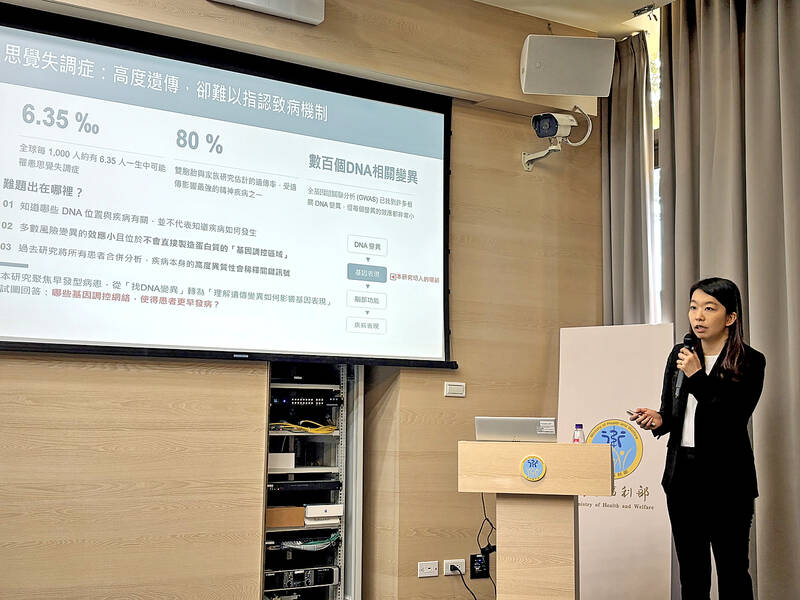
Photo courtesy of the institute
Early-onset schizophrenia is associated with a higher genetic load than adult-onset forms, and linked to more severe neurodevelopmental disruption and higher rates of treatment resistance, Yen said, adding that they are a more challenging patient group in clinical practice and in need of new therapeutic strategies.
Although past genome-wide association studies have identified hundreds of disease-
associated DNA variants, most of these variants have limited individual effects and are predominantly located in gene regulatory regions that do not directly encode proteins, making it difficult to directly explain the pathogenesis, she said.
Although schizophrenia has an estimated heritability of 80 percent, genetics alone does not tell the whole story, she said.
Much of this genetic link remains a mystery, and researchers believe that how genes interact with the environment plays a major role in driving the disease, she added.
The research team led by Center for Neuropsychiatric Research director Chen Wei-jen (陳為堅), Lin Yan-yeng (林彥鋒), an attending physician at the center, and Yen, in collaboration with local and international academics, aimed to identify the key genes that drive the genetic regulation of the disease.
The team used genotype data from patients in multiplex families and simplex families, referenced large-scale international brain tissue transcriptome databases, and through transcriptome-wide association studies, estimated the genetically regulated expression levels of individual genes in the brain and established individual-level gene expression risk scores that more closely approximate true biological functions, the institute said.
Yen said they found that “Module 10,” consisting of 58 genes, is most significantly associated with early-onset schizophrenia, a result consistent with findings from two sets of family data.
The team found that for every 1-standard-deviation increase in Module 10’s GeRS, the risk of developing early-onset schizophrenia increases by 1.32-fold, she said.
Subsequently, the research team identified four hub genes from Module 10 — COPS6, MRPS7, RUVBL2, and PSMD2 — which are involved in functions such as protein clearance, DNA repair and cellular operations, Yen said.
These hub genes are primarily concentrated in the brain’s excitatory neurons, which amplify neural signals, and their activity gradually increases from late fetal development through adulthood, suggesting that early-onset schizophrenia might be linked to abnormal gene regulation during brain development, she said.
The team believes the hub genes might have clinical relevance, and future studies integrating pharmacogenomic data and longitudinal clinical measures might be able to determine whether these genes can serve as therapeutic entry points or biomarkers for early intervention, Yen said.
The study was published in the peer-reviewed scientific journal Molecular Psychiatry in July, the NHRI said.

‘FRIENDSHIP FLEET’: A CGA official is scheduled to meet with the president of the Pacific nation, while one of the ships is to host a banquet and National Day event Two Coast Guard Administration (CGA) patrol vessels have docked at Malakal Harbor in Palau as part of an expedition exercise and diplomatic visit, during which a senior official is expected to meet with Palauan President Surangel Whipps Jr, the agency said yesterday. The two vessels, the 4,000-tonne-class Chiayi and the 1,000-tonne-class Penghu, set sail for Palau from Taiwan last week and arrived on Tuesday at Malakal Harbor, the CGA’s Fleet Branch said in a statement. The journey marks the second time the CGA has dispatched a “friendship fleet” to another country, after it sent its first-ever goodwill fleet, comprising the Hualien and

Two executives of drone supplier Jiin Ming Industry Co (錦明實業) have been detained and held incommunicado over the company's alleged use of prohibited China-made chips and camera lenses in drones supplied under recent military contracts, the Taoyuan District Prosecutors' Office said today. In a statement, prosecutors said they raided the offices of Jiin Ming — headquartered in Taoyuan — as well as those of its subsidiaries and its suppliers on Thursday last week. The raids followed a report that the company had breached its procurement contracts by putting the prohibited components into drones delivered to the military. During the raids, prosecutors summoned

The Coast Guard Administration (CGA) today said that two of its patrol vessels have docked at Palau's Malakal Harbor as part of an expedition exercise and diplomatic visit, during which a senior official is expected to meet with the Palauan president. The two vessels, the 4,000-tonne-class Chiayi (嘉義) and the 1,000-tonne-class Penghu (澎湖), set sail for Palau from Taiwan last week and arrived at Malakal Harbor yesterday, the CGA's Fleet Branch said in a statement. The journey marked the second time the CGA has dispatched a "Friendship Fleet" to another country, after it sent its first-ever goodwill fleet, comprising the Hualien (花蓮)
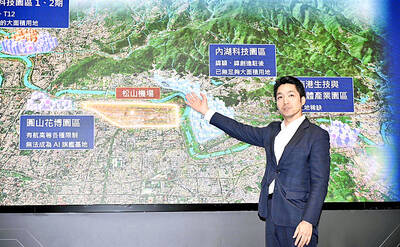
DETAILED PLAN NEEDED: Relocating the airport would affect not just travelers, but also undermine national defense and emergency medical services, a legislator said Taipei Mayor Chiang Wan-an (蔣萬安) yesterday proposed relocating Taipei International Airport (Songshan airport) and turning the site into an artificial intelligence (AI) park, drawing opposition from politicians across party lines. Chiang’s plan would turn the 300 hectares into an AI park featuring tech clusters, residential communities and green space. The industrial cluster would host 200 domestic enterprises, generate NT$12 trillion (US$376.47 billion) in output, and accommodate 65,000 jobs and 35,000 residents, he said. Cabinet spokeswoman Michelle Lee (李慧芝) said the Executive Yuan was surprised by the announcement, as the Taipei City Government did not discuss the proposal with the central government before making


 RSS
RSS