

Chinese Nationalist Party (KMT) Chairwoman Cheng Li-wun (鄭麗文) accused the Democratic Progressive Party (DPP) government in an interview of championing Taiwan’s identity while depriving Taiwan of its ability to shape its own future, saying that Taiwan should pursue peace and propose practical solutions to reduce cross-strait risks.
The interview with Japanese digital news outlet Shincho QUE, published on Friday last week, covered cross-strait relations, Taiwan’s exchanges with Japan and the US, and how Taiwan can take the initiative amid shifts in the international situation.
The KMT has been falsely labeled regarding its positions, Cheng said.
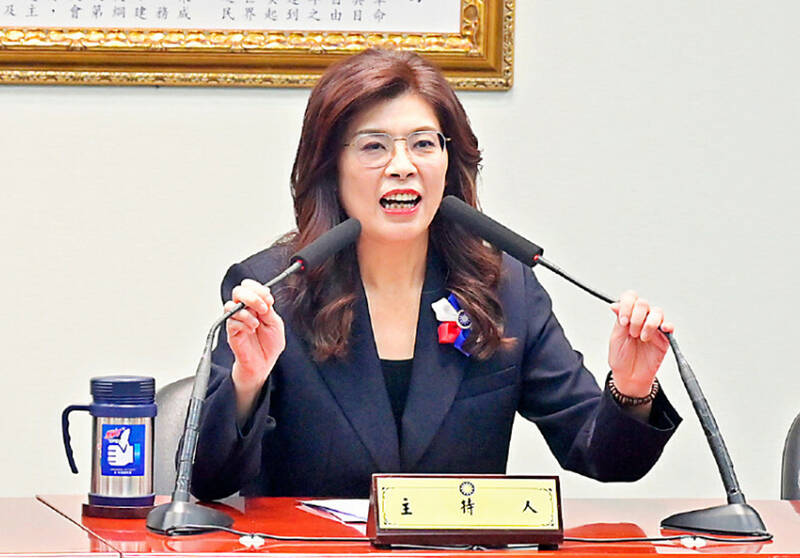
Photo: Taipei Times
Since taking office as party chair, she has expanded communication with the international community, helping people in Japan, Europe and the US understand the KMT and the importance of peace across the Taiwan Strait, she said.
The KMT pursues stable cross-strait relations to safeguard Taiwan’s democracy, freedom and prosperity, Cheng said, adding that the KMT should play an active role in promoting peace.
Taiwan must safeguard its democratic values and should not make unilateral concessions, she said, adding that stable cross-strait relations must be built on mutual respect and understanding.
Trips to Beijing this April and the US this June were important steps for the KMT to explain its position to the international community, the party chair said.
The KMT advocates easing tensions in the Taiwan Strait and resuming cross-strait dialogue based on the so-called “1992 consensus,” she said.
The “1992 consensus” refers to a tacit understanding between the KMT and the Chinese Communist Party that both sides of the Taiwan Strait acknowledge that there is “one China,” with each side having its own interpretation of what “China” means.
The DPP rejects the “1992 consensus,” saying that Beijing does not recognize the Republic of China and acceptance of the understanding would imply agreement with China’s claim over Taiwan.
This would enable Taiwan to improve its own situation rather than wait for major powers to decide its future, she added.
Although the DPP champions Taiwanese subjectivity, its governing has led people to lose faith in Taiwan’s ability to shape its own future, Cheng said.
Without that initiative, Taiwan risks becoming a bargaining chip in the power struggles between major countries, she said.
Cheng voiced concerns about how Taiwan Semiconductor Manufacturing Co’s (台積電) expansion in the US might impact Taiwan’s strategic value, citing Taiwan’s key role in the global high-tech industry.
Easing cross-strait tensions would help integrate regional talent, technology, markets and capital, she said, adding that the US could continue to play a leading role in the region while promoting cooperation.
The DPP has stirred anti-China sentiment, but this strategy is losing its effectiveness as people become increasingly aware of the risks of war, Cheng said.
No country wants to go to war with China and any military conflict in the Taiwan Strait would have far-reaching consequences for the world, Cheng said.
“If everyone can share in the benefits of peace, who would want to start a war?” she said.
The KMT would continue to pursue peace, stability and prosperity for Taiwan through dialogue and communication with the international community, she added.
In response, the DPP yesterday said President William Lai (賴清德) in his National Day address on Saturday outlined how Taiwan, in 10 years of DPP rule and amid upheavals in the global landscape, has worked with democratic allies and leveraged its technological strengths to improve its footing and engage with the world.
Rather than worrying about Taiwan losing its say, Cheng should focus on whether she, as KMT chair, still has control over her own party’s strategy in next month’s local elections, the DPP said.
Additional reporting by Chen Yun
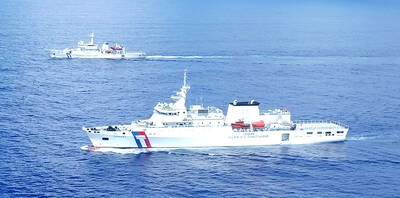
‘FRIENDSHIP FLEET’: A CGA official is scheduled to meet with the president of the Pacific nation, while one of the ships is to host a banquet and National Day event Two Coast Guard Administration (CGA) patrol vessels have docked at Malakal Harbor in Palau as part of an expedition exercise and diplomatic visit, during which a senior official is expected to meet with Palauan President Surangel Whipps Jr, the agency said yesterday. The two vessels, the 4,000-tonne-class Chiayi and the 1,000-tonne-class Penghu, set sail for Palau from Taiwan last week and arrived on Tuesday at Malakal Harbor, the CGA’s Fleet Branch said in a statement. The journey marks the second time the CGA has dispatched a “friendship fleet” to another country, after it sent its first-ever goodwill fleet, comprising the Hualien and
The Coast Guard Administration (CGA) today said that two of its patrol vessels have docked at Palau's Malakal Harbor as part of an expedition exercise and diplomatic visit, during which a senior official is expected to meet with the Palauan president. The two vessels, the 4,000-tonne-class Chiayi (嘉義) and the 1,000-tonne-class Penghu (澎湖), set sail for Palau from Taiwan last week and arrived at Malakal Harbor yesterday, the CGA's Fleet Branch said in a statement. The journey marked the second time the CGA has dispatched a "Friendship Fleet" to another country, after it sent its first-ever goodwill fleet, comprising the Hualien (花蓮)

Had I Not Seen the Sun (如果我不曾見過太陽), a coming-of-age mystery romance, yesterday won best series at the Seoul International Drama Awards in South Korea. The show's producer, Phoebe Ma (麻怡婷), accepted the award on behalf of the production team. "Telling this story was difficult," Ma said. "There were moments when I doubted my strength to keep going, but I never doubted the story itself." Ma went on to thank the cast and crew of the show for making the win possible. Released in two parts on Netflix at the end of last year, the 20-episode drama starred Tseng Jing-hua (曾敬驊) and Alice Ko (柯佳嬿). The
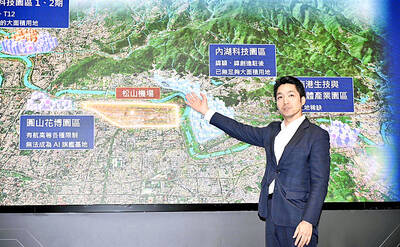
DETAILED PLAN NEEDED: Relocating the airport would affect not just travelers, but also undermine national defense and emergency medical services, a legislator said Taipei Mayor Chiang Wan-an (蔣萬安) yesterday proposed relocating Taipei International Airport (Songshan airport) and turning the site into an artificial intelligence (AI) park, drawing opposition from politicians across party lines. Chiang’s plan would turn the 300 hectares into an AI park featuring tech clusters, residential communities and green space. The industrial cluster would host 200 domestic enterprises, generate NT$12 trillion (US$376.47 billion) in output, and accommodate 65,000 jobs and 35,000 residents, he said. Cabinet spokeswoman Michelle Lee (李慧芝) said the Executive Yuan was surprised by the announcement, as the Taipei City Government did not discuss the proposal with the central government before making


 RSS
RSS