

About 77 percent of Chinese surveyed supported military operations against Kinmen and Lienchiang (Matsu) counties if Taiwan declares independence, the latest China Pulse survey found.
About 24 percent supported a full-scale military attack on Taiwan if it were to declare independence, rising from 21 to 29 percent following the summit between US President Donald Trump and Chinese President Xi Jinping (習近平) in May, China Pulse said in the survey published on Friday last week.
China Pulse publishes a twice-annual survey of Chinese public opinion on international relations conducted by the Carter Center and Emory University in the US.
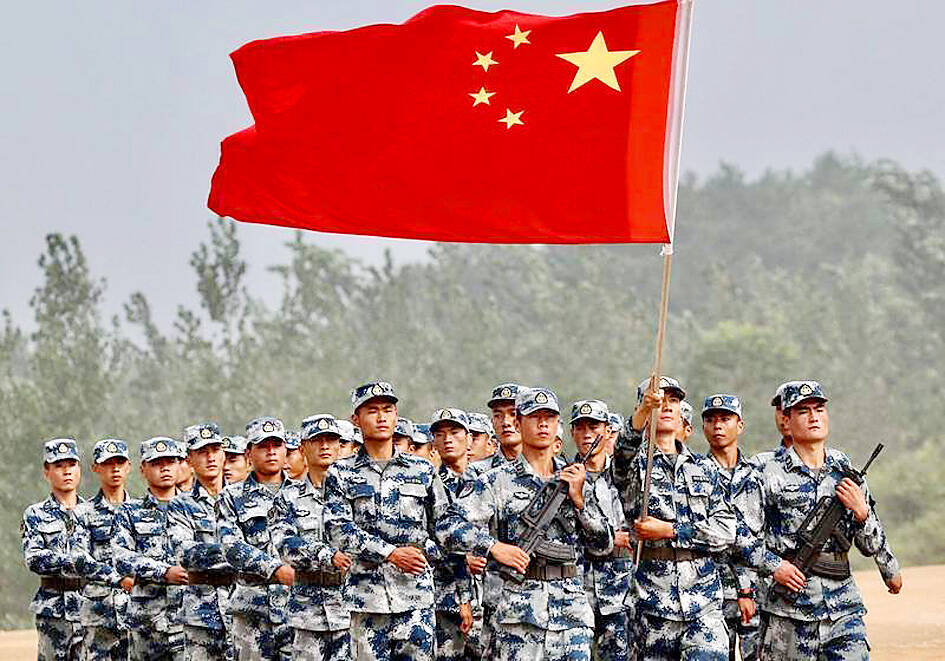
Photo: Reuters
The latest survey was fielded between April 16 and June 26 — during the Trump-Xi summit in May and ahead of their second meeting of the year last month — gathering responses from 2,500 Chinese across the demographic spectrum.
The proportion of those who oppose the use of force to unify Taiwan "under any circumstances" increased from 32 percent to 40 percent following the summit, it found, although the majority disagreed with that statement.
However, were Taiwan to make an official declaration of independence, 24 percent supported using military force, 59 percent supported a military blockade on commercial shipping and maritime traffic in the Taiwan Strait and 56 percent supported imposing economic sanctions on Taiwan, it found.
A summary for the Carter Center's US-China Perception Monitor publication said that, within China, it is believed that a declaration of independence from Taiwan would amount to an act of war to which Beijing must respond.
However, a narrow majority of 51 percent of respondents believed that the use of force against Taiwan would worsen the issue of cross-strait relations, the survey found.
The most popular non-coercive approach to cross-strait relations was cultural exchange, with an 83 percent support rate, while support for reciprocal economic exchanges increased to 82 percent from 78 percent late last year.
Support for official negotiations on a peaceful agreement increased from 52 percent to 66 percent since the last survey, although support for unilateral concessions decreased from 27 to 15 percent.
The article suggested that the increase may be a reaction to Chinese Nationalist Party (KMT) Chairwoman Cheng Li-wun's (鄭麗文) highly publicized visit to China in April, during which she met with Xi in Beijing.
The survey began just four days after her visit concluded, it said.
Meanwhile, Chinese favorability toward Taiwan ranked at 61 out of 100, higher than any other country or region in the survey, including Russia and Singapore, the survey found.
Asked why Taiwan is important, 82 percent said that "both sides of the Strait share the same cultural heritage and are like one family," up from 67 percent in the last survey, while 77 percent said that unification with Taiwan would symbolize resolving a long-standing historical issue.
About 63 percent said Taiwan's strategic location is important for China to break through US strategic containment, 53 percent said the advanced semiconductor industry is important to Beijing's long-term technological development and 48 percent said Taiwan's open and inclusive society would provide China with a "useful reference" for social development, it found.
Belief in the importance of shared cultural heritage seems to have increased since Cheng's visit, while recognition of Taiwan's semiconductor industry rose "significantly" after the Trump-Xi summit for all demographics, except college-educated Chinese, the article said.
The survey "did not reveal a Chinese public eager for a preemptive attack on Taiwan to force unification," it said, although it revealed a widening gap between those who oppose the use of force and those who do not.
For the Chinese public, improvement of cross-strait relations by diplomatic means is possible, but the consequences of any sudden action could be severe due to belief in cultural and historical nationalist positions on Taiwan that are intensifying amid the US-China artificial intelligence race, it said.

The donation of offshore patrol vessel Kinmen to the Philippines includes provisions that protect Taiwanese fishers and facilitate security cooperation across the First Island Chain, officials said yesterday. The comment was made during the Cabinet’s comprehensive administrative report at the legislature after Chinese Nationalist Party (KMT) Legislator Hsu Yu-chen (許宇甄) expressed concerns about the decision to give a ship to a country whose coast guard had in 2013 fired on a Taiwanese trawler and killed its captain without provocation. The Cabinet should lay out the safeguards that have been established to prevent the Philippine government from using the Kinmen to harass, expel
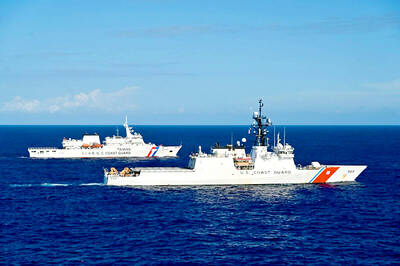
GROWING TIES: The CGA is planning a goodwill mission to the Philippines, in what would be the first time since 1975 a Taiwanese paramilitary vessel has visited the country The Coast Guard Administration (CGA) plans to significantly expand its participation in international security cooperative frameworks and its operational capabilities, a budget proposal for next year showed. The budget indicates a transformation of the CGA from a maritime law enforcement arm into a national defense and intelligence gathering entity capable of tackling larger regional security matters. The proposal showed that personnel from the coast guard’s Intelligence Division and Special Action Support Center are to participate in high-level national security talks with the US. As the CGA has dealt with China’s rising “gray zone” threats around Taiwan, it has become a valuable asset to
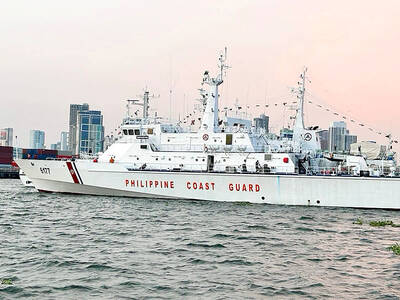
A patrol vessel donated by the Coast Guard Administration (CGA) to the Philippines was commissioned into the Philippine Coast Guard (PCG) on Friday, a Philippine non-governmental organization said. The CGA on Sept. 16 confirmed media reports that Taiwan had donated a retired 500-tonne patrol vessel to the Philippines. The Manila-based We Protect Our Seas (WPS) foundation, which served as an intermediary in the transfer, said that the vessel was formerly the CGA’s 500-tonne petrol vessel Kinmen (CG123). The WPS, in a statement issued on Friday, said the vessel, renamed as the BRP Sarangani, had been commissioned into the PCG the
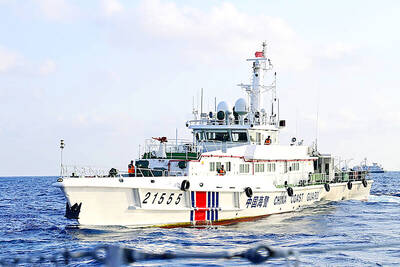
‘GRAY ZONE’ TACTICS: Beijing sent two China Coast Guard vessels to escort a ‘supposedly private research ship,’ a Philippine Coast Guard spokesman said The Coast Guard Administration (CGA) yesterday confirmed that it had recently deployed three patrol vessels to waters in Taiwan’s overlapping exclusive economic zone with the Philippines to monitor three Chinese vessels. CGA Deputy Director-General Hsieh Ching-chin (謝慶欽) said the agency regularly monitors Chinese vessels around Taiwan, and that the deployment south of Oluanpi (鵝鑾鼻), Taiwan proper’s southernmost point, was carried out in accordance with standard procedures. He added that the waters fall within the overlapping exclusive economic zones of Taiwan and the Philippines, which extend 200 nautical miles (370km) from their coastlines. Hsieh made the comments when asked about a


 RSS
RSS