

Arizona Governor Katie Hobbs joined Taiwanese leaders at the opening of an economic and cultural office on Monday to aid Taiwanese businesses and citizens in the region, despite pressure from the Chinese government to block it.
The new Phoenix office, the 14th such office in the US, is meant to promote collaboration in technology, especially in semiconductor manufacturing, and better serve the growing number of Taiwanese in the city.
After the plans for the office were announced in July, Hobbs received two letters from China’s consulate general in Los Angeles asking her to object to the proposal, according to documents the governor’s office shared with The Associated Press.
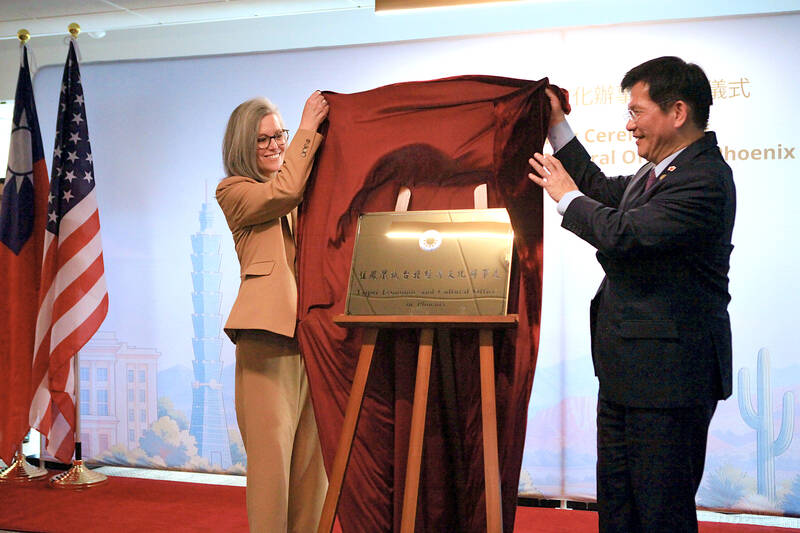
Photo: AP
In a July 3 letter, the Chinese authority called on the governor to “refute such an attempt by the Taiwan authorities and stop any political gimmicks to harm the friendship and cooperation between China and the state of Arizona.”
The stance was reiterated in an Aug. 21 letter.
The letters were first reported by Phoenix radio station KJZZ.
Hobbs spoke about Arizona’s ties with Taiwan at Monday’s opening.
“Every Arizona elected official should show the courage necessary to support the partnership between Arizona and Taiwan,” Hobbs said. “As our economic partnership grows, we are mobilizing every available resource to support Taiwanese companies expanding here in Arizona.”
Academics say that local-level collaborations with the Chinese government and Taiwan have become more politicized as US-China relations have deteriorated over the years.
“China firmly opposes official interactions of any form between China’s Taiwan region and the US, including its federal and state governments,” Liu Chang (劉暢), a spokesperson for China’s embassy in the US, said in a statement on Monday.
Taiwan has been increasing its economic footprint in Arizona, with advanced chipmaker Taiwanese Semiconductor Manufacturing Company (TSMC) pledging US$100 billion to expand its operation in northern Phoenix. That brings its investment in the city to US$265 billion, the largest foreign direct investment in US history.
About 500 Taiwanese engineers are working in Arizona to accelerate production at the TSMC facility, according to Jason Hsu (許毓仁), a former Taiwanese lawmaker and a senior fellow at the public policy think tank Hudson Institute.
Phoenix Mayor Kate Gallego said the city is seeing a sort of “baby boom” in its Taiwanese communities, with several labor and delivery rooms even launching Mandarin-language programs.
At the opening ceremony on Monday, Minister of Foreign Affairs Lin Chia-lung (林佳龍) said the establishment of the Taipei Economic and Cultural Office in Phoenix is a milestone in the “symbiotic partnership” between Taiwan and the US.
The partnership is built on shared interests, mutual benefits and a commitment to working together to promote growth and prosperity, he said.
Lin said that Arizona is an important economic partner for Taiwan.
In the first quarter alone, TSMC’s US operations generated nearly US$600 million in profit, surpassing its full-year profit from last year, he said.
The strong growth demonstrated how Taiwan’s investments are creating value for both sides, he said.
Additional reporting by Huang Chin-hsuan

The donation of offshore patrol vessel Kinmen to the Philippines includes provisions that protect Taiwanese fishers and facilitate security cooperation across the First Island Chain, officials said yesterday. The comment was made during the Cabinet’s comprehensive administrative report at the legislature after Chinese Nationalist Party (KMT) Legislator Hsu Yu-chen (許宇甄) expressed concerns about the decision to give a ship to a country whose coast guard had in 2013 fired on a Taiwanese trawler and killed its captain without provocation. The Cabinet should lay out the safeguards that have been established to prevent the Philippine government from using the Kinmen to harass, expel
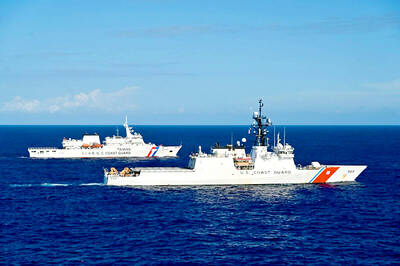
GROWING TIES: The CGA is planning a goodwill mission to the Philippines, in what would be the first time since 1975 a Taiwanese paramilitary vessel has visited the country The Coast Guard Administration (CGA) plans to significantly expand its participation in international security cooperative frameworks and its operational capabilities, a budget proposal for next year showed. The budget indicates a transformation of the CGA from a maritime law enforcement arm into a national defense and intelligence gathering entity capable of tackling larger regional security matters. The proposal showed that personnel from the coast guard’s Intelligence Division and Special Action Support Center are to participate in high-level national security talks with the US. As the CGA has dealt with China’s rising “gray zone” threats around Taiwan, it has become a valuable asset to
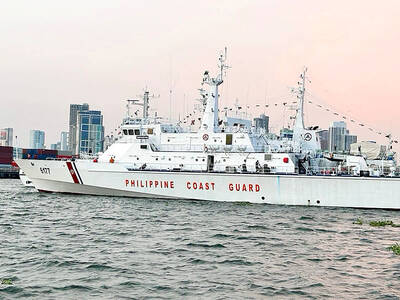
A patrol vessel donated by the Coast Guard Administration (CGA) to the Philippines was commissioned into the Philippine Coast Guard (PCG) on Friday, a Philippine non-governmental organization said. The CGA on Sept. 16 confirmed media reports that Taiwan had donated a retired 500-tonne patrol vessel to the Philippines. The Manila-based We Protect Our Seas (WPS) foundation, which served as an intermediary in the transfer, said that the vessel was formerly the CGA’s 500-tonne petrol vessel Kinmen (CG123). The WPS, in a statement issued on Friday, said the vessel, renamed as the BRP Sarangani, had been commissioned into the PCG the
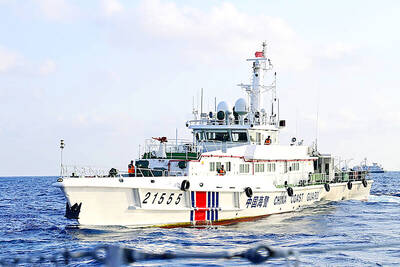
‘GRAY ZONE’ TACTICS: Beijing sent two China Coast Guard vessels to escort a ‘supposedly private research ship,’ a Philippine Coast Guard spokesman said The Coast Guard Administration (CGA) yesterday confirmed that it had recently deployed three patrol vessels to waters in Taiwan’s overlapping exclusive economic zone with the Philippines to monitor three Chinese vessels. CGA Deputy Director-General Hsieh Ching-chin (謝慶欽) said the agency regularly monitors Chinese vessels around Taiwan, and that the deployment south of Oluanpi (鵝鑾鼻), Taiwan proper’s southernmost point, was carried out in accordance with standard procedures. He added that the waters fall within the overlapping exclusive economic zones of Taiwan and the Philippines, which extend 200 nautical miles (370km) from their coastlines. Hsieh made the comments when asked about a


 RSS
RSS