

A tourism alliance promoting the east of Taiwan has been established aiming to link the East Rift Valley with the coast, Tourism Administration Director-General Chen Yu-hsiu (陳玉秀) said today.
The East of Taiwan Alliance is to promote cross-regional tourism integration beyond administrative and geographic boundaries, Chen said.
Local tourism operators from Hualien and Taitung counties are to collaborate and share resources to market the area's natural scenery, indigenous cultures and distinctive industries as travel experiences, the Tourism Administration said.

Photo: Liu Jen-wei, Taipei Times
The goal is to offer visitors a more relaxed and immersive way to experience eastern Taiwan and its unique character, the agency said.
Many tourism associations are confined to specific administrative areas, limiting cooperation and creating inconsistent experiences for visitors, Chen said.
The alliance aims to overcome those barriers and expand the scale of tourism development, she said.
The tourism circle policy is designed to foster cross-regional cooperation by integrating tourism resources from the rift valley and the east coast into a single network, she said.
The establishment of the alliance marks a concrete step toward deeper integration of mountain and coastal tourism resources, she said.
Operating under the principle of private-sector leadership with government support, the alliance would turn scattered attractions into commercially viable products capable of generating new business opportunities, she said.
The Tourism Administration would continue to assist the alliance in elevating tourism development in eastern Taiwan, she added.

The donation of offshore patrol vessel Kinmen to the Philippines includes provisions that protect Taiwanese fishers and facilitate security cooperation across the First Island Chain, officials said yesterday. The comment was made during the Cabinet’s comprehensive administrative report at the legislature after Chinese Nationalist Party (KMT) Legislator Hsu Yu-chen (許宇甄) expressed concerns about the decision to give a ship to a country whose coast guard had in 2013 fired on a Taiwanese trawler and killed its captain without provocation. The Cabinet should lay out the safeguards that have been established to prevent the Philippine government from using the Kinmen to harass, expel
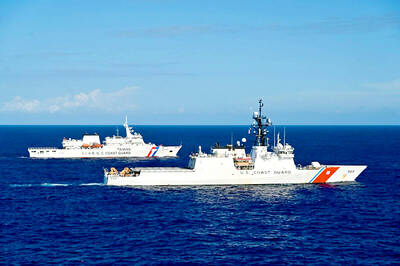
GROWING TIES: The CGA is planning a goodwill mission to the Philippines, in what would be the first time since 1975 a Taiwanese paramilitary vessel has visited the country The Coast Guard Administration (CGA) plans to significantly expand its participation in international security cooperative frameworks and its operational capabilities, a budget proposal for next year showed. The budget indicates a transformation of the CGA from a maritime law enforcement arm into a national defense and intelligence gathering entity capable of tackling larger regional security matters. The proposal showed that personnel from the coast guard’s Intelligence Division and Special Action Support Center are to participate in high-level national security talks with the US. As the CGA has dealt with China’s rising “gray zone” threats around Taiwan, it has become a valuable asset to
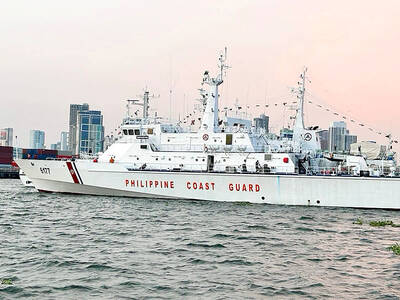
A patrol vessel donated by the Coast Guard Administration (CGA) to the Philippines was commissioned into the Philippine Coast Guard (PCG) on Friday, a Philippine non-governmental organization said. The CGA on Sept. 16 confirmed media reports that Taiwan had donated a retired 500-tonne patrol vessel to the Philippines. The Manila-based We Protect Our Seas (WPS) foundation, which served as an intermediary in the transfer, said that the vessel was formerly the CGA’s 500-tonne petrol vessel Kinmen (CG123). The WPS, in a statement issued on Friday, said the vessel, renamed as the BRP Sarangani, had been commissioned into the PCG the
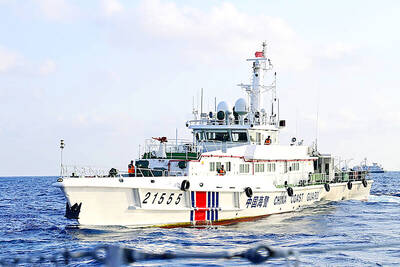
‘GRAY ZONE’ TACTICS: Beijing sent two China Coast Guard vessels to escort a ‘supposedly private research ship,’ a Philippine Coast Guard spokesman said The Coast Guard Administration (CGA) yesterday confirmed that it had recently deployed three patrol vessels to waters in Taiwan’s overlapping exclusive economic zone with the Philippines to monitor three Chinese vessels. CGA Deputy Director-General Hsieh Ching-chin (謝慶欽) said the agency regularly monitors Chinese vessels around Taiwan, and that the deployment south of Oluanpi (鵝鑾鼻), Taiwan proper’s southernmost point, was carried out in accordance with standard procedures. He added that the waters fall within the overlapping exclusive economic zones of Taiwan and the Philippines, which extend 200 nautical miles (370km) from their coastlines. Hsieh made the comments when asked about a


 RSS
RSS