

The government is working on national guidelines to counter China’s transnational repression, Mainland Affairs Council (MAC) Minister Chiu Chui-cheng (邱垂正) said today, following reports that Beijing had instructed an unregistered agent to surveil the son of President William Lai (賴清德) in the US.
FBI Director Kash Patel on X yesterday said that the Chinese government had allegedly dispatched an operative in the US to surveil Lai’s family, including photographing and filming them, and recording vehicle license plate numbers.
Agents arrested the suspect, Wanying Heather Zhang (張婉瑩), at Los Angeles International Airport on Sunday before attempting to fly to Shanghai.
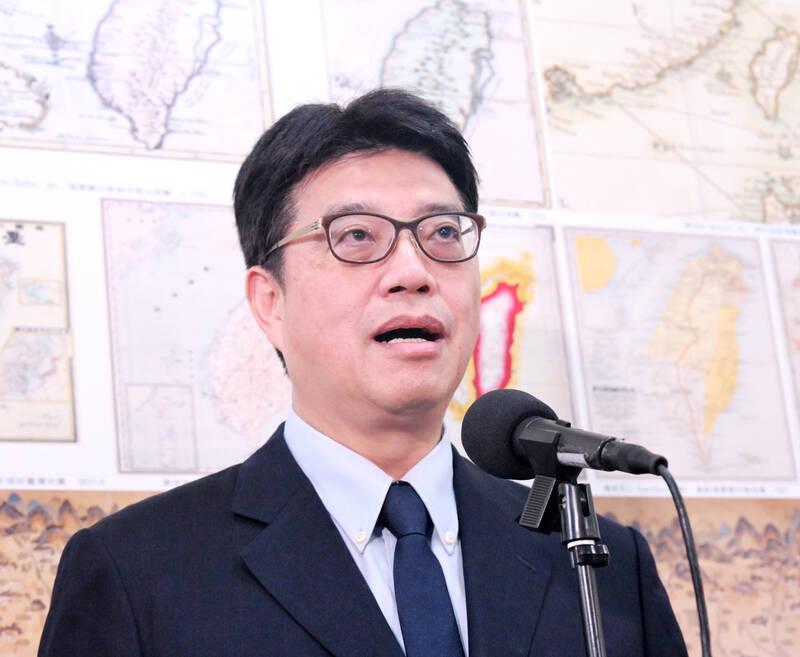
Photo: Fang Pin-chao, Taipei Times
Chiu told reporters before a legislative session that the council is working on amendments to the Anti-Infiltration Act (反滲透法) to help Taiwanese understand how to seek assistance when confronted with transnational repression.
Chiu said the case shows that Beijing's transnational repression is not limited to government officials, politicians or specific people.
It is rather an attempt to expand such tactics into collective intimidation targeting all Taiwanese, creating a chilling effect and extending its reach overseas, posing a serious threat to the safety and freedom of Taiwanese abroad, he said.
Taiwan has long been responding to the issue through preventive, protective and countermeasure policies, Chiu said.
The government would soon introduce public guidance explaining the nature of such activities and provide information on how to obtain assistance to ensure that people facing China's transnational repression do not feel isolated or helpless, he said.
Chiu also said that no country can tackle transnational repression alone, calling for collaboration among democratic allies to condemn and counter Chinese coercion.
In addition, Taiwan's current legal framework is inadequate to address China's transnational repression, he said.
While using local collaborators to tail or collect intelligence on individuals constitutes a felony in the US, Taiwan's laws do not fully address similar conduct, making legal reform imperative, he said.
The MAC is drafting amendments to the Anti-Infiltration Act and related legislation to protect national security and public rights, he said, urging the public to support the initiative.
Separately, Chiu commented on online criticism directed at Taiwanese television host Kevin Tsai (蔡康永) after he appeared at a campaign event for Democratic Progressive Party Taipei mayoral candidate Puma Shen (沈伯洋).
The backlash from Chinese Internet users once again demonstrates the risks faced by Taiwanese pursuing careers in China if their political views differ from Beijing's, highlighting the stark divide between a free, democratic society and an authoritarian regime, he said.
He called on Beijing to respect Taiwan's democratic way of life and refrain from interfering in Taiwanese elections, as such tactics would not improve cross-strait relations.
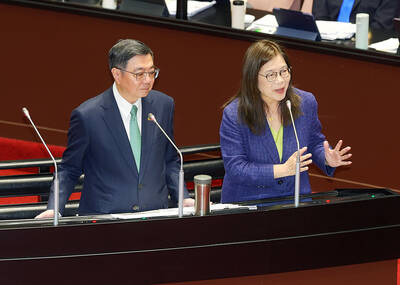
The donation of offshore patrol vessel Kinmen to the Philippines includes provisions that protect Taiwanese fishers and facilitate security cooperation across the First Island Chain, officials said yesterday. The comment was made during the Cabinet’s comprehensive administrative report at the legislature after Chinese Nationalist Party (KMT) Legislator Hsu Yu-chen (許宇甄) expressed concerns about the decision to give a ship to a country whose coast guard had in 2013 fired on a Taiwanese trawler and killed its captain without provocation. The Cabinet should lay out the safeguards that have been established to prevent the Philippine government from using the Kinmen to harass, expel
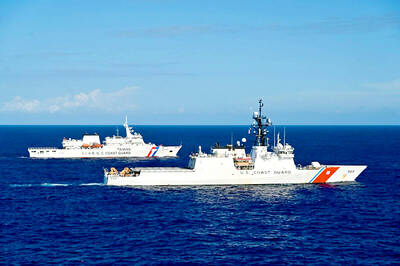
GROWING TIES: The CGA is planning a goodwill mission to the Philippines, in what would be the first time since 1975 a Taiwanese paramilitary vessel has visited the country The Coast Guard Administration (CGA) plans to significantly expand its participation in international security cooperative frameworks and its operational capabilities, a budget proposal for next year showed. The budget indicates a transformation of the CGA from a maritime law enforcement arm into a national defense and intelligence gathering entity capable of tackling larger regional security matters. The proposal showed that personnel from the coast guard’s Intelligence Division and Special Action Support Center are to participate in high-level national security talks with the US. As the CGA has dealt with China’s rising “gray zone” threats around Taiwan, it has become a valuable asset to
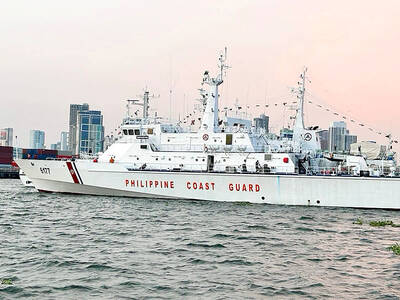
A patrol vessel donated by the Coast Guard Administration (CGA) to the Philippines was commissioned into the Philippine Coast Guard (PCG) on Friday, a Philippine non-governmental organization said. The CGA on Sept. 16 confirmed media reports that Taiwan had donated a retired 500-tonne patrol vessel to the Philippines. The Manila-based We Protect Our Seas (WPS) foundation, which served as an intermediary in the transfer, said that the vessel was formerly the CGA’s 500-tonne petrol vessel Kinmen (CG123). The WPS, in a statement issued on Friday, said the vessel, renamed as the BRP Sarangani, had been commissioned into the PCG the
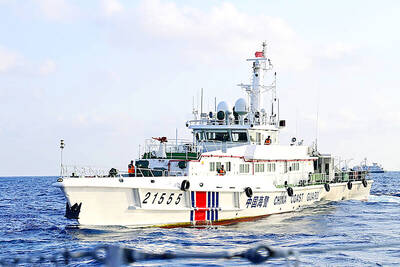
‘GRAY ZONE’ TACTICS: Beijing sent two China Coast Guard vessels to escort a ‘supposedly private research ship,’ a Philippine Coast Guard spokesman said The Coast Guard Administration (CGA) yesterday confirmed that it had recently deployed three patrol vessels to waters in Taiwan’s overlapping exclusive economic zone with the Philippines to monitor three Chinese vessels. CGA Deputy Director-General Hsieh Ching-chin (謝慶欽) said the agency regularly monitors Chinese vessels around Taiwan, and that the deployment south of Oluanpi (鵝鑾鼻), Taiwan proper’s southernmost point, was carried out in accordance with standard procedures. He added that the waters fall within the overlapping exclusive economic zones of Taiwan and the Philippines, which extend 200 nautical miles (370km) from their coastlines. Hsieh made the comments when asked about a


 RSS
RSS