

The government would begin black-box cybersecurity testing using agentic artificial intelligence (AI) to imitate hackers next year, the National Institute of Cybersecurity said yesterday.
The institute’s new director, Dennis Kung (龔化中), told a news conference in Taipei that this would be one of the tasks he would prioritize during his term.
Kung, who has private-sector experience in researching and developing networking equipment, smartphones and cybersecurity software, said cybersecurity research should not be limited to product development in laboratories.

Photo: Reuters
The focus should be on closely linking R&D units with frontline defense units, with the experiences gained from defense units guiding the work of the R&D units, Kung said.
The products developed by R&D teams should be used by the defense units as well.
“With the addition of AI-proficient staff, we can produce a cybersecurity defense that truly meets the needs of the government and private sectors in the fast-changing AI age,” he said.
Kung said that he aims to lead the team at the National Institute of Cybersecurity in upgrading four areas of defense.
First, for the government’s annual cybersecurity exercises next year, the institute would run black-box penetration tests, using agentic AI to imitate hackers. Agentic AI would be used in the Cybersecurity Operations and Defense Exercise next year, he said.
Second, the institute would work with international AI firms to use on-premises models to conduct automated source-code scans of software used in key government and critical infrastructure projects, addressing vulnerabilities at the development stage, he said.
Third, the institute would use agentic AI and large language models to analyze millions of pieces of global cybersecurity intelligence in real time each day and turn them into blocking rules for perimeter security devices, he said.
Fourth, the institute would assist the government and the private sector in building a controlled environment for high-intensity AI-powered cybersecurity attacks, Kung said, adding that this would help build a strong, ingrained defensive response.
Kung said that he found that AI can identify vulnerabilities at least 10 times faster than traditional methods. Government agencies should first establish a comprehensive software bill of materials inventory and prioritize repair based on risk levels, he said, adding that they can deploy virtual patches as temporary measures to block threats, rather than attempting to patch every vulnerability indiscriminately.
Kung said the institute would be committed to strengthening Taiwan’s overall cybersecurity capabilities by working with its incident response center and the Administration for Cybersecurity to help domestic companies establish product security incident response teams (PSIRTs).
The initiative is introduced in line with the EU’s Cyber Resilience Act, Kung said.
This year, the institute plans to assist at least 30 companies in establishing PSIRTs to ensure that vulnerabilities can be reported and patched promptly when discovered, he added.
Regarding frequent DDoS attacks targeting media Web sites, Kung said that the institute and the Taiwan Computer Emergency Response Team/Coordination Center are always ready to provide support.

The donation of offshore patrol vessel Kinmen to the Philippines includes provisions that protect Taiwanese fishers and facilitate security cooperation across the First Island Chain, officials said yesterday. The comment was made during the Cabinet’s comprehensive administrative report at the legislature after Chinese Nationalist Party (KMT) Legislator Hsu Yu-chen (許宇甄) expressed concerns about the decision to give a ship to a country whose coast guard had in 2013 fired on a Taiwanese trawler and killed its captain without provocation. The Cabinet should lay out the safeguards that have been established to prevent the Philippine government from using the Kinmen to harass, expel
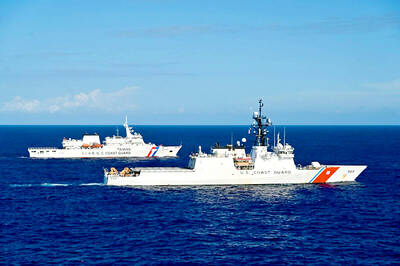
GROWING TIES: The CGA is planning a goodwill mission to the Philippines, in what would be the first time since 1975 a Taiwanese paramilitary vessel has visited the country The Coast Guard Administration (CGA) plans to significantly expand its participation in international security cooperative frameworks and its operational capabilities, a budget proposal for next year showed. The budget indicates a transformation of the CGA from a maritime law enforcement arm into a national defense and intelligence gathering entity capable of tackling larger regional security matters. The proposal showed that personnel from the coast guard’s Intelligence Division and Special Action Support Center are to participate in high-level national security talks with the US. As the CGA has dealt with China’s rising “gray zone” threats around Taiwan, it has become a valuable asset to
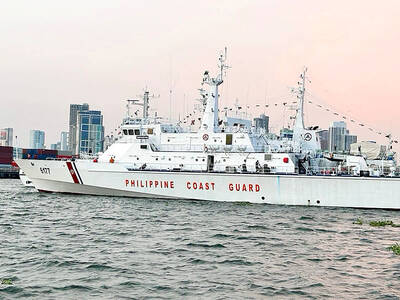
A patrol vessel donated by the Coast Guard Administration (CGA) to the Philippines was commissioned into the Philippine Coast Guard (PCG) on Friday, a Philippine non-governmental organization said. The CGA on Sept. 16 confirmed media reports that Taiwan had donated a retired 500-tonne patrol vessel to the Philippines. The Manila-based We Protect Our Seas (WPS) foundation, which served as an intermediary in the transfer, said that the vessel was formerly the CGA’s 500-tonne petrol vessel Kinmen (CG123). The WPS, in a statement issued on Friday, said the vessel, renamed as the BRP Sarangani, had been commissioned into the PCG the
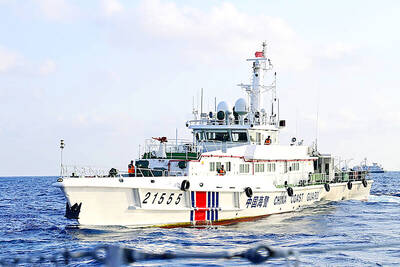
‘GRAY ZONE’ TACTICS: Beijing sent two China Coast Guard vessels to escort a ‘supposedly private research ship,’ a Philippine Coast Guard spokesman said The Coast Guard Administration (CGA) yesterday confirmed that it had recently deployed three patrol vessels to waters in Taiwan’s overlapping exclusive economic zone with the Philippines to monitor three Chinese vessels. CGA Deputy Director-General Hsieh Ching-chin (謝慶欽) said the agency regularly monitors Chinese vessels around Taiwan, and that the deployment south of Oluanpi (鵝鑾鼻), Taiwan proper’s southernmost point, was carried out in accordance with standard procedures. He added that the waters fall within the overlapping exclusive economic zones of Taiwan and the Philippines, which extend 200 nautical miles (370km) from their coastlines. Hsieh made the comments when asked about a


 RSS
RSS