

Taiwan High Speed Rail Corp (THSRC) said yesterday that beginning on Thursday, it would operate eight southbound train services from Taipei to Taichung between 5pm and 9pm every Friday consisting solely of non-reserved seat carriages to ease passenger pressure.
The announcement came after the high-speed railway operator faced criticism for not limiting sales of non-reserved seats for the four-day Mid-Autumn Festival and Teachers’ Day weekend last month, resulting in large numbers of non-reserved-seat passengers spilling into reserved-seat cars and leaving many passengers with reserved seats unable to board during the first two days of the holiday.
Statistics from the Ministry of Transportation and Communications showed the number of high-speed rail passengers reached a record-high 347,979 on the first day of the holiday. The system transported approximately 1.788 million people during the four-day long weekend, ministry data showed.
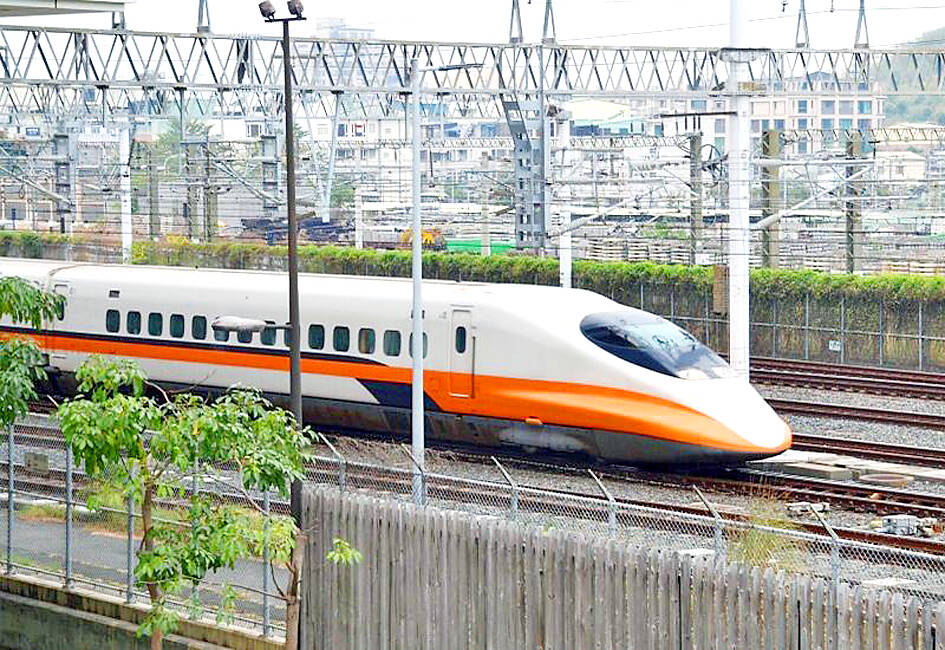
Photo: Wu Cheng-fung, Taipei Times
Railway Bureau Director-General Yang Cheng-chun (楊正君) said last week that pressure on the high-speed system’s capacity is unlikely to ease until all 12 newly procured train sets enter service by 2028.
The THSRC said three of the new train sets are scheduled to begin operations in July next year. Before new trains are added to the service fleet, the high-speed rail operator said that it would implement special service deployment plans designed to maximize its transport capacity during peak or even super peak hours.
The peak hours for the high-speed rail system refer to the period from 5pm to 9pm on Friday, while the super-peak hours occur when the time coincides with the beginning of a long weekend or a major national holiday, it said.
During peak hours, cabins of non-reserved seats are often crowded, particularly in sections north of Taichung, it said.
Starting on Thursday, eight southbound train services would operate at the beginning of every weekend between 5pm and 9pm and provide only non-reserved seats, except business-class cabins. The eight train services would depart from Nangang or Taipei and terminate in Taichung.
Under the special deployment plan, trains would reverse directions directly at the platforms, without returning to the depot, the company said, adding that trains depart again after a 12-minute interval.
This would reduce the train deployment time by one hour and increase capacity during peak hours, quickly transporting southbound passengers and reducing the wait time for northbound passengers, it added.
The company said that the special scheduling would be implemented for the first time on Thursday, the last workday this week before people begin the three-day holiday weekend.
THSRC would run a pair of Taichung-bound train services departing from Nangang or Taipei hourly from 5pm to 9pm that would stop at every station along the way, each with nine to 11 cars of non-reserved seats.
During the Double Ten National Day holiday travel period, 23 additional train services would be provided to help accommodate increased passenger demand, it said.
To encourage passengers to travel during off-peak hours, an extra late-night service would be operated on Thursday, while an additional northbound service would be added on Saturday, it said.

The donation of offshore patrol vessel Kinmen to the Philippines includes provisions that protect Taiwanese fishers and facilitate security cooperation across the First Island Chain, officials said yesterday. The comment was made during the Cabinet’s comprehensive administrative report at the legislature after Chinese Nationalist Party (KMT) Legislator Hsu Yu-chen (許宇甄) expressed concerns about the decision to give a ship to a country whose coast guard had in 2013 fired on a Taiwanese trawler and killed its captain without provocation. The Cabinet should lay out the safeguards that have been established to prevent the Philippine government from using the Kinmen to harass, expel
GROWING TIES: The CGA is planning a goodwill mission to the Philippines, in what would be the first time since 1975 a Taiwanese paramilitary vessel has visited the country The Coast Guard Administration (CGA) plans to significantly expand its participation in international security cooperative frameworks and its operational capabilities, a budget proposal for next year showed. The budget indicates a transformation of the CGA from a maritime law enforcement arm into a national defense and intelligence gathering entity capable of tackling larger regional security matters. The proposal showed that personnel from the coast guard’s Intelligence Division and Special Action Support Center are to participate in high-level national security talks with the US. As the CGA has dealt with China’s rising “gray zone” threats around Taiwan, it has become a valuable asset to
A patrol vessel donated by the Coast Guard Administration (CGA) to the Philippines was commissioned into the Philippine Coast Guard (PCG) on Friday, a Philippine non-governmental organization said. The CGA on Sept. 16 confirmed media reports that Taiwan had donated a retired 500-tonne patrol vessel to the Philippines. The Manila-based We Protect Our Seas (WPS) foundation, which served as an intermediary in the transfer, said that the vessel was formerly the CGA’s 500-tonne petrol vessel Kinmen (CG123). The WPS, in a statement issued on Friday, said the vessel, renamed as the BRP Sarangani, had been commissioned into the PCG the
‘GRAY ZONE’ TACTICS: Beijing sent two China Coast Guard vessels to escort a ‘supposedly private research ship,’ a Philippine Coast Guard spokesman said The Coast Guard Administration (CGA) yesterday confirmed that it had recently deployed three patrol vessels to waters in Taiwan’s overlapping exclusive economic zone with the Philippines to monitor three Chinese vessels. CGA Deputy Director-General Hsieh Ching-chin (謝慶欽) said the agency regularly monitors Chinese vessels around Taiwan, and that the deployment south of Oluanpi (鵝鑾鼻), Taiwan proper’s southernmost point, was carried out in accordance with standard procedures. He added that the waters fall within the overlapping exclusive economic zones of Taiwan and the Philippines, which extend 200 nautical miles (370km) from their coastlines. Hsieh made the comments when asked about a


 RSS
RSS