

The Taichung District Prosecutors’ Office has indicted a soldier on a charge of disobeying orders after he allegedly refused to go to sleep or get out of bed, seeking a heavy sentence.
The soldier, surnamed Lee (李), assigned to the 302nd Infantry Brigade at the Chenggong Ling (成功嶺) training depot in Taichung, was suspended on July 4, prosecutors said.
Lee allegedly struggled to adapt to military life and repeatedly disobeyed orders from his superiors, investigators found.
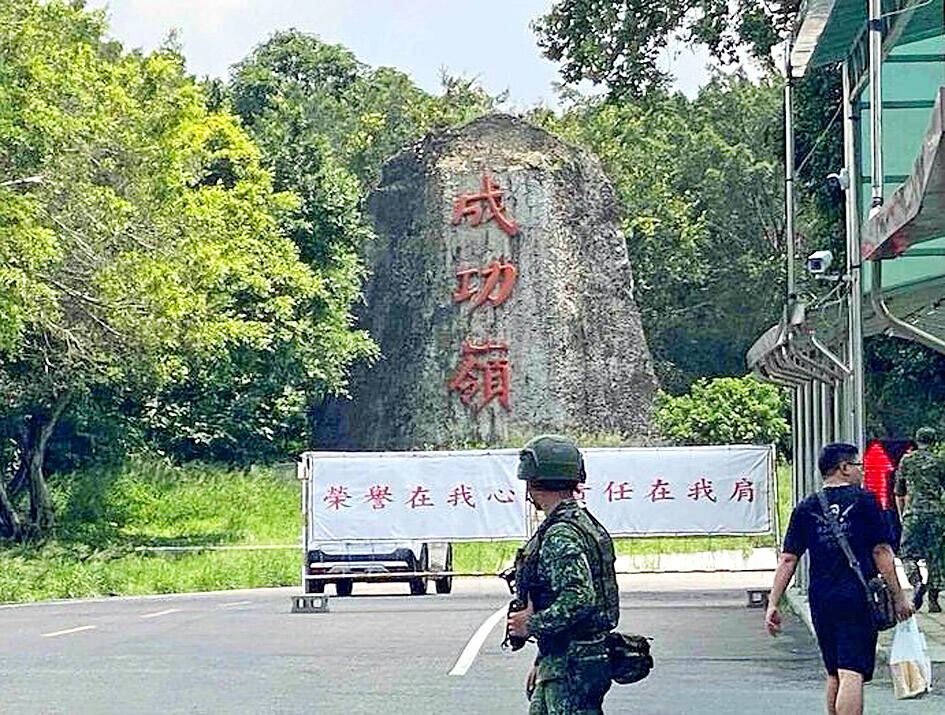
Photo:Taipei Times
At about 10pm on May 3, he allegedly refused to go to bed at lights-out after being told to do so by his company commander, surnamed Lin (林), and was eventually carried bodily to the dormitory by other soldiers.
The following morning, he ignored orders issued by Lin to get up, sleeping in until 9:30am, the indictment said.
Lee allegedly disobeyed orders issued by his commander within the scope of his authority and related to military duties on two consecutive occasions within a short period, prosecutors said.
The alleged conduct went beyond his daily routine, involving military discipline and the chain of command, they said.
Lee had admitted the offenses, prosecutors said, adding that testimony from Lin and other officers supported the allegations and there was sufficient evidence to prosecute.
Lee was charged under the Criminal Code of the Armed Forces (陸海空軍刑法) with disobeying orders issued within the scope of authority regarding military affairs.
The case, referred for investigation by the Taichung military police of the Military Police Command, had a serious impact on unit discipline and the authority of the commanding officer, prosecutors said, requesting the court impose a heavy sentence.
When asked for comment, lawyer Lee Hsueh-yung (李學鏞) said on Saturday that soldiers are obliged to obey lawful, clear orders issued by superiors within their authority and concerning military matters.
Under Article 47-1 of the Criminal Code of the Armed Forces, anyone who disobeys an order issued by higher authorities or within the commander’s powers faces a sentence of up to five years in prison, he said.
The punishment for disobeying orders is not limited to disciplinary action, such as demerits or confinement to base, but can lead to criminal prosecution, he said.
Not every instance of disobeying orders constitutes the crime of disobedience, he said.
Orders involving ordinary day-to-day matters would not necessarily fall within the scope of criminal law, he said.
The key issues are whether the order was issued with the superior’s authority, whether its content was clear and whether it concerned military matters, he said.
The issue in this case is whether the orders to “return to the dormitory and go to bed” and to “get up” constituted orders related to military duties, unit routines and military management, he said.
Based on the indictment, the soldier did refused to obey more than once, and he continued to disregard the company commander’s orders despite being repeatedly instructed to comply, he said.
Both incidents involved disobedience of orders issued by a superior within the scope of the officer’s authority and related to military matters, he said.
The court would consider factors including the frequency of violations, degree of defiance, impact on discipline, and the defendant’s attitude after the offenses, he said.
Last year, a soldier was sentenced to three months in prison, commutable to a fine of NT$90,000, for allegedly twice ignoring a sergeant major’s orders to put away his mobile phone during an inspection at Penghu Defense Command. The court ruled that while it was not a direct combat order, it concerned military affairs, leaving the soldier with no right to refuse to comply.

The donation of offshore patrol vessel Kinmen to the Philippines includes provisions that protect Taiwanese fishers and facilitate security cooperation across the First Island Chain, officials said yesterday. The comment was made during the Cabinet’s comprehensive administrative report at the legislature after Chinese Nationalist Party (KMT) Legislator Hsu Yu-chen (許宇甄) expressed concerns about the decision to give a ship to a country whose coast guard had in 2013 fired on a Taiwanese trawler and killed its captain without provocation. The Cabinet should lay out the safeguards that have been established to prevent the Philippine government from using the Kinmen to harass, expel
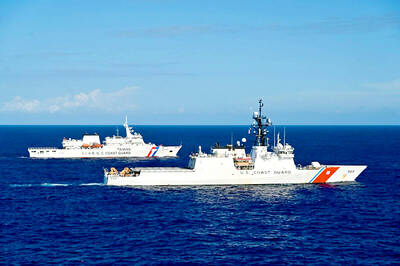
GROWING TIES: The CGA is planning a goodwill mission to the Philippines, in what would be the first time since 1975 a Taiwanese paramilitary vessel has visited the country The Coast Guard Administration (CGA) plans to significantly expand its participation in international security cooperative frameworks and its operational capabilities, a budget proposal for next year showed. The budget indicates a transformation of the CGA from a maritime law enforcement arm into a national defense and intelligence gathering entity capable of tackling larger regional security matters. The proposal showed that personnel from the coast guard’s Intelligence Division and Special Action Support Center are to participate in high-level national security talks with the US. As the CGA has dealt with China’s rising “gray zone” threats around Taiwan, it has become a valuable asset to

The National Police Agency’s Third Special Police Corps yesterday said that from May to July, it intercepted five smuggling operations from China, seizing more than 70,000 counterfeit Beyblades with an estimated infringement value of NT$34.45 million (US$1.08 million). It added that any bootleg unit that reached the local market could present hidden health hazards to players. Beyblades, a line of spinning toy tops used in competitive gaming and developed in Japan by toy company Takara Tomy, have become popular in Taiwan, making them a target for fraudsters. The Third Special Police Corps, dedicated to safeguarding maritime borders and trade lines,
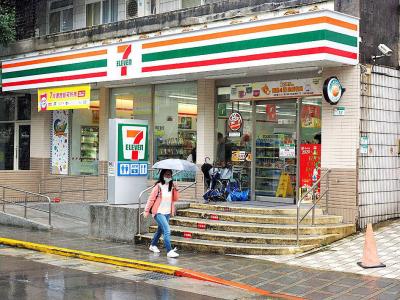
Five customers who made purchases at 7-Eleven stores across Taiwan won the top NT$10 million (US$313,716) special prize in the July-August uniform invoice lottery, including one who spent just NT$27 on photocopying, the convenience store chain said today. The five special prize winners made their purchases at stores in Taoyuan, Taipei, Taichung and Kaohsiung, 7-Eleven operator President Chain Store Corp said. The five winning purchases included NT$29 spent on snacks at a store in Taoyuan's Zhongli District (中壢), NT$27 on photocopying at a store in Taipei's Zhongzheng District (中正), NT$139 on City Cafe coffee and daily necessities at a store in Taipei's


 RSS
RSS