

A domestically developed system combining artificial intelligence (AI)-powered autonomous navigation and federated learning has completed autonomous patrol tests using a medium to large-sized uncrewed surface vessel, the Ocean Affairs Council said yesterday, adding that it would help protect sensitive maritime data and improve vessels’ object-recognition capabilities.
The system is the result of the council’s “AI Navigation and Federated Learning for Maritime Object Recognition: Feasibility and Reliability Testing for Scalable Unmanned Surface Vessels” project, conducted under its Marine Technology Project Program.
The project was part of the council’s efforts to accelerate marine technology development and the application of smart maritime systems in Taiwan, it said.
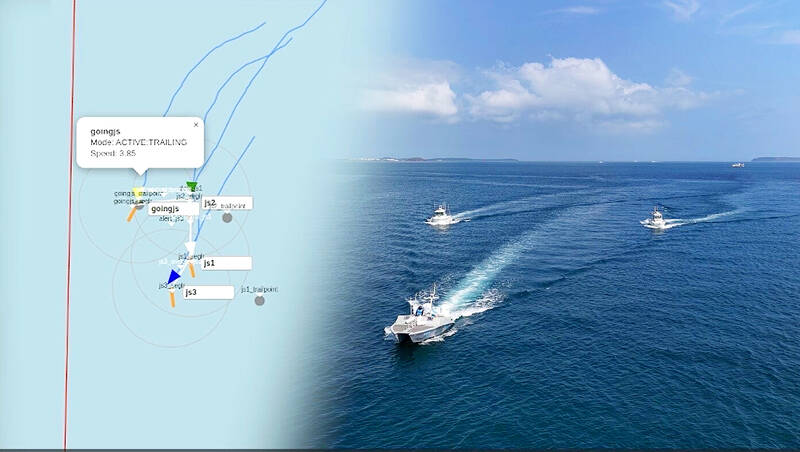
Photo courtesy of the Ocean Affairs Council
Maritime imagery has been collected mainly as snapshots of individual incidents, while national and port security concerns limited access to broader datasets, restricting the amount of data available for AI training, the council said.
The use of federated learning allows AI models to be trained using data from multiple vessels without requiring ships to share sensitive data or imagery, it said.
Previously, uncrewed vessels trained their own AI models and could share the algorithms used in the training process, but not the underlying data, the council said.
The new system allows vessels across the fleet to improve their models collaboratively while keeping sensitive information and imagery on individual platforms, significantly improving their ability to recognize objects, it said.
To prevent “catastrophic forgetting,” in which AI models lose previously learned skills when acquiring new ones, the research team incorporated elastic weight consolidation.
The technology allows uncrewed vessels to learn to recognize new objects, such as newly introduced maritime warning buoys, without losing their ability to identify commercial vessels and fishing boats, the council said.
The vessels underwent stress tests in waters off Fengbitou (鳳鼻頭) near Kaohsiung Harbor.
Under real-world conditions, including sea states of force 2 or higher and challenging lighting, the vessel completed a series of demanding tasks, including point-to-point obstacle avoidance, hexagonal navigation, Z-shaped patrols and large-area “lawnmower” searches, the council said.
The system achieved a mean average precision of more than 90 percent for object detection, an inference speed of at least 15 frames per second and a forgetting rate of less than 10 percent, it said.
The project also established Taiwan’s first standard operating procedures for operating medium and large-sized uncrewed vessels in open waters, the council said.
The vessels are equipped with an emergency system that allows human operators to take control within three seconds of a communications failure, ensuring safe navigation, it said.
All of the system’s algorithms were developed domestically, the council said, adding that the project was designed to reduce reliance on foreign technologies subject to export controls and bolster Taiwan’s resilience in marine research and maritime security.

The National Police Agency’s Third Special Police Corps yesterday said that from May to July, it intercepted five smuggling operations from China, seizing more than 70,000 counterfeit Beyblades with an estimated infringement value of NT$34.45 million (US$1.08 million). It added that any bootleg unit that reached the local market could present hidden health hazards to players. Beyblades, a line of spinning toy tops used in competitive gaming and developed in Japan by toy company Takara Tomy, have become popular in Taiwan, making them a target for fraudsters. The Third Special Police Corps, dedicated to safeguarding maritime borders and trade lines,
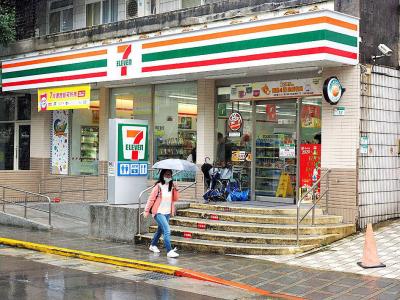
Five customers who made purchases at 7-Eleven stores across Taiwan won the top NT$10 million (US$313,716) special prize in the July-August uniform invoice lottery, including one who spent just NT$27 on photocopying, the convenience store chain said today. The five special prize winners made their purchases at stores in Taoyuan, Taipei, Taichung and Kaohsiung, 7-Eleven operator President Chain Store Corp said. The five winning purchases included NT$29 spent on snacks at a store in Taoyuan's Zhongli District (中壢), NT$27 on photocopying at a store in Taipei's Zhongzheng District (中正), NT$139 on City Cafe coffee and daily necessities at a store in Taipei's
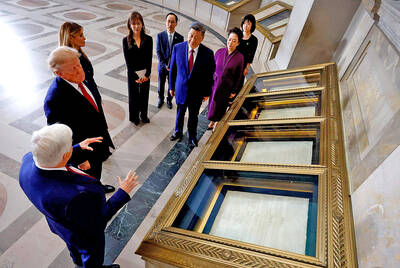
Chinese President Xi Jinping (習近平) reportedly cut short his visit to the National Archives in Washington after the Chinese delegation objected to plans to view the Treaty of San Francisco, sources in Washington’s media circles said. Xi and his wife, Peng Liyuan (彭麗媛), concluded their three-day state visit to the US on Friday after having tea with US President Donald Trump and first lady Melania Trump at the White House and visiting the archives. Chinese democracy advocates and members of pro-China groups gathered outside the venue during Xi’s visit, with the two groups exchanging competing slogans while police kept them separated. The US

TRICKY ISSUE: Taiwan’s defense of the ROC in WWII could conflict with the government’s narrative on Taiwanese history and identity, an academic said Chinese President Xi Jinping (習近平) had no standing to discuss US-China relations in World War II (WWII), as the People’s Republic of China did not exist at that time, Mainland Affairs Council (MAC) Deputy Minister Shen Yu-chung (沈有忠) said yesterday. Taipei would ensure that Washington has a clear understanding that it was the Republic of China (ROC), not the People’s Republic of China (PRC), that was a steadfast ally of the US in WWII, Shen said. Shen was referring to a White House fact sheet released on Friday about Xi’s meeting with US President Donald Trump in Washington. It said that “the two


 RSS
RSS