

Taiwan has completed production of all 66 domestically developed Brave Eagle (勇鷹) advanced jet trainers (AJT), with Aerospace Industrial Development Corp (AIDC) chairman Tsao Chin-pin (曹進平) yesterday personally piloting one of the final two aircraft to the Air Force Academy in Kaohsiung’s Gangshan District (岡山).
The two aircraft, No. 1165 and 1166, took off at about 11am, circled Ching Chuan Kang Air Base (清泉崗基地) and made a low pass over AIDC’s Shalu plant in Taichung, where employees waved to the aircraft.
They landed at 11:36am, marking the completion of a nine-year program to develop and mass-produce the new trainer.
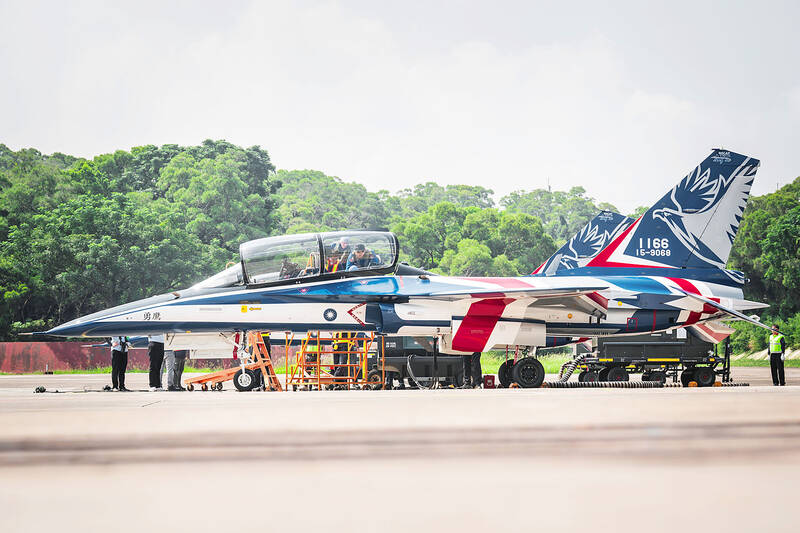
Photo: CNA
Although 66 Brave Eagles have been produced, the air force currently has 65 after one crashed into waters off Taitung County in February last year.
The pilot ejected safely from the aircraft.
The Brave Eagle is designed to replace the decommissioned F-5E/F and AT-3 aircraft, enabling the air force to adopt a “three-stage, two-aircraft” pilot training system that also involves the T-34 trainer aircraft.
The Brave Eagle serves advanced and operational flight-training roles, allowing pilots to transition more efficiently to frontline fighters such as the F-16V Block 20 and Block 70 aircraft.
The advanced jet trainer program was launched in 2017 through contracts involving the air force, government-funded weapons developer National Chungshan Institute of Science and Technology (NCSIST) and the AIDC.
AIDC was the prime contractor, overseeing aircraft design, component production, assembly and testing, while more than 200 domestic suppliers participated in the program.
Derived from Taiwan’s Indigenous Defense Fighter (IDF), the Brave Eagle has more than 80 percent of its components redesigned from those of the IDF, with changes to its aerodynamics, exterior and fuselage. Its domestic content reached 55 percent.
The first prototype was unveiled on Sept. 24, 2019, and named Brave Eagle by then-president Tsai Ing-wen (蔡英文).
AIDC completed the aircraft’s design and conducted its first flight within three years and two months, the company said.
Mass production began in 2021, but was affected by the COVID-19 pandemic, international conflicts and geopolitical tensions that disrupted global supply chains.
AIDC said it overcame shortages of imported systems and key components by developing some of them domestically in cooperation with government research institutes and local manufacturers.
Despite those disruptions, AIDC delivered 14 Brave Eagles each last year and this year, it said.
Completing the program has also strengthened its experience and capabilities in aircraft development, systems integration, mass production and supply chain management, which would support future military aircraft maintenance, upgrades and logistics programs, AIDC said.
With the Brave Eagle production completed and plans for a next-generation primary trainer or fighter jet still undetermined, experts warned of a potential talent drain in the domestic aerospace industry.
Chi Li-ping (齊立平), former head of the institute’s Aeronautical Systems Research Division, urged the government not to repeat the mistake it made after the IDF program in the 1990s, when a halt in development led to a decades-long technology and talent gap.
Maintaining an indigenous aircraft platform is the lifeblood of national defense autonomy, Chi said, adding that while Taiwan could integrate its domestically developed missiles onto the IDF, the US would never open the interfaces of purchased F-16s or MQ-9B drones to accommodate Taiwanese weapons.
Institute for National Defense and Security Research research fellow Shu Hsiao-huang (舒孝煌) suggested that pivoting to develop advanced combat drones could be a viable path to sustain the local industry’s manufacturing capabilities, although it would require significant financial and personnel investments.
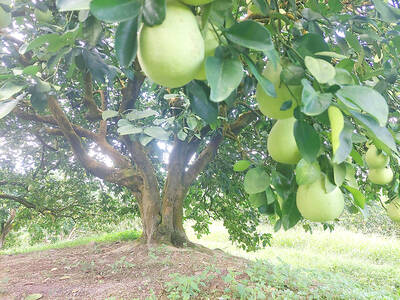
A Hualien pomelo farmer refused to sell to China after the country announced it would permit more Taiwanese pomelo imports, prompting widespread support from Taiwanese consumers, who rallied to buy his fruit. China’s Taiwan Affairs Office last month said that China’s General Administration of Customs registered an additional 79 Taiwanese pomelo orchards and packing facilities in Hualien County, allowing more Taiwanese producers to export pomelos to China. “I am a Hualien fruit farmer and I refuse to sell to China,” Liu Tzu-hao (劉子豪) from Ruisui Township (瑞穗) said in an online post. Liu is a well-known farmer in the community and has served
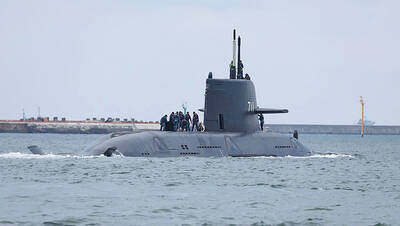
UPDATE: The submarine would need to undergo combined systems testing and crew training for navy personnel before it is ready for mission, an expert said Taiwan’s first domestically built submarine, the Hai Kun (Narwhal, 海鯤), could be delivered to the navy as early as next month, military expert and Taiwan Association for Security and Development chairman Chi Tung-yun (紀東昀) said yesterday. The submarine was yesterday morning observed departing for its 21st sea trial and its 15th submerged test. The vessel missed the initial delivery deadline of November last year due to “testing delays,” its primary contractor, shipbuilder CSBC Corp, Taiwan, said in June. The contractor also cited “political pressure from China” in procuring critical equipment. All testing operations are in the final stages, with the

OCT. 31: The antiviral drugs Tamiflu and Eraflu have been distributed to about 4,000 medical facilities nationwide for people in seven groups who develop flu-like symptoms As the domestic influenza epidemic enters its peak season and continues to escalate, the Centers for Disease Control (CDC) yesterday announced that publicly funded influenza antiviral drugs for seven eligible groups have been extended to Oct. 31, allowing those who develop flu-like symptoms to receive the medication without undergoing a rapid influenza test. The CDC has extended the expanded use of flu antiviral drugs to seven groups: healthcare and influenza-prevention personnel; residents and staff at nursing homes, long-term care facilities and similar institutions; kindergarten and daycare workers and home-based caregivers; students from kindergarten through high school, vocational high school and the
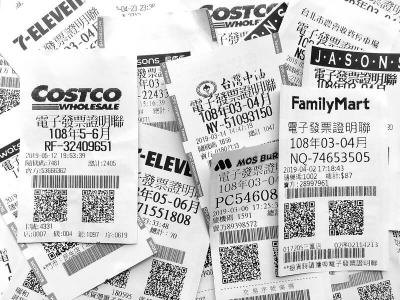
Six NT$10 million (US$315,527) special prizes and seven NT$2 million grand prizes in Taiwan's May-June uniform invoice lottery remained unclaimed as of today, including one NT$10 million winner who spent only NT$10 on an Uber Eats delivery order, the Ministry of Finance said. The ministry said the 13 winners need to claim their prizes by Nov. 5. The eight-digit serial number that won the NT$10 million special prize for May-June was 38548029, with 18 winning receipts in total. The NT$2 million grand prize number was 10138845, of which there were 22 winning receipts, the ministry said. In addition to the receipt issued for an


 RSS
RSS