

US Secretary of State Marco Rubio yesterday reiterated that US arms sales to Taiwan remain under review, saying that the US must balance such decisions against its own needs.
After four Republican senators raised concerns earlier in the day about stalled US arms sales and other military assistance to Taiwan, Rubio said that it was a multidimensional issue.
"People think ... we view arms sales through the limited vacuum of one particular place. A lot of this also involves balancing our industrial capacity and our military industrial base," Rubio told reporters in New York.
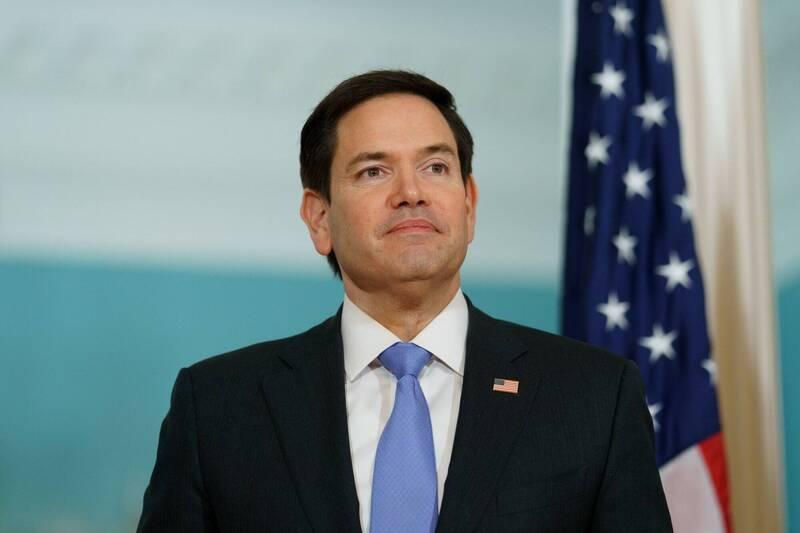
Photo: EPA
"This is not about Taiwan in specific, but when we sell something, that means we don't have it anymore," he said.
Washington's decision on arms sales to Taiwan was still under review, Rubio added.
"Anytime we do any sales — not to Taiwan, to anybody — it is always balanced against what are our own needs in different parts of the world and whether we can afford to sell something, because we may need it for ourselves. So that's going through that process," he said.
Rubio made the comments in response to reporters' questions after four Republican senators yesterday wrote to him and US Secretary of Defense Pete Hegseth about Washington's obligation to assist with Taiwan's self-defense capabilities.
US senators Mitch McConnell, John Cornyn, Lisa Murkowski and Thom Tillis expressed concerns about whether the US Department of State intended to fulfill its obligation to provide US$300 million in foreign military financing for Taiwan and US$1 billion in funding for the Taiwan Security Cooperation Initiative.
They also questioned Washington's decision to stall US$14 billion in foreign military sales to Taiwan.
"We are concerned by [US] President [Donald] Trump's description of Taiwan as 'a very good negotiating chip' in engagements with [Chinese President] Xi Jinping [習近平] and the Chinese Communist Party," the four senators wrote.
"It is difficult to imagine how the United States might credibly project influence in the Indo-Pacific if the price of keeping up diplomatic appearances is denying our partners key deterrent capabilities," they added.
Asked about the issue, a senior administration official said that Trump had earlier this year said that he would decide "in a fairly short time regarding a new Taiwan arms package."
In December last year, Trump had approved "the largest ever arms package for Taiwan" of US$11.1 billion, the unnamed official said in an e-mail.
"In his first term, President Trump approved more arms sales to Taiwan than any other President in history," the official said. "In his second term, President Trump approved more in his first year than all four years under President Biden."
Xi arrived in Washington on Wednesday for a summit with Trump, which is expected to include discussions on arms sales to Taiwan.
Under US law, Washington is obligated to provide Taiwan with the means to defend itself.
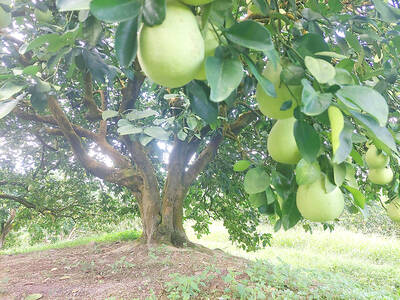
A Hualien pomelo farmer refused to sell to China after the country announced it would permit more Taiwanese pomelo imports, prompting widespread support from Taiwanese consumers, who rallied to buy his fruit. China’s Taiwan Affairs Office last month said that China’s General Administration of Customs registered an additional 79 Taiwanese pomelo orchards and packing facilities in Hualien County, allowing more Taiwanese producers to export pomelos to China. “I am a Hualien fruit farmer and I refuse to sell to China,” Liu Tzu-hao (劉子豪) from Ruisui Township (瑞穗) said in an online post. Liu is a well-known farmer in the community and has served
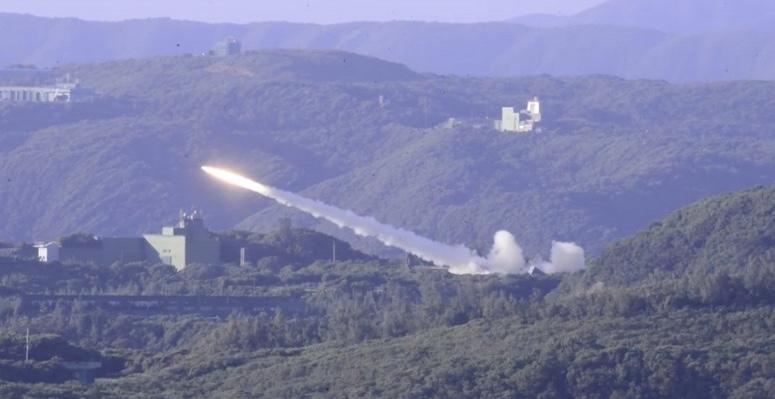
A Chinese military drone was spotted conducting reconnaissance off Taitung County as President William Lai (賴清德) visited Pingtung County this morning to inspect a drill of the armed forces’ precision-strike capabilities, prompting the military to closely monitor its actions. Today was the final day of a three-day military exercise at Jioupeng Base (九鵬基地) to test the joint combat capabilities of the armed forces and coast guard. The exercise began on Wednesday simulating air defense interception and yesterday tested long-range strike capabilities and new air defense weapons. This morning, the military conducted a final exercise involving air defense, anti-ship and drone operations. Military sources said
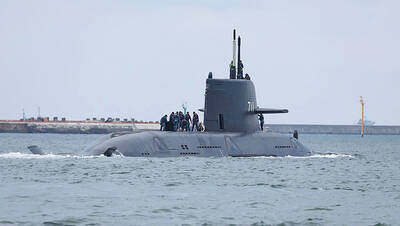
UPDATE: The submarine would need to undergo combined systems testing and crew training for navy personnel before it is ready for mission, an expert said Taiwan’s first domestically built submarine, the Hai Kun (Narwhal, 海鯤), could be delivered to the navy as early as next month, military expert and Taiwan Association for Security and Development chairman Chi Tung-yun (紀東昀) said yesterday. The submarine was yesterday morning observed departing for its 21st sea trial and its 15th submerged test. The vessel missed the initial delivery deadline of November last year due to “testing delays,” its primary contractor, shipbuilder CSBC Corp, Taiwan, said in June. The contractor also cited “political pressure from China” in procuring critical equipment. All testing operations are in the final stages, with the

OCT. 31: The antiviral drugs Tamiflu and Eraflu have been distributed to about 4,000 medical facilities nationwide for people in seven groups who develop flu-like symptoms As the domestic influenza epidemic enters its peak season and continues to escalate, the Centers for Disease Control (CDC) yesterday announced that publicly funded influenza antiviral drugs for seven eligible groups have been extended to Oct. 31, allowing those who develop flu-like symptoms to receive the medication without undergoing a rapid influenza test. The CDC has extended the expanded use of flu antiviral drugs to seven groups: healthcare and influenza-prevention personnel; residents and staff at nursing homes, long-term care facilities and similar institutions; kindergarten and daycare workers and home-based caregivers; students from kindergarten through high school, vocational high school and the


 RSS
RSS