

US President Donald Trump and Chinese President Xi Jinping (習近平) are expected to discuss trade, artificial intelligence (AI) and Taiwan at a summit beginning in Washington today, with academics saying the talks would also aim to manage competition between the two countries.
The summit, the leaders’ second face-to-face meeting this year following talks in Beijing in May, is expected to build on their agreement to establish a “constructive relationship of strategic stability,” said Bao Chengke (包承柯), a researcher at the Shanghai Institute for East Asian Studies.
Bao told the Central News Agency that the two sides have made progress in implementing agreements reached in May, including China’s purchases of US agricultural products.
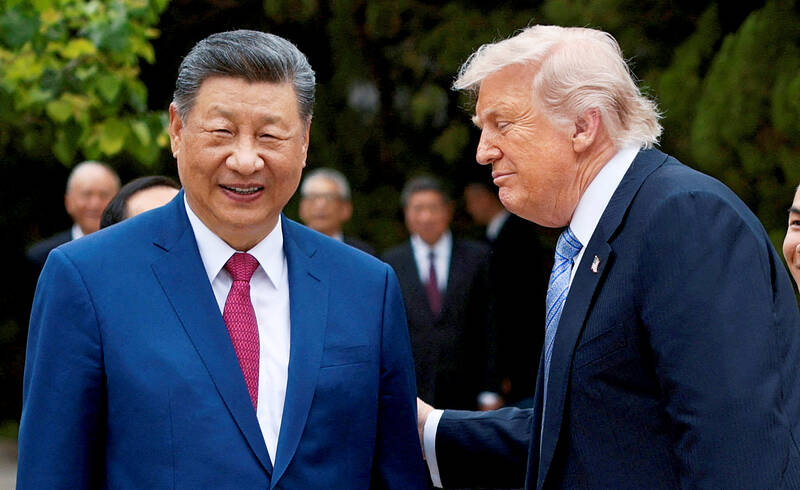
Photo: Reuters
Negotiators are also working on a reciprocal framework to reduce tariffs on about US$30 billion of non-sensitive goods from each country, with an announcement on the framework expected after the summit, he said.
Ensuring a stable supply of Chinese rare earths to the US could also be discussed, Bao said.
On broader strategic issues, Bao said Beijing and Washington have common interests regarding Iran and Russia.
Both support freedom of navigation through the Strait of Hormuz and favor a peaceful resolution to the Russia-Ukraine war, leaving room for greater cooperation to help preserve global stability, he said.
Taiwan is also expected to feature in the talks, with Beijing hoping Washington will provide greater clarity on US arms sales to Taiwan to reduce unnecessary risks, Bao said.
On AI, the two countries should establish mechanisms to manage risks and prevent competition from escalating uncontrollably in a field critical to national security, economic competitiveness and military capabilities, he said.
Separately, Wu Xinbo (吳心伯), dean of Fudan University’s Institute of International Studies, said at the Xiangshan Forum in Beijing that the US and China need to begin talks on AI risks and safeguards, adding that the two countries account for about 90 percent of global AI capabilities.
Although no government-to-government AI dialogue has begun, Wu said Beijing should remain cautious because Washington could use such talks to slow China’s AI development.
Taiwanese academics offered a different assessment, saying trade, procurement commitments and AI are likely to dominate the agenda, while Taiwan is expected to play a secondary role.
Wang Hsin-hsien (王信賢), a professor at National Chengchi University’s Graduate Institute of East Asian Studies, said that Trump is seeking tangible outcomes to boost Republican prospects ahead of the November US midterm elections.
Meanwhile, Xi aims to show that China’s foreign policy and domestic governance remain stable ahead of the Chinese Communist Party’s 21st National Congress next year, Wang said.
Wang Hung-jen (王宏仁), a professor of political science at National Cheng Kung University, said Beijing is expected to press Washington to slow the pace of arms sales to Taiwan and limit high-level US-Taiwan exchanges.
However, Wang Hung-jen said China recognizes that it is unlikely to persuade the US to halt arms sales to Taiwan altogether.
While Taiwan will be discussed, it is unlikely to feature more prominently than it did during the leaders’ May meeting, he said.
As attention turns to the summit, Jakob Lengacher, the US Department of State’s Chinese-language spokesman, told Voice of America in New York that US policy toward Taiwan remains unchanged.
Washington continues to support Taiwan’s meaningful participation in international organizations, including the APEC forum, Lengacher said.
He reiterated that the US opposes unilateral changes to the “status quo” by either side of the Taiwan Strait and remains committed to maintaining peace and stability in the region.
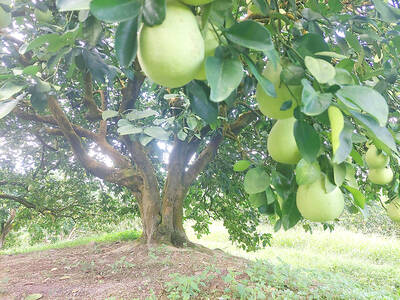
A Hualien pomelo farmer refused to sell to China after the country announced it would permit more Taiwanese pomelo imports, prompting widespread support from Taiwanese consumers, who rallied to buy his fruit. China’s Taiwan Affairs Office last month said that China’s General Administration of Customs registered an additional 79 Taiwanese pomelo orchards and packing facilities in Hualien County, allowing more Taiwanese producers to export pomelos to China. “I am a Hualien fruit farmer and I refuse to sell to China,” Liu Tzu-hao (劉子豪) from Ruisui Township (瑞穗) said in an online post. Liu is a well-known farmer in the community and has served
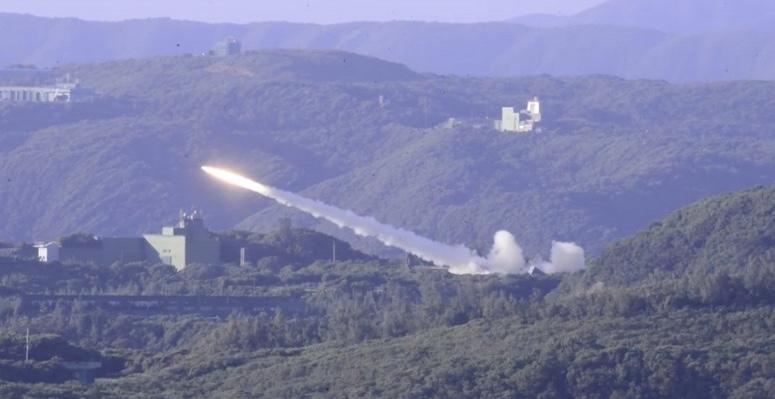
A Chinese military drone was spotted conducting reconnaissance off Taitung County as President William Lai (賴清德) visited Pingtung County this morning to inspect a drill of the armed forces’ precision-strike capabilities, prompting the military to closely monitor its actions. Today was the final day of a three-day military exercise at Jioupeng Base (九鵬基地) to test the joint combat capabilities of the armed forces and coast guard. The exercise began on Wednesday simulating air defense interception and yesterday tested long-range strike capabilities and new air defense weapons. This morning, the military conducted a final exercise involving air defense, anti-ship and drone operations. Military sources said
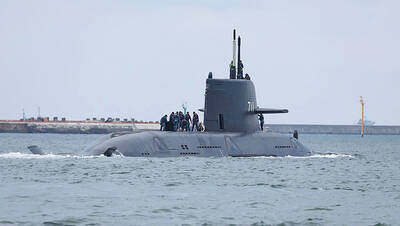
UPDATE: The submarine would need to undergo combined systems testing and crew training for navy personnel before it is ready for mission, an expert said Taiwan’s first domestically built submarine, the Hai Kun (Narwhal, 海鯤), could be delivered to the navy as early as next month, military expert and Taiwan Association for Security and Development chairman Chi Tung-yun (紀東昀) said yesterday. The submarine was yesterday morning observed departing for its 21st sea trial and its 15th submerged test. The vessel missed the initial delivery deadline of November last year due to “testing delays,” its primary contractor, shipbuilder CSBC Corp, Taiwan, said in June. The contractor also cited “political pressure from China” in procuring critical equipment. All testing operations are in the final stages, with the

OCT. 31: The antiviral drugs Tamiflu and Eraflu have been distributed to about 4,000 medical facilities nationwide for people in seven groups who develop flu-like symptoms As the domestic influenza epidemic enters its peak season and continues to escalate, the Centers for Disease Control (CDC) yesterday announced that publicly funded influenza antiviral drugs for seven eligible groups have been extended to Oct. 31, allowing those who develop flu-like symptoms to receive the medication without undergoing a rapid influenza test. The CDC has extended the expanded use of flu antiviral drugs to seven groups: healthcare and influenza-prevention personnel; residents and staff at nursing homes, long-term care facilities and similar institutions; kindergarten and daycare workers and home-based caregivers; students from kindergarten through high school, vocational high school and the


 RSS
RSS