

With US President Donald Trump and Chinese President Xi Jinping (習近平) expected to meet in Washington this week, Mainland Affairs Council Deputy Minister Shen Yu-chung (沈有忠) yesterday said he believes the US would not change its policy toward Taiwan.
Shen made the remarks at a seminar held by the Cross-Strait Policy Association and Tamkang University’s Center for Cross-Strait Relations Studies in Taipei, adding that he believes there would be “three no changes” in the relations among the US, Taiwan and China after the meeting.
First, the fundamental nature and structure of US-China competition would not change; second, US policy toward Taiwan would not fundamentally change; and third, the government’s determination to maintain the “status quo” of peace and stability in the Taiwan Strait will not change, he said.
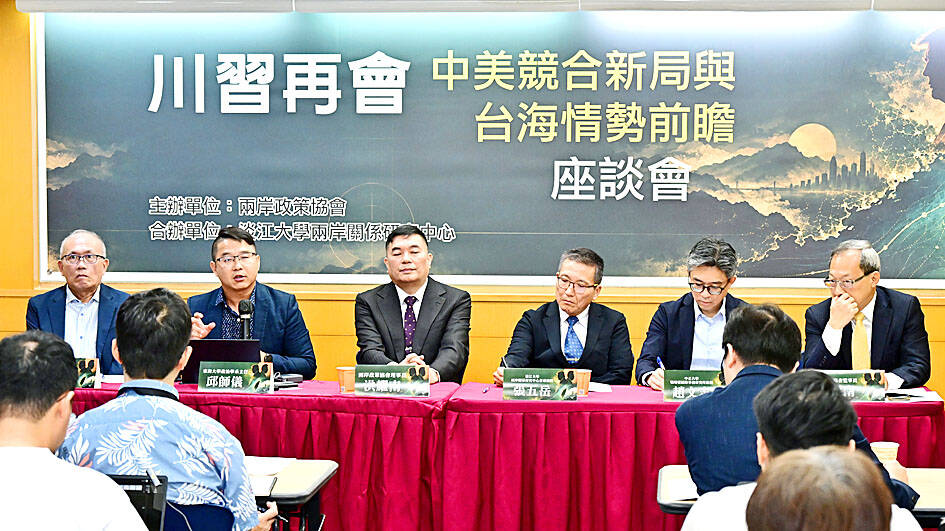
Photo: Chen Yi-kuan, Taipei Times
Trade and economic issues, including artificial intelligence (AI) competition, tariffs and rare earth export controls, remain the top priority for the US and China in the upcoming summit, he said.
Purchases of US goods, such as soybeans and beef, by China might see further progress during this summit, he said, adding that while they might make some progress on procurement lists, structural competition would persist in areas such as AI and tariffs.
Shen said Xi might continue to exert pressure on Trump on Taiwan and Indo-Pacific, and conduct personal cognitive warfare against him.
The Chinese president might accuse Japan and Taiwan as the real “troublemakers” destroying the “status quo” in the region, and falsely reframe the meaning of maintaining the “status quo,” to pressure the US to compromise to China, he said.
Since the Trump-Xi summit in May, cross-agency and bipartisan US political figures, including US Secretary of State Marco Rubio and House of Representatives Speaker Mike Johnson, have repeatedly stated that US policy toward Taiwan will remain unchanged, Shen said.
The council believes the US would not change its long-established policy toward Taiwan and would sustain deterrent capabilities across the First Island Chain, and Taiwan would continue to deepen cooperation with the US on this basis, he said.
The government will also continue to closely monitor the manipulation of “US skepticism,” “Taiwan skepticism” and “Taiwan abandonment” narratives before and after the summit, he said.
China might leverage this summit to spread defeatist and pessimistic narratives in Taiwan, to drive a wedge between Taiwan and the US, undermine Taiwanese society’s morale and extend those efforts to November’s local elections, he added.
Tamkang University cross-strait relations expert Chang Wu-ueh (張五岳) said the upcoming meeting should not be viewed as a major turning point in US-China relations, but rather managing differences and paving the way for future interactions, with
Chang said he believes Beijing would reiterate its position, but it is unlikely that the US and China would make major new declarations or reach significant deals.
Another Tamkang University cross-strait relations expert, Chen Chien-fu (陳建甫), said observers should not only focus on how many times Taiwan is mentioned in the meeting or if Taiwan would be “sold out,” but instead observe the “boundaries” of any US-China deal and Taiwan’s position within them.
Taiwan must bolster its defense and societal resilience, solidify ties with the US Congress and the First Island Chain allies such as Japan, and reinforce the semiconductor industry as a “silicon shield,” he said.
Additional reporting by CNA
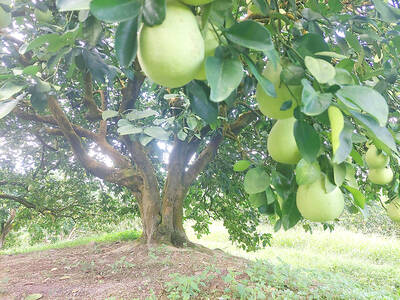
A Hualien pomelo farmer refused to sell to China after the country announced it would permit more Taiwanese pomelo imports, prompting widespread support from Taiwanese consumers, who rallied to buy his fruit. China’s Taiwan Affairs Office last month said that China’s General Administration of Customs registered an additional 79 Taiwanese pomelo orchards and packing facilities in Hualien County, allowing more Taiwanese producers to export pomelos to China. “I am a Hualien fruit farmer and I refuse to sell to China,” Liu Tzu-hao (劉子豪) from Ruisui Township (瑞穗) said in an online post. Liu is a well-known farmer in the community and has served
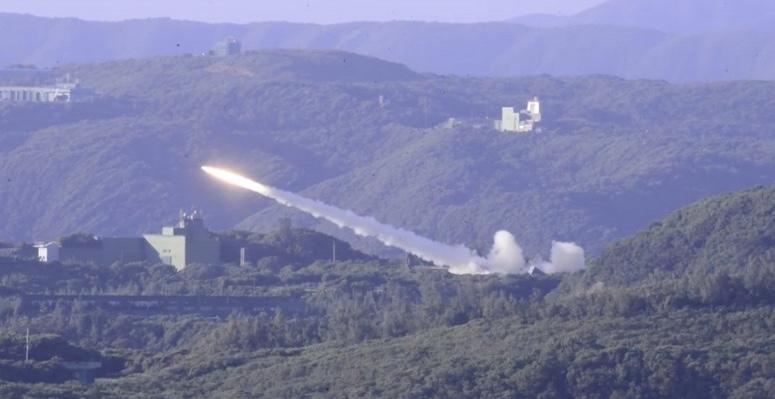
A Chinese military drone was spotted conducting reconnaissance off Taitung County as President William Lai (賴清德) visited Pingtung County this morning to inspect a drill of the armed forces’ precision-strike capabilities, prompting the military to closely monitor its actions. Today was the final day of a three-day military exercise at Jioupeng Base (九鵬基地) to test the joint combat capabilities of the armed forces and coast guard. The exercise began on Wednesday simulating air defense interception and yesterday tested long-range strike capabilities and new air defense weapons. This morning, the military conducted a final exercise involving air defense, anti-ship and drone operations. Military sources said

OCT. 31: The antiviral drugs Tamiflu and Eraflu have been distributed to about 4,000 medical facilities nationwide for people in seven groups who develop flu-like symptoms As the domestic influenza epidemic enters its peak season and continues to escalate, the Centers for Disease Control (CDC) yesterday announced that publicly funded influenza antiviral drugs for seven eligible groups have been extended to Oct. 31, allowing those who develop flu-like symptoms to receive the medication without undergoing a rapid influenza test. The CDC has extended the expanded use of flu antiviral drugs to seven groups: healthcare and influenza-prevention personnel; residents and staff at nursing homes, long-term care facilities and similar institutions; kindergarten and daycare workers and home-based caregivers; students from kindergarten through high school, vocational high school and the

Taiwanese Tsai Chin-shu (蔡金樹), who had been imprisoned in China for engaging in activity that “endangers national security,” said on Facebook on Friday that he has returned to Taiwan. Tsai, chairman of the Southern Taiwan Union of Cross-strait Relations Associations, had traveled frequently between Taiwan and China for years, and at one time ran a trading company in China’s Pingtan. In July 2018, he traveled to Quanzhou, Fujian Province, to attend a cross-strait food trade fair and stayed at a hotel in Xiamen. He checked out the following day and then disappeared. His family had made repeated appeals to the authorities


 RSS
RSS