

Baipu Industrial Park (白埔產業園區) in Kaohsiung would fill a crucial gap in southern Taiwan’s semiconductor ecosystem and is an important step toward more balanced development across Taiwan, President William Lai (賴清德) said today at the site’s groundbreaking ceremony to kick off construction.
The president said he hopes industry players would work together to ensure Taiwan’s competitive edge for the next 100 years.
The nearly 89-hectare park is expected to generate NT$300 billion (US$9.445 billion) in annual output and create more than 4,000 jobs, Lai said.
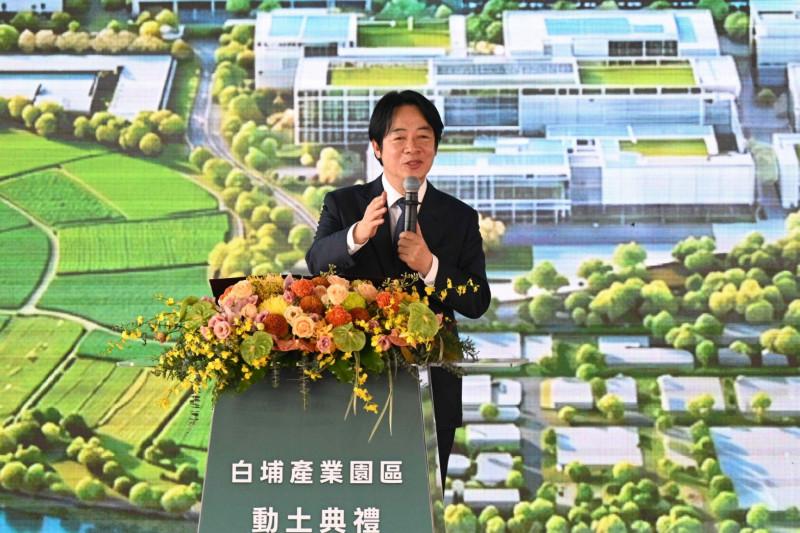
Photo: Lee Hui-chou, Taipei Times
The park is a collaboration by the Ministry of Economic Affairs (MOEA), the Kaohsiung City Government and Taiwan Semiconductor Manufacturing Co (TSMC, 台積電), and it would be the country’s first testing and verification base for advanced semiconductor equipment and materials, he said.
Today’s groundbreaking ceremony was also attended by Minister of Economic Affairs Kung Ming-hsin (龔明鑫), Minister of the Interior Liu Shyh-fang (劉世芳) and Kaohsiung Mayor Chen Chi-mai (陳其邁), as well as representatives from TSMC, ASE Technology Holding Co (日月光投控) and Hon Hai, also known as Foxconn Technology Group (富士康).
Lai praised Kaohsiung for completing an environmental impact assessment, urban planning reviews and receiving a permit from the MOEA in just three years.
It also selected a developer and promoted investment in the park, with companies positioning themselves before the park even broke ground, he said.
With the development of artificial intelligence (AI) and high-performance computing, advanced packaging has already become an important part of global semiconductor competition, he added.
Key equipment and materials would be developed, tested and verified at the park, shortening the timeframe to introduce new technologies into mass production and increasing opportunities for domestic companies to enter supply chains, Lai said.
He said he hoped that the technology industry would drive the upgrade and transformation of traditional industries, while enabling large companies to work with micro, small and medium-sized enterprises to promote Taiwan’s economic development.
The Baipu Industrial Park would link advanced-process manufacturing in Nanzih District (楠梓) with packaging and testing in Renwu District (仁武), while coordinating with the materials and key components cluster in Ciaotou District (橋頭), the president said.
It would make the semiconductor industry S-corridor that links technology centers and science parks in the south more resilient, he added.
Metal processing and precision machinery industries in Gangshan (岡山) and Lujhu (路竹) districts would also have more opportunities to enter the high-value-added semiconductor supply chain, Lai added.
The “pearl chain” water project would connect reservoirs through cross-regional pipeline networks, complemented by water treatment plants and seawater desalination facilities, increasing flexibility in water allocation, he said.
On electricity, Lai said Taiwan Power Co (Taipower) has confirmed that the park would have a stable power supply.
Power supplies would be secured nationwide through 2035, accounting for demand from economic development, AI and data centers, the president said, adding that efforts would continue to promote renewable energy and low-carbon electricity.
Lai further pledged that companies seeking to invest in Taiwan would receive assistance from the Executive Yuan, which would set up interministerial task forces to address issues involving land, water, electricity, labor and talent.
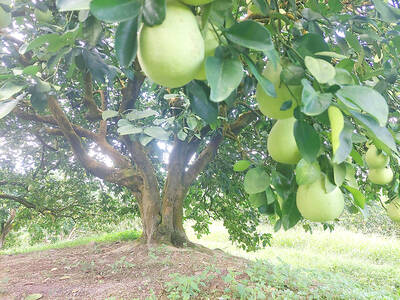
A Hualien pomelo farmer refused to sell to China after the country announced it would permit more Taiwanese pomelo imports, prompting widespread support from Taiwanese consumers, who rallied to buy his fruit. China’s Taiwan Affairs Office last month said that China’s General Administration of Customs registered an additional 79 Taiwanese pomelo orchards and packing facilities in Hualien County, allowing more Taiwanese producers to export pomelos to China. “I am a Hualien fruit farmer and I refuse to sell to China,” Liu Tzu-hao (劉子豪) from Ruisui Township (瑞穗) said in an online post. Liu is a well-known farmer in the community and has served
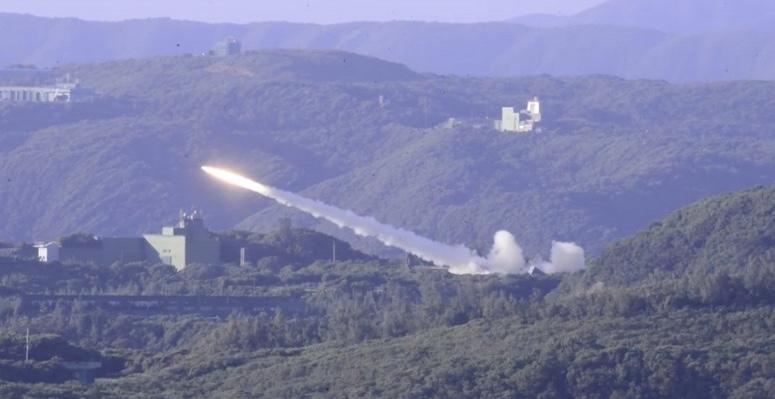
A Chinese military drone was spotted conducting reconnaissance off Taitung County as President William Lai (賴清德) visited Pingtung County this morning to inspect a drill of the armed forces’ precision-strike capabilities, prompting the military to closely monitor its actions. Today was the final day of a three-day military exercise at Jioupeng Base (九鵬基地) to test the joint combat capabilities of the armed forces and coast guard. The exercise began on Wednesday simulating air defense interception and yesterday tested long-range strike capabilities and new air defense weapons. This morning, the military conducted a final exercise involving air defense, anti-ship and drone operations. Military sources said

OCT. 31: The antiviral drugs Tamiflu and Eraflu have been distributed to about 4,000 medical facilities nationwide for people in seven groups who develop flu-like symptoms As the domestic influenza epidemic enters its peak season and continues to escalate, the Centers for Disease Control (CDC) yesterday announced that publicly funded influenza antiviral drugs for seven eligible groups have been extended to Oct. 31, allowing those who develop flu-like symptoms to receive the medication without undergoing a rapid influenza test. The CDC has extended the expanded use of flu antiviral drugs to seven groups: healthcare and influenza-prevention personnel; residents and staff at nursing homes, long-term care facilities and similar institutions; kindergarten and daycare workers and home-based caregivers; students from kindergarten through high school, vocational high school and the
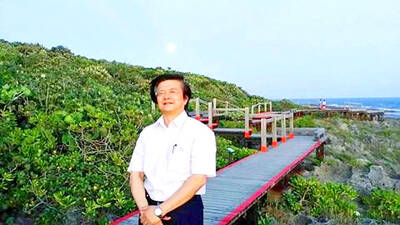
Taiwanese Tsai Chin-shu (蔡金樹), who had been imprisoned in China for engaging in activity that “endangers national security,” said on Facebook on Friday that he has returned to Taiwan. Tsai, chairman of the Southern Taiwan Union of Cross-strait Relations Associations, had traveled frequently between Taiwan and China for years, and at one time ran a trading company in China’s Pingtan. In July 2018, he traveled to Quanzhou, Fujian Province, to attend a cross-strait food trade fair and stayed at a hotel in Xiamen. He checked out the following day and then disappeared. His family had made repeated appeals to the authorities


 RSS
RSS