

In the pre-dawn darkness on an island in the Taiwan Strait, Taiwanese troops earlier this month pulled long, gleaming 105mm shells from their green plastic canisters. After all the ammunition had been checked and safely loaded through hatches on four tanks, troops waited silently for the order to fire.
The soldiers are among the thousands of troops who form a garrison in Penghu County and they were training for war with China.
A popular tourist destination known for its pristine beaches and coral reefs, the strategically crucial cluster of 90 islands and islets about 50km off the southwest coast of Taiwan proper would be hit in the first wave of an attempted Chinese invasion, senior Taiwanese security officials and military experts said.
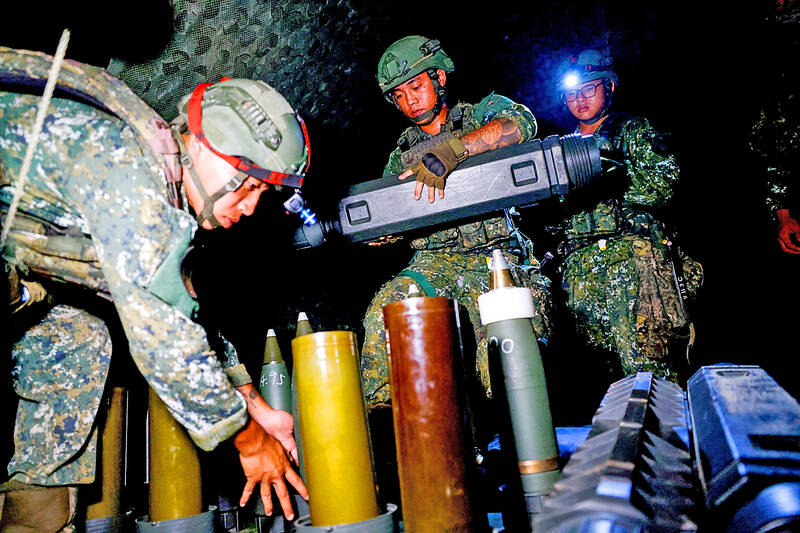
Photo: Ann Wang, Reuters
For Taiwan, holding Penghu would allow its forces to resist a Chinese invasion fleet heading toward Taiwan proper, they said.
If Chinese People’s Liberation Army (PLA) Navy ships tried to attack Taiwan while bypassing Penghu, they “could be struck by missiles from Penghu,” Institute for National Defense and Security Research research fellow Su Tzu-yun (蘇紫雲) said.
“That forces the PLA to attack Penghu before it can attack Taiwan,” he said.
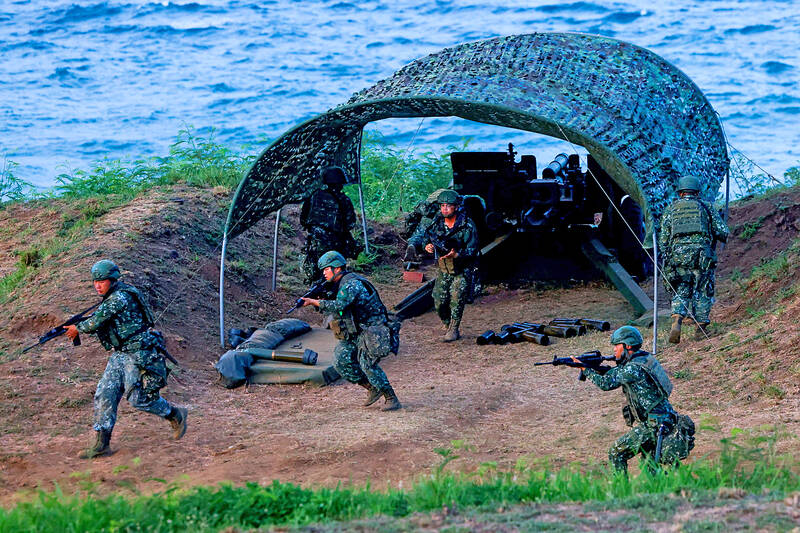
Photo: Ann Wang, Reuters
By deploying longer-range weapons such as Hsiung Feng III (雄風, “Brave Wind”) missiles on Penghu, Taiwan could also make it harder for the PLA to assemble its forces along the Chinese coast for an invasion, a senior Taiwanese official said on condition of anonymity.
Chinese forces could be targeted even before they set out across the Strait.
If Penghu were taken, the entire Taiwan Strait would effectively fall into China’s hands, they said.
Taipei has been investing in Penghu’s defense, including running programs to beef up the resilience of the 110,000 people who live on the islands in the event of war.
Chinese Ministry of National Defense spokesman Jiang Bin (蔣斌) has said that Taiwan’s plans to fortify the islands were “increasingly absurd and delusional.”
For the troops waiting in the dark during the Aug. 10 drill on the main island of the Penghu group, the quiet was shattered when artillery guns nestled under camouflage netting fired illumination rounds out to sea.
The shells burst with a crump in the distance, casting brilliant light over the ocean approaches.
In a series of maneuvers, the four tanks, along with armored personnel carriers, wheeled forward through clouds of dust, exhaust fumes and explosive gases, blasting away at “invaders” attempting to land.
As sunlight crept across the sea, artillery, mortars and infantry poured fire down over the ocean below. Orange-red tracers from machine guns arched into the sky.
The live-fire drill during the annual Han Kuang exercises was part of rehearsals across Taiwan to resist landings by air and sea.
In the same week, the navy’s Coastal Operations Command were deployed to Penghu for the first time, sending Hsiung Feng missile launch vehicles to beachfront positions in anti-ship and anti-landing operations, military officials said.
Penghu’s strategic location, along with the presence of such weapons, makes the islands a prime target for the PLA, Su said.
Taiwan’s two other major outlying counties, Kinmen and Lienchiang, are too close to China to be a useful part of a defensive network, he said.
However, Taiwanese forces could catch invading Chinese ships in a crossfire of missiles between the Penghu islands and Taiwan proper, Su said.
Missiles on the islands could also launch “counterstrikes” further into China’s hinterland, he added.
The defense ministry is pushing the use of uncrewed aerial vehicles (UAV) to defend Penghu.
The military established the first drone force on the islands last month and UAVs were deployed during the Han Kuang exercises.
Beijing tightly restricts public discussion of military plans related to Taiwan, although Chinese strategists have previously identified the importance of Penghu.
Retired Chinese lieutenant general Wang Hongguang (王洪光) in 2019 suggested that the PLA “strategically suppress” Taiwan by occupying the Penghu Islands.
During a war game attended by retired Taiwanese, US and Japanese military officials last year, Penghu fell just a day after China began surprise long-range attacks on military and infrastructure targets across Taiwan.
The quick capitulation to the PLA startled Taiwanese participants, a report of the activity said.
Asked about that war game, the ministry referred to Minister of National Defense Wellington Koo’s (顧立雄) statement last year that the government takes such exercises into account when making adjustments to its defensive plans.
While the Taiwanese military trains to repel a Chinese landing, Penghu officials and residents are preparing to play their part.
Yen Min-ching is one of about 1,200 people on Penghu who have been certified by the government’s Whole-of-Society Defense Resilience Program. Volunteers are trained to provide support, including first aid, in the event of emergencies such as earthquakes and invasions.
Yen, a retired police officer who is a neighborhood warden, is acutely aware of Penghu’s exposed position between the Chinese coast and Taiwan proper, and has encouraged residents to sign up for the program.
By the end of the year, about 200,000 Taiwanese are expected to have completed the training.
“We absolutely need to have a sense of crisis,” said Husi (湖西) Township Mayor Chen Chen-chung (陳振中), whose district hosts key infrastructure, including cargo transport docks, an airport used for civil and military purposes, and Penghu’s main power plant.
Penghu County “would definitely be one of the first places attacked,” said Chen, who leads about 100 people in a civil defense group that is tasked with wartime support missions.
Those might include distributing rations, setting up defensive fortifications and countering enemy propaganda.
Local businesspeople such as auto workshop owner Ho Chi-hua have signed agreements to cooperate with Taiwanese authorities.
During a drill this month that simulated a scenario in which military logistics facilities were damaged, rifle-carrying troops joined Ho’s staff as they practiced emergency repairs on military vehicles.
Penghu is also preparing for Chinese coercion that stops short of a military attack: Beijing could impose a blockade on Taiwan, which could quickly choke Taipei’s trade-dependent economy and leave outlying islands isolated.
Locals starved of supplies might quickly capitulate, said Kao Yu-jou, a 15-year-old student in Penghu. “People might think: Let’s surrender first, get something to eat, and after I’m full, then we’ll see.”
However, taxi driver William Chen said he would resist.
“If my homeland were invaded, there’s no way I could just stand by,” he said.
Magong (馬公), Penghu’s urban center, has rehearsed its response, holding drills that simulate a blockade and all-out combat, Mayor Huang Jian-zhong (黃健忠) said.
Municipal authorities have signed agreements with grocery stores, pharmacies and construction companies to safeguard emergency supplies and repair capabilities if a crisis occurs, government documents show.
The islands have been a springboard for invasions of Taiwan over the centuries. When Taiwan was a Japanese colony during World War II, the harbor was the target of Allied bombing attacks late in the conflict.
Some analysts think Penghu would provide stiff resistance.
The prospect of heavy losses during WWII had prompted US war planners to cancel a planned offensive on the islands as part of a wider invasion of Taiwan, US Naval War College associate professor Ian Easton said.
“My guess is that if the terrible crunch ever comes, the PLA will find these islands a tough nut to crack,” he said.

Heavy rain is expected to continue across much of Taiwan through tomorrow morning, with torrential rainfall likely in southern and southeastern areas due to strong southwesterly winds and multiple weather systems in the area, the Central Weather Administration (CWA) said today. The CWA issued a warning today for torrential or extremely torrential rain in Tainan, Kaohsiung, Pingtung County and Taitung County, and for extremely heavy to torrential rain in Chiayi County, Hualien County and on the Hengchun Peninsula (恆春半島). Heavy to extremely heavy rain is also expected through tomorrow in Changhua County, Yunlin County, Chiayi City, Yilan County, Green Island (綠島), Penghu
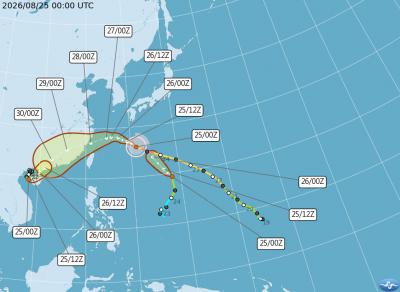
Typhoon Saudel has shown signs of weakening but is still expected to affect Taiwan when it comes closest to the nation on Friday, the Central Weather Administration (CWA) said today. The radius of Saudel shrank to about 220km as of 8am today from 250km a day earlier, and its maximum sustained winds were down to 155kph from 184kph previously, the weather agency said. As of 8am, Typhoon Saudel was 980km east of Taipei, moving west-northwest at 18kph, it said. Under the influence of a Pacific high pressure system, the storm is moving northward, meaning it is less likely to make landfall in Taiwan,

Minister of Sports Lee Yang (李洋) today said the Chinese Taipei Basketball Association (CTBA) has been urged not to undermine Taiwan’s credibility in international competitions, after a Taiwanese team advanced to the semi-finals of the 45th William Jones Cup over the Philippines last week due to a controversial new rule guaranteeing a semi-final place to the host team. The Republic of China Blue team advanced to the semi-finals after winning just one game in the group round due to a “host guarantee” spot, overtaking the Philippines, who held a 5-1 record ahead of the semi-finals. The Blue team finished the tournament
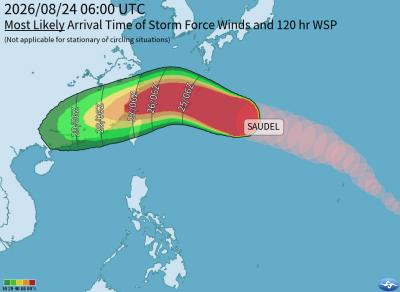
Typhoon Saudel is expected to pass closest to Taiwan on Thursday and Friday as it moves over waters to the north, having already progressed to a strong typhoon, the Central Weather Administration (CWA) said today. The typhoon is not expected to make landfall in Taiwan, but its path remains unclear, it said. Saudel strengthened into a strong moderate typhoon this afternoon with sustained winds near the center reaching 183.6kph, although it is expected to weaken somewhat by Wednesday, it added. Storm-force winds are expected to affect northern Taiwan and Lienchiang County, while northern Taiwan and mountainous areas of central Taiwan should


 RSS
RSS